99 expert-guided explainers

Crypto security knowledge,
organized for action.

Search the complete guide library—from seed phrase protection and scam detection to safer DEX swaps and trading risk controls.

99 guides
Emergency response sequence after cryptocurrency theft
Scam Defense4 min read

My Crypto Was Stolen: What Can I Do Now?

If crypto was stolen, stop further exposure first: secure connected accounts, move unaffected assets from compromised wallets, revoke malicious permissions, preserve transaction evidence…

Read guide
Web3 permission map separating connection, signature, approval and transfer authority
Wallet Safety3 min read

What Is Wallet Approval Risk in Web3?

Wallet approval risk is the possibility that a contract or operator can move tokens after you grant it permission. An approval may remain active after the original swap, mint or game…

Read guide
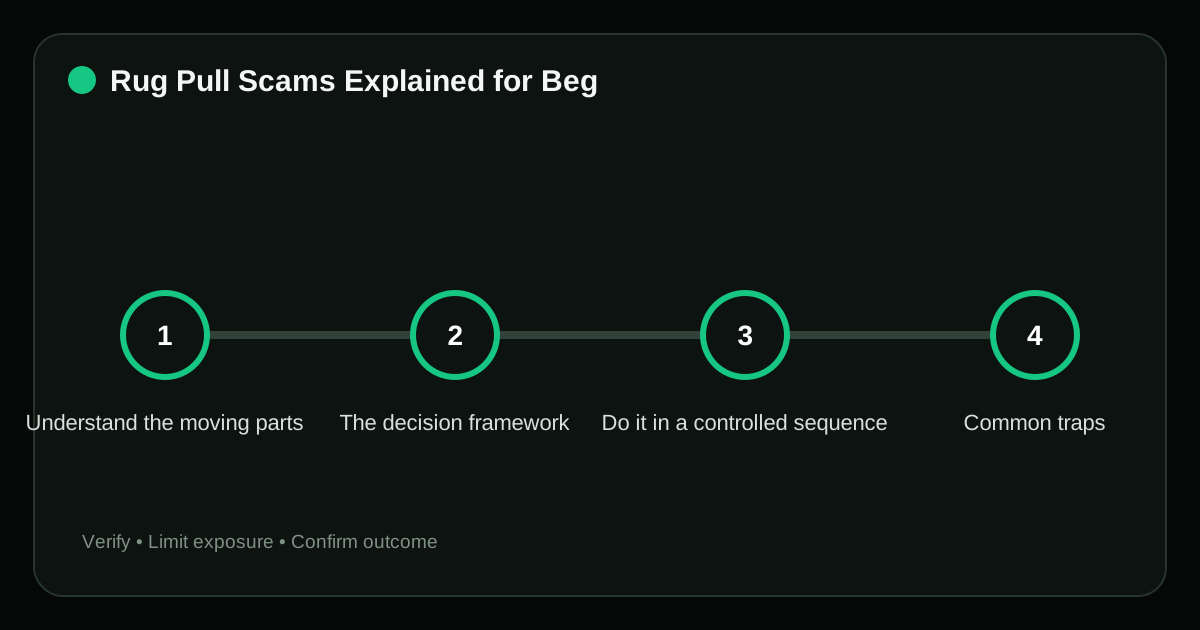
Decision workflow for rug pull scams explained for beginners
Scam Defense3 min read

Rug Pull Scams Explained for Beginners

A rug pull happens when insiders use control over a token, liquidity pool or project treasury to extract value and leave holders with losses. Before buying, inspect who can mint or freeze…

Read guide
Decision workflow for crypto giveaway scam checklist
Scam Defense3 min read

Crypto Giveaway Scam Checklist

A real giveaway does not require you to send crypto first, reveal a seed phrase or connect a valuable wallet to “verify” eligibility. Check the announcement from the organization’s verified…

Read guide
Decision workflow for cross-chain bridge hacks and fraud risk
Web3 Safety3 min read

Cross-Chain Bridge Hacks and Fraud Risk

A cross-chain bridge adds smart-contract, validator, liquidity and destination-token risk to an ordinary transfer. Use the project’s verified interface, confirm the source and destination…

Read guide
Decision workflow for how to check wallet authorization history
Wallet Safety3 min read

How to Check Wallet Authorization History

To review wallet authorization history, inspect token allowances, NFT operator approvals, signed permissions and recent contract interactions on every chain you use. A transaction list…

Read guide
Decision workflow for how to create a safer hot wallet
Wallet Safety3 min read

How to Create a Safer Hot Wallet

Create a hot wallet on an updated, malware-free device, back up its recovery phrase offline, protect the app with a strong local lock and keep only the amount needed for routine activity.…

Read guide
Decision workflow for how to secure a crypto exchange account
Account Security3 min read

How to Secure a Crypto Exchange Account

Secure an exchange account with a unique password, phishing-resistant 2FA, locked-down email, withdrawal allowlists and account alerts. Then review sessions, API keys and recovery methods;…

Read guide
Decision workflow for safer browser settings for web3 wallets
Wallet Safety3 min read

Safer Browser Settings for Web3 Wallets

Use a dedicated browser profile for Web3, install only the wallet extension you need, block unsolicited notifications and downloads, keep the browser updated and require manual approval for…

Read guide
Decision workflow for what is a smart contract exploit?
Web3 Safety4 min read

What Is a Smart Contract Exploit?

A smart contract exploit abuses a flaw in code, economic design, permissions or an external dependency to produce an unintended result—often draining or freezing assets. It differs from…

Read guide
Decision workflow for what is a crypto drainer contract?
Web3 Safety3 min read

What Is a Crypto Drainer Contract?

A drainer is malicious infrastructure designed to turn wallet signatures, approvals or deceptive transactions into asset theft. It may target tokens, NFTs or native assets and can…

Read guide
Decision workflow for what is a dust attack in crypto?
Account Security4 min read

What Is a Dust Attack in Crypto?

A dust attack sends a tiny amount to many addresses so the sender can observe how those outputs later move and attempt to link wallet activity. The dust does not reveal your private key;…

Read guide
Decision workflow for crypto malware and keylogger risk
Scam Defense3 min read

Crypto Malware and Keylogger Risk

Crypto malware can record keystrokes, replace clipboard addresses, steal browser sessions or alter what a wallet displays. Use an updated operating system, minimal software, hardware-backed…

Read guide
Decision workflow for what is a sandbox wallet?
Wallet Safety4 min read

What Is a Sandbox Wallet?

A sandbox wallet is a low-value wallet created to isolate experimental dapps, testnets, mints or unknown contracts from your primary holdings. Its value comes from a separate seed or…

Read guide
Decision workflow for crypto security checklist for beginners
Account Security3 min read

Crypto Security Checklist for Beginners

Beginners should secure email and exchange accounts first, create an offline recovery backup, test small transfers, separate savings from Web3 activity and learn to reject secret requests.…

Read guide
Decision workflow for can stolen crypto be recovered?
Scam Defense3 min read

Can Stolen Crypto Be Recovered?

Sometimes, but recovery is uncommon and depends on rapid reporting, traceable funds, a cooperative exchange or stablecoin issuer, and legal authority to freeze or seize assets. No private…

Read guide
Decision workflow for can a hardware wallet be hacked?
Wallet Safety3 min read

Can a Hardware Wallet Be Hacked?

Hardware wallets can fail through supply-chain tampering, firmware flaws, physical attacks, malicious transactions or recovery-phrase theft. Their main advantage is keeping signing keys…

Read guide
Decision workflow for how to report a crypto scam
Scam Defense3 min read

How to Report a Crypto Scam

Report a crypto scam quickly to local law enforcement, the relevant national cybercrime or fraud portal, the receiving exchange or issuer, and the platform hosting the scam. Include…

Read guide
Decision workflow for why unlimited token approval is dangerous
Web3 Safety3 min read

Why Unlimited Token Approval Is Dangerous

Unlimited approval lets a spender contract transfer the approved token up to an extremely high cap without asking for a new allowance each time. If that spender is malicious or compromised,…

Read guide
Decision workflow for how to deposit fiat to a crypto exchange
Safer Trading3 min read

How to Deposit Fiat to a Crypto Exchange

Verify that the exchange supports your currency and country, complete required identity checks, add a bank or payment method from an account in your own name, and copy the official transfer…

Read guide
Decision workflow for how to swap tokens on a dex safely
Safer Trading3 min read

How to Swap Tokens on a DEX Safely

Use the DEX link from its verified documentation, confirm chain and token contract, review route, price impact, slippage and approval, then swap a small amount first. Revoke unnecessary…

Read guide
Decision workflow for how to open a crypto futures position
Safer Trading3 min read

How to Open a Crypto Futures Position

To open a futures position, understand the contract and margin mode, fund the derivatives wallet, choose long or short, set leverage conservatively, calculate size from a defined stop, and…

Read guide
Decision workflow for how to trade crypto options for beginners
Safer Trading3 min read

How to Trade Crypto Options for Beginners

Before trading crypto options, learn calls, puts, strike, expiry, premium and settlement. Start in a demo account with defined-risk long options; understand that buyers can lose the entire…

Read guide
Decision workflow for how to fund a crypto futures wallet
Safer Trading3 min read

How to Fund a Crypto Futures Wallet

Transfer collateral from the exchange’s spot or funding account into the derivatives wallet using the internal transfer function. Confirm the supported collateral and margin currency; do…

Read guide
Decision workflow for how to cross-chain swap crypto safely
Safer Trading3 min read

How to Cross-Chain Swap Crypto Safely

A cross-chain swap combines a swap with bridge or messaging risk. Verify the route and destination token, check bridge trust assumptions and destination liquidity, use a small test and keep…

Read guide
Decision workflow for how to set gas fees for crypto transactions
Safer Trading4 min read

How to Set Gas Fees for Crypto Transactions

Use the wallet’s current network estimate, then choose low, market or priority based on urgency. Confirm max fee, priority fee and gas limit where applicable; increasing gas limit does not…

Read guide
Decision workflow for how to trade liquidity pool tokens
Safer Trading3 min read

How to Trade Liquidity Pool Tokens

LP tokens represent a claim on assets deposited in a pool, not an ordinary directional coin. Before buying, depositing or transferring them, verify the pool, fee tier, position range,…

Read guide
Decision workflow for how to remove liquidity from a dex pool
Safer Trading3 min read

How to Remove Liquidity From a DEX Pool

Open the verified DEX interface, locate the exact position, choose the percentage to remove, review expected token amounts and slippage, approve the position if required and confirm the…

Read guide
Decision workflow for how to do crypto scalping for beginners
Safer Trading3 min read

How to Do Crypto Scalping for Beginners

Beginners should practice scalping in a simulator before risking money. Trade only highly liquid pairs, use limit orders deliberately, cap daily loss and include fees and slippage in every…

Read guide
Decision workflow for how to manage risk in crypto trading
Safer Trading3 min read

How to Manage Risk in Crypto Trading

Manage risk by limiting loss per trade, sizing from the stop, capping total correlated exposure and defining daily or weekly drawdown limits. Security, custody and exchange failure belong…

Read guide
Decision workflow for how to keep a crypto trading journal
Safer Trading3 min read

How to Keep a Crypto Trading Journal

Record the plan before entry, actual fills, fees, screenshots, emotions, rule adherence and post-trade lesson. A journal is useful when it separates strategy performance from execution…

Read guide
Decision workflow for how to use rsi for crypto trading
Safer Trading3 min read

How to Use RSI for Crypto Trading

RSI measures recent gains relative to losses on a 0–100 scale. Use it to compare momentum with price structure, not as an automatic buy below 30 or sell above 70; strong trends can remain…

Read guide
Decision workflow for how to avoid fomo when trading crypto
Safer Trading3 min read

How to Avoid FOMO When Trading Crypto

Avoid FOMO by defining entry criteria and maximum chase distance before the market moves, using alerts instead of constant feeds, and accepting missed trades as normal. If risk cannot be…

Read guide
Decision workflow for how to diversify a crypto spot portfolio
Safer Trading3 min read

How to Diversify a Crypto Spot Portfolio

Diversify by risk driver, liquidity, custody and position size—not by counting token names. Many altcoins share the same market beta, so holding ten of them may still be one concentrated…

Read guide
Decision workflow for how to cancel a pending crypto limit order
Safer Trading3 min read

How to Cancel a Pending Crypto Limit Order

Open the exchange’s active-orders panel, select the correct pair and order ID, cancel it, then confirm the status is canceled and reserved funds are released. Cancellation is not guaranteed…

Read guide
Decision workflow for how to calculate crypto trading fees
Safer Trading3 min read

How to Calculate Crypto Trading Fees

Trading fee equals executed notional multiplied by the applicable maker or taker rate, adjusted for tier, discounts and fee currency. Add spread, slippage, funding and transfer costs to…

Read guide
Decision workflow for how to trade stablecoin pairs
Safer Trading3 min read

How to Trade Stablecoin Pairs

Stablecoin pairs trade relative issuer and redemption risk, not a guaranteed one-dollar equivalence. Check depth, spread, issuer reserves and redemption access; use limit orders when…

Read guide
Decision workflow for how to recover a failed crypto withdrawal
Safer Trading3 min read

How to Recover a Failed Crypto Withdrawal

First classify the withdrawal: rejected internally, pending at the exchange, broadcast but unconfirmed, or confirmed to the wrong destination. Each requires different action. Preserve the…

Read guide