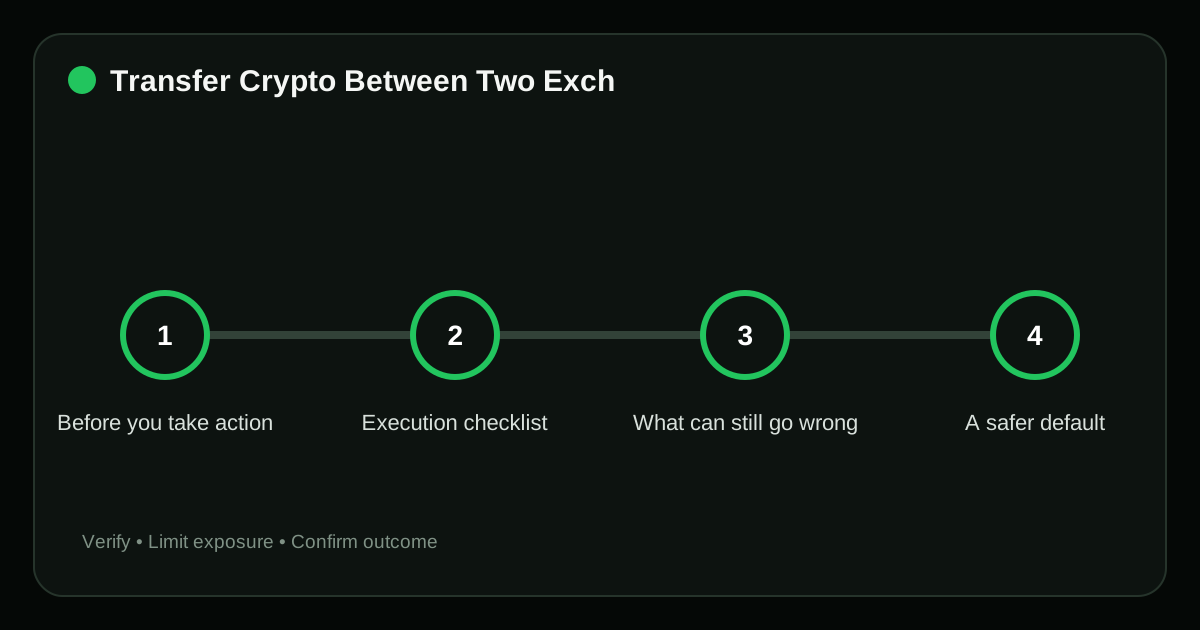
Confirm both exchanges support the same asset, network and memo format, copy the deposit details from the destination, send a small test from the source and wait for credit before sending the rest.
Before you take action#
Two exchanges may list the same ticker on different networks or suspend one route. Internal display names can hide wrapped asset differences.
For transfer crypto between exchanges, the visible interface shows only part of the system. Confirm the identity, asset, network and authority involved before treating a familiar label as proof.
Execution checklist#
- Open deposit on the destination first. The choice determines which asset, authority or risk model applies, so resolve any ambiguity before the next step.
- Match asset, chain, address and memo. Use actual position size, venue rules and costs; a rounded mental estimate is not enough for an irreversible order.
- Check source withdrawal fee and destination confirmations. Compare the live venue details with the written plan; do not rely on a chart label or a remembered setting.
- Send a test above the minimum deposit. Keep the first exposure small enough that a wrong assumption can be corrected without a material loss.
- Save transaction ID and both account records. Keep the original timestamp, identifier and unedited record so another person can reproduce the conclusion.
What can still go wrong#
- Using a saved old deposit address without checking. The branding can be copied, so the request must be re-opened through an independently verified channel.
- Selecting a network by lowest fee only. A label can look correct while the underlying destination differs, and a confirmed onchain action may be irreversible.
- Sending below destination minimum. This changes the planned exposure or execution cost of transfer crypto between exchanges after the decision has already been made.
- Repeating a delayed withdrawal. This changes the planned exposure or execution cost of transfer crypto between exchanges after the decision has already been made.
A safer default#
If time matters, verify withdrawal status and destination deposit status before initiating. A cheap chain is useless if deposits are paused.
Proof that the task is complete#
Do not judge the outcome of transfer crypto between exchanges only by whether the interface shows a success message. Use evidence that can still be checked after the page is closed.
| Checkpoint | Evidence | Stop condition |
|---|---|---|
| Open deposit on the destination first | Transaction or withdrawal ID plus the matching explorer or account record | Using a saved old deposit address without checking |
| Match asset, chain, address and memo | Account history entry and a journal note showing the planned value | Selecting a network by lowest fee only |
| Check source withdrawal fee and destination confirmations | Transaction or withdrawal ID plus the matching explorer or account record | Sending below destination minimum |
Record actual fills, fees and remaining exposure for transfer crypto between exchanges. The order ticket is an estimate; account history is the durable record.
Frequently asked questions#
Why is the blockchain confirmed but exchange not credited?
The exchange may require more confirmations or a compliance review.
Can support recover a missing memo?
Sometimes, after identity checks and a fee, but recovery is not guaranteed.
Is a direct exchange transfer private?
No. Both providers keep account records and may exchange required information.
Related guides#
Sources#
- Uniswap Support: Swaps and Troubleshooting
- Ethereum.org: Gas and Fees
- MetaMask: Transactions and Gas
Risk notice: Crypto trading can produce rapid losses. Examples are educational, not personalized financial advice; verify venue rules, fees and legal or tax obligations before acting.
Editorial standard
This guide is educational and source-led. Security controls, exchange rules and legal requirements can change; verify critical steps through the relevant official service before acting.