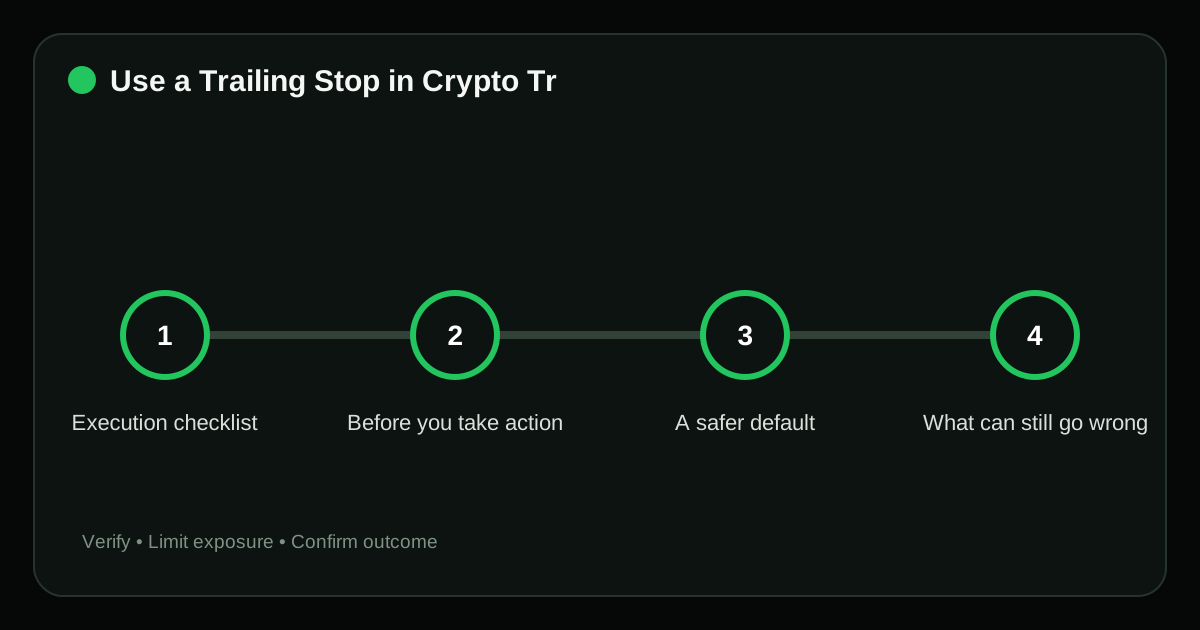
A trailing stop follows favorable price movement by a fixed amount or percentage and triggers when price reverses by that distance. Set activation, callback and order size from market volatility; a trail that is too tight becomes ordinary noise exit.
Execution checklist#
- Read the venue’s trigger and reference-price rules. Compare the live venue details with the written plan; do not rely on a chart label or a remembered setting.
- Choose a callback wider than normal noise. The choice determines which asset, authority or risk model applies, so resolve any ambiguity before the next step.
- Set activation only after the trade has room to develop. Use actual position size, venue rules and costs; a rounded mental estimate is not enough for an irreversible order.
- Use reduce-only for derivatives. Keep the first exposure small enough that a wrong assumption can be corrected without a material loss.
- Test behavior with small size. Keep the first exposure small enough that a wrong assumption can be corrected without a material loss.
Before you take action#
Trailing stops protect only after price moves favorably enough. Exchanges differ on whether the trail starts immediately, after an activation price, or from the highest/lowest price observed.
For crypto trailing stop, separate what can be verified before acting from what can only be monitored afterward. Put hard limits around the second category.
A safer default#
Derive the trail from recent volatility and trade horizon. A swing trade normally needs more room than an intraday scalp.
What can still go wrong#
- Setting 1% because it is a round number. This changes the planned exposure or execution cost of crypto trailing stop after the decision has already been made.
- Confusing callback rate with guaranteed slippage. Execution cost can consume the expected edge even when the directional idea is right.
- Using a trailing stop in a gap-prone illiquid pair. Execution cost can consume the expected edge even when the directional idea is right.
- Leaving the order after the position closes. This changes the planned exposure or execution cost of crypto trailing stop after the decision has already been made.
Evidence to keep#
Do not judge the outcome of crypto trailing stop only by whether the interface shows a success message. Use evidence that can still be checked after the page is closed.
| Checkpoint | Evidence | Stop condition |
|---|---|---|
| Read the venue’s trigger and reference-price rules | Account history entry and a journal note showing the planned value | Setting 1% because it is a round number |
| Choose a callback wider than normal noise | Account history entry and a journal note showing the planned value | Confusing callback rate with guaranteed slippage |
| Set activation only after the trade has room to develop | Order ID, fill price, quantity, fees and current open-position screen | Using a trailing stop in a gap-prone illiquid pair |
Record actual fills, fees and remaining exposure for crypto trailing stop. The order ticket is an estimate; account history is the durable record.
Frequently asked questions#
Can a trailing stop move backward?
A standard trail ratchets only in the favorable direction.
Does it guarantee profit?
No. It can trigger below entry or fill worse than the trigger.
Can I combine it with take profit?
Often, but check whether orders are linked or could exceed the position.
Related guides#
Sources#
- Coinbase: Understanding Order Types
- CFTC: Customer Advisory on Virtual Currencies
- Kraken: Trading Order Types
Risk notice: Crypto trading can produce rapid losses. Examples are educational, not personalized financial advice; verify venue rules, fees and legal or tax obligations before acting.
Editorial standard
This guide is educational and source-led. Security controls, exchange rules and legal requirements can change; verify critical steps through the relevant official service before acting.