Beginners should secure email and exchange accounts first, create an offline recovery backup, test small transfers, separate savings from Web3 activity and learn to reject secret requests. These five habits prevent more damage than collecting advanced tools without a recovery plan.
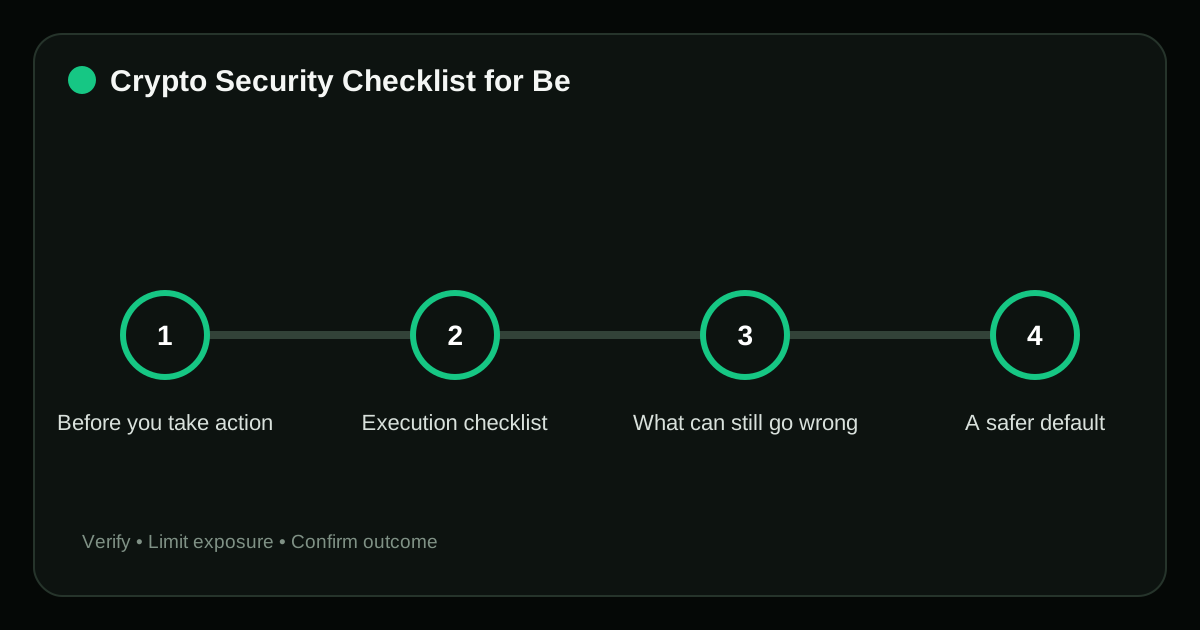
Before you take action#
Crypto combines irreversible settlement with personal key responsibility. The checklist must cover both custodial accounts and self-custody because each fails differently.
For crypto security checklist, the visible interface shows only part of the system. Confirm the identity, asset, network and authority involved before treating a familiar label as proof.
Execution checklist#
- Unique passwords and phishing-resistant 2FA. For crypto security checklist, complete this before value or signing authority changes hands and verify the resulting state afterward.
- Offline, verified seed backup with no photos. For crypto security checklist, complete this before value or signing authority changes hands and verify the resulting state afterward.
- Small test transaction for every new route. Keep the first exposure small enough that a wrong assumption can be corrected without a material loss.
- Hardware or cold storage for long-term value. For crypto security checklist, complete this before value or signing authority changes hands and verify the resulting state afterward.
- Routine review of approvals, sessions and withdrawal addresses. Compare the exact domain, address, network or permission with an independent official source before continuing.
What can still go wrong#
- Buying before testing recovery. This weakens a control that should limit the blast radius of crypto security checklist.
- Keeping every asset in one hot wallet. This weakens a control that should limit the blast radius of crypto security checklist.
- Following support links from direct messages. The branding can be copied, so the request must be re-opened through an independently verified channel.
- Ignoring software updates and account alerts. This removes a required input from the crypto security checklist decision and makes the apparent result unreliable.
A safer default#
Use a 30-minute quarterly review: verify backups, update devices, inspect account sessions and approvals, and confirm heirs can find instructions without finding exposed secrets.
Proof that the task is complete#
Do not judge the outcome of crypto security checklist only by whether the interface shows a success message. Use evidence that can still be checked after the page is closed.
| Checkpoint | Evidence | Stop condition |
|---|---|---|
| Unique passwords and phishing-resistant 2FA | Dated control check, recovery test or authenticated settings record with secrets removed | Buying before testing recovery |
| Offline, verified seed backup with no photos | Dated control check, recovery test or authenticated settings record with secrets removed | Keeping every asset in one hot wallet |
| Small test transaction for every new route | Transaction or withdrawal ID plus the matching explorer or account record | Following support links from direct messages |
Keep transaction hashes, official case numbers or dated screenshots when they help document crypto security checklist, but exclude seed phrases, private keys and authentication codes.
Frequently asked questions#
What should I secure first?
Secure the email account that controls exchange recovery, then the exchange and wallet backups.
How much belongs in a hot wallet?
Only an amount whose loss would not threaten long-term holdings; the exact figure is personal.
Do I need a hardware wallet immediately?
Not for a tiny learning balance, but it becomes valuable as holdings or transaction risk grows.
Related guides#
Sources#
- Ethereum.org: Security and Scam Prevention
- MetaMask: Wallet Security
- CISA: Avoiding Social Engineering and Phishing Attacks
Risk notice: Crypto actions can be irreversible. Never share a seed phrase, private key, password or authentication code, and verify every domain and wallet prompt independently.
Editorial standard
This guide is educational and source-led. Security controls, exchange rules and legal requirements can change; verify critical steps through the relevant official service before acting.