Manage risk by limiting loss per trade, sizing from the stop, capping total correlated exposure and defining daily or weekly drawdown limits. Security, custody and exchange failure belong in the risk plan alongside market direction.
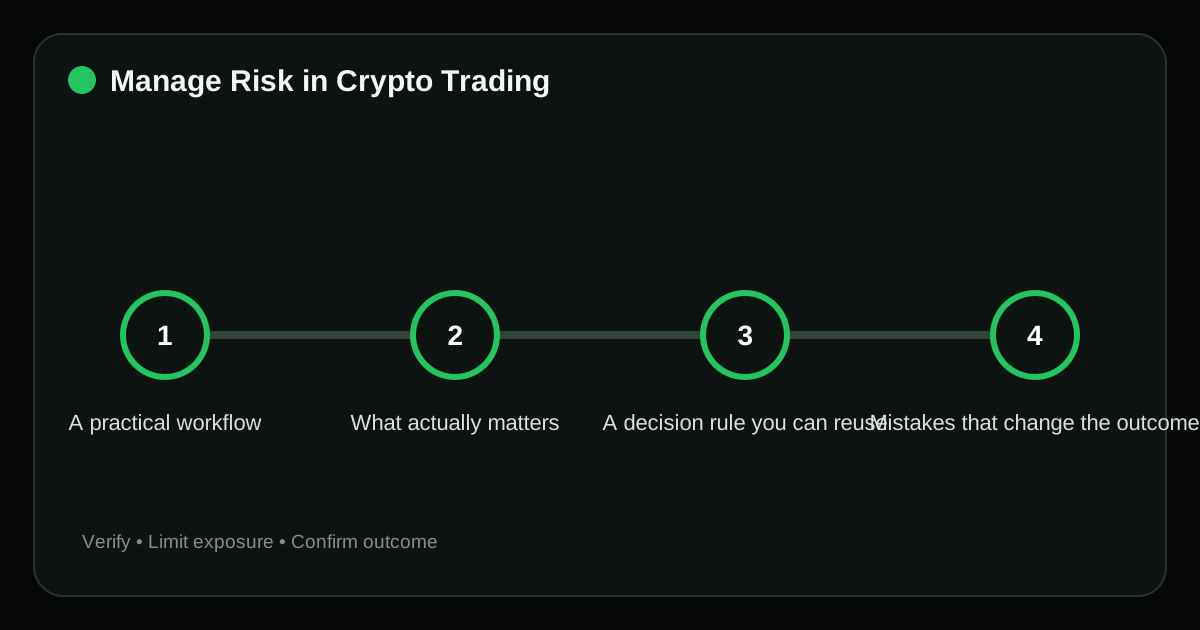
A practical workflow#
- Set account and trade risk limits. Use actual position size, venue rules and costs; a rounded mental estimate is not enough for an irreversible order.
- Calculate size before entry. Use actual position size, venue rules and costs; a rounded mental estimate is not enough for an irreversible order.
- Use planned exits and reduce-only orders. Keep the first exposure small enough that a wrong assumption can be corrected without a material loss.
- Diversify custody and counterparty exposure. For crypto trading risk management, complete this before value or signing authority changes hands and verify the resulting state afterward.
- Review drawdown and rule violations. Compare the live venue details with the written plan; do not rely on a chart label or a remembered setting.
What actually matters#
A profitable setup can still ruin an account if position size is inconsistent. Correlation and leverage make nominally separate trades fail together.
For crypto trading risk management, separate what can be verified before acting from what can only be monitored afterward. Put hard limits around the second category.
A decision rule you can reuse#
Risk limits should become tighter when uncertainty or volatility rises. Survival preserves the ability to trade the next valid setup.
Mistakes that change the outcome#
- Increasing size after a winning streak. This increases loss faster than the planned account-risk limit and may remove the opportunity to exit normally.
- Moving stops farther. This changes the planned exposure or execution cost of crypto trading risk management after the decision has already been made.
- Holding too many correlated altcoins. This changes the planned exposure or execution cost of crypto trading risk management after the decision has already been made.
- Keeping all trading capital on one venue. The branding can be copied, so the request must be re-opened through an independently verified channel.
Evidence to keep#
Do not judge the outcome of crypto trading risk management only by whether the interface shows a success message. Use evidence that can still be checked after the page is closed.
| Checkpoint | Evidence | Stop condition |
|---|---|---|
| Set account and trade risk limits | Order ID, fill price, quantity, fees and current open-position screen | Increasing size after a winning streak |
| Calculate size before entry | Order ID, fill price, quantity, fees and current open-position screen | Moving stops farther |
| Use planned exits and reduce-only orders | Order ID, fill price, quantity, fees and current open-position screen | Holding too many correlated altcoins |
Record actual fills, fees and remaining exposure for crypto trading risk management. The order ticket is an estimate; account history is the durable record.
Frequently asked questions#
What percentage should I risk?
There is no universal number. Choose an amount that tolerates a realistic losing streak without impairing finances.
Is a stop-loss enough?
No. Gaps, slippage, outages and counterparty failure require additional limits.
How do I handle correlated trades?
Treat them as one risk cluster and reduce combined size.
Related guides#
Sources#
- Coinbase: Understanding Order Types
- CFTC: Customer Advisory on Virtual Currencies
- Kraken: Trading Order Types
Risk notice: Crypto trading can produce rapid losses. Examples are educational, not personalized financial advice; verify venue rules, fees and legal or tax obligations before acting.
Editorial standard
This guide is educational and source-led. Security controls, exchange rules and legal requirements can change; verify critical steps through the relevant official service before acting.