Avoid over-leverage by setting a fixed account-risk limit, sizing from the stop distance, using isolated margin when appropriate and tracking total correlated exposure. Do not choose size from the maximum leverage offered.
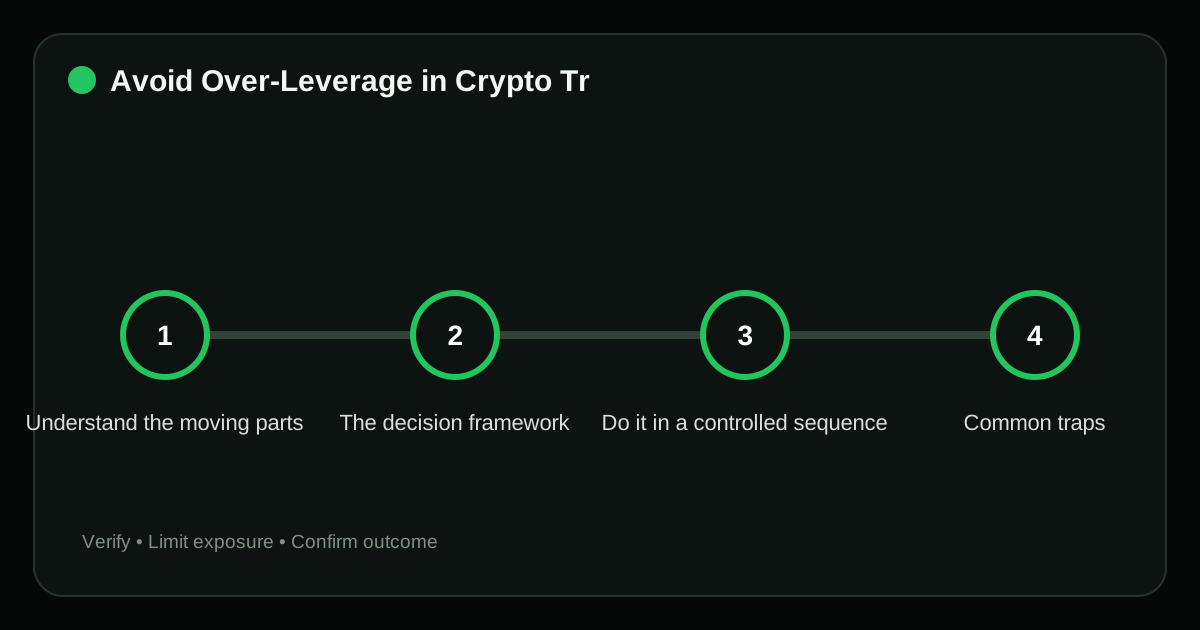
Understand the moving parts#
Several small positions in correlated coins can behave like one large Bitcoin bet. Effective leverage can rise as losses reduce equity even if quantity stays constant.
The decision framework#
If a normal market move could liquidate the position, leverage is excessive. The correct fix is smaller notional exposure, not a tighter arbitrary stop.
Do it in a controlled sequence#
- Set maximum loss per trade and per day. Use actual position size, venue rules and costs; a rounded mental estimate is not enough for an irreversible order.
- Calculate position size before selecting leverage. Use actual position size, venue rules and costs; a rounded mental estimate is not enough for an irreversible order.
- Add correlated positions into one risk bucket. For avoid over leverage crypto, complete this before value or signing authority changes hands and verify the resulting state afterward.
- Keep liquidation far beyond the planned stop. Complete this through the verified product interface, then test the control instead of assuming it is active.
- Reduce size after volatility expands. Keep the first exposure small enough that a wrong assumption can be corrected without a material loss.
Common traps#
- Averaging down with borrowed exposure. This changes the planned exposure or execution cost of avoid over leverage crypto after the decision has already been made.
- Using cross margin to hide weak risk control. This increases loss faster than the planned account-risk limit and may remove the opportunity to exit normally.
- Counting unrealized profit as permanent collateral. This changes the planned exposure or execution cost of avoid over leverage crypto after the decision has already been made.
- Trading after the daily loss limit. The branding can be copied, so the request must be re-opened through an independently verified channel.
For avoid over leverage crypto, a clean result is not merely a completed transaction or setting. It is a result you can independently verify, reproduce and recover from if the surrounding service fails.
Confirm the result#
Do not judge the outcome of avoid over leverage crypto only by whether the interface shows a success message. Use evidence that can still be checked after the page is closed.
| Checkpoint | Evidence | Stop condition |
|---|---|---|
| Set maximum loss per trade and per day | Order ID, fill price, quantity, fees and current open-position screen | Averaging down with borrowed exposure |
| Calculate position size before selecting leverage | Order ID, fill price, quantity, fees and current open-position screen | Using cross margin to hide weak risk control |
| Add correlated positions into one risk bucket | Order ID, fill price, quantity, fees and current open-position screen | Counting unrealized profit as permanent collateral |
Record actual fills, fees and remaining exposure for avoid over leverage crypto. The order ticket is an estimate; account history is the durable record.
Frequently asked questions#
What leverage is safe?
No fixed number is safe; it depends on volatility, stop distance, liquidity and account risk.
Does isolated margin remove risk?
It caps collateral assigned to one position but does not prevent losing that amount.
How do I measure portfolio leverage?
Compare total directional notional, adjusted for hedges and correlation, with account equity.
Related guides#
Sources#
- Coinbase: Understanding Order Types
- CFTC: Customer Advisory on Virtual Currencies
- Kraken: Trading Order Types
Risk notice: Crypto trading can produce rapid losses. Examples are educational, not personalized financial advice; verify venue rules, fees and legal or tax obligations before acting.
Editorial standard
This guide is educational and source-led. Security controls, exchange rules and legal requirements can change; verify critical steps through the relevant official service before acting.