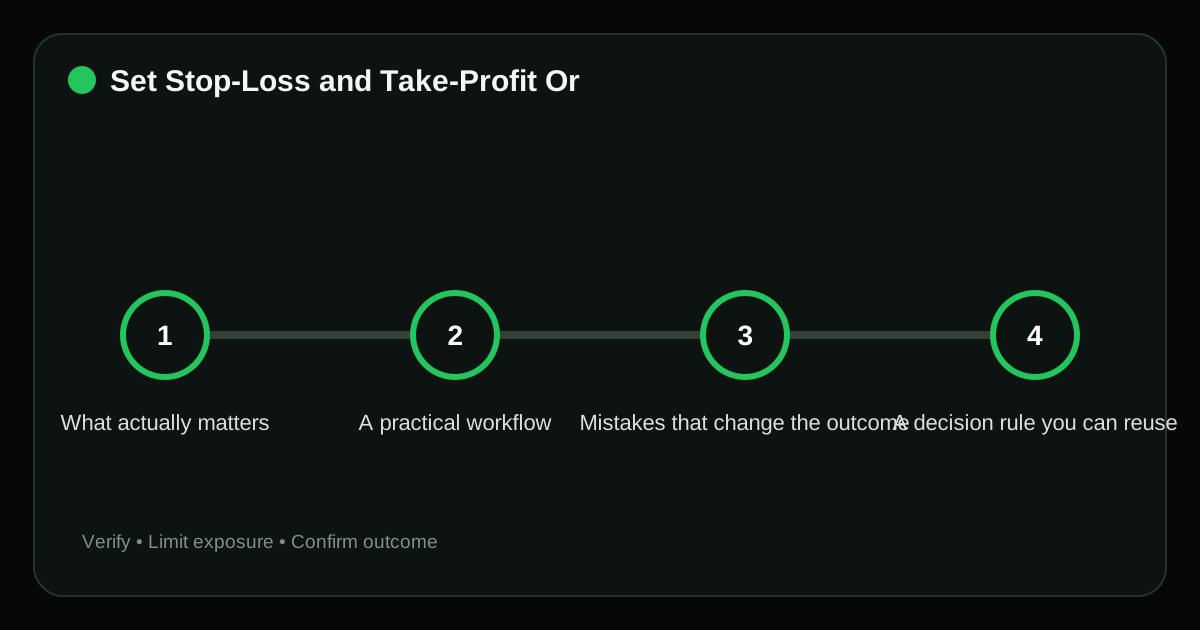
Set a stop-loss at the price that invalidates your trade idea and size the position so a stop fill stays within your risk budget. Set take-profit orders at planned objectives, then confirm whether the exchange uses stop-market, stop-limit, OCO or bracket orders.
What actually matters#
A trigger price is not always the execution price. Stop-market prioritizes exit after triggering; stop-limit controls price but can remain unfilled during a fast move.
For crypto stop loss take profit, the visible interface shows only part of the system. Confirm the identity, asset, network and authority involved before treating a familiar label as proof.
A practical workflow#
- Define entry, invalidation and target before opening. Use actual position size, venue rules and costs; a rounded mental estimate is not enough for an irreversible order.
- Calculate position size from account risk and stop distance. Use actual position size, venue rules and costs; a rounded mental estimate is not enough for an irreversible order.
- Choose the correct trigger reference: last, mark or index price. The choice determines which asset, authority or risk model applies, so resolve any ambiguity before the next step.
- Use reduce-only where available. Keep the first exposure small enough that a wrong assumption can be corrected without a material loss.
- Test the order behavior with small size. Keep the first exposure small enough that a wrong assumption can be corrected without a material loss.
Mistakes that change the outcome#
- Placing a stop exactly at an obvious noisy level. This changes the planned exposure or execution cost of crypto stop loss take profit after the decision has already been made.
- Using stop-limit without understanding non-fill risk. This changes the planned exposure or execution cost of crypto stop loss take profit after the decision has already been made.
- Moving the stop farther to avoid taking a loss. This changes the planned exposure or execution cost of crypto stop loss take profit after the decision has already been made.
- Creating exit orders larger than the position. This changes the planned exposure or execution cost of crypto stop loss take profit after the decision has already been made.
A decision rule you can reuse#
The stop belongs where the trade thesis fails, not where an arbitrary percentage feels comfortable. Reduce size if that logical stop is too expensive.
Proof that the task is complete#
Do not judge the outcome of crypto stop loss take profit only by whether the interface shows a success message. Use evidence that can still be checked after the page is closed.
| Checkpoint | Evidence | Stop condition |
|---|---|---|
| Define entry, invalidation and target before opening | Order ID, fill price, quantity, fees and current open-position screen | Placing a stop exactly at an obvious noisy level |
| Calculate position size from account risk and stop distance | Order ID, fill price, quantity, fees and current open-position screen | Using stop-limit without understanding non-fill risk |
| Choose the correct trigger reference: last, mark or index price | Account history entry and a journal note showing the planned value | Moving the stop farther to avoid taking a loss |
Record actual fills, fees and remaining exposure for crypto stop loss take profit. The order ticket is an estimate; account history is the durable record.
Frequently asked questions#
Can a stop guarantee my exit price?
No. Stop-market can slip, while stop-limit can fail to execute.
What is an OCO order?
One-cancels-the-other links two exits so filling one cancels the other.
Should every trade have a stop?
A defined exit plan is essential; the exact mechanism may differ for spot, options or long-term holdings.
Related guides#
Sources#
- Coinbase: Understanding Order Types
- CFTC: Customer Advisory on Virtual Currencies
- Kraken: Trading Order Types
Risk notice: Crypto trading can produce rapid losses. Examples are educational, not personalized financial advice; verify venue rules, fees and legal or tax obligations before acting.
Editorial standard
This guide is educational and source-led. Security controls, exchange rules and legal requirements can change; verify critical steps through the relevant official service before acting.