A cross-chain bridge adds smart-contract, validator, liquidity and destination-token risk to an ordinary transfer. Use the project’s verified interface, confirm the source and destination contracts, test with a small amount and understand what asset you will receive before bridging meaningful value.
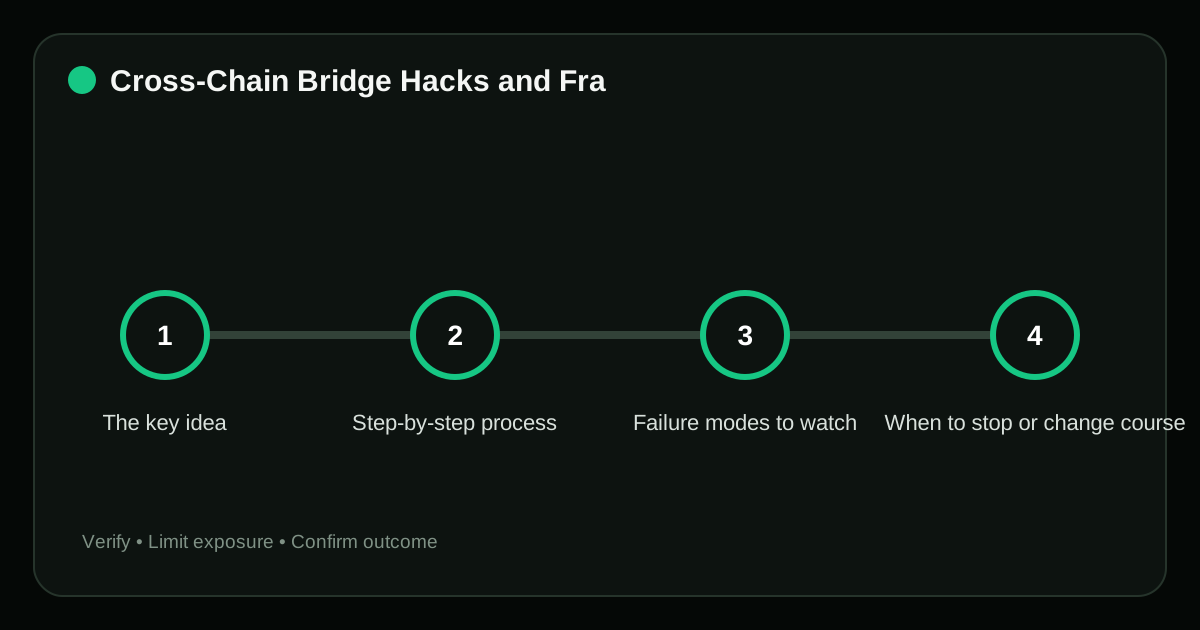
The key idea#
Most bridges do not literally move the same coin between chains. They lock, burn or route value on one network and mint or release a representation on another, creating dependencies beyond either base chain.
For cross-chain bridge risk, the visible interface shows only part of the system. Confirm the identity, asset, network and authority involved before treating a familiar label as proof.
Step-by-step process#
- Confirm the bridge from both ecosystems’ official documentation. Compare the exact domain, address, network or permission with an independent official source before continuing.
- Check supported assets, destination token address and finality assumptions. Compare the exact domain, address, network or permission with an independent official source before continuing.
- Review audits, incident history, admin controls and upgrade delays. Compare the exact domain, address, network or permission with an independent official source before continuing.
- Estimate fees and liquidity at the destination. Write the boundary down first so urgency cannot quietly expand what the wallet or account is allowed to expose.
- Send a small test and verify redemption before scaling. Compare the exact domain, address, network or permission with an independent official source before continuing.
Failure modes to watch#
- Fake bridge domains promoted through ads. The branding can be copied, so the request must be re-opened through an independently verified channel.
- Wrapped assets with weak or unknown issuers. This weakens a control that should limit the blast radius of cross-chain bridge risk.
- Emergency pause or upgrade power held by one key. The branding can be copied, so the request must be re-opened through an independently verified channel.
- Low destination liquidity that prevents exit. Execution cost can consume the expected edge even when the directional idea is right.
When to stop or change course#
Choose a bridge by its trust model, not only its quoted fee. If you cannot describe who can mint, pause or upgrade the system, limit exposure or use a more established route.
Proof that the task is complete#
Do not judge the outcome of cross-chain bridge risk only by whether the interface shows a success message. Use evidence that can still be checked after the page is closed.
| Checkpoint | Evidence | Stop condition |
|---|---|---|
| Confirm the bridge from both ecosystems’ official documentation | Transaction or withdrawal ID plus the matching explorer or account record | Fake bridge domains promoted through ads |
| Check supported assets, destination token address and finality assumptions | Exact URL or contract address matched to official documentation | Wrapped assets with weak or unknown issuers |
| Review audits, incident history, admin controls and upgrade delays | Dated screenshot or onchain record with sensitive data removed | Emergency pause or upgrade power held by one key |
Keep transaction hashes, official case numbers or dated screenshots when they help document cross-chain bridge risk, but exclude seed phrases, private keys and authentication codes.
Frequently asked questions#
Can a completed bridge transfer be reversed?
Usually not by the user. Recovery depends on the bridge design and operator response.
Why did I receive a different token?
Many bridges deliver a wrapped or canonical representation. Verify the destination contract before trading it.
Does an audit make a bridge safe?
No. Audits reduce uncertainty within scope; key management, validators, upgrades and operational failures remain relevant.
Related guides#
Sources#
Risk notice: Crypto actions can be irreversible. Never share a seed phrase, private key, password or authentication code, and verify every domain and wallet prompt independently.
Editorial standard
This guide is educational and source-led. Security controls, exchange rules and legal requirements can change; verify critical steps through the relevant official service before acting.