Report a crypto scam quickly to local law enforcement, the relevant national cybercrime or fraud portal, the receiving exchange or issuer, and the platform hosting the scam. Include transaction IDs, wallet addresses, timestamps, URLs and communications; never send your seed phrase as evidence.
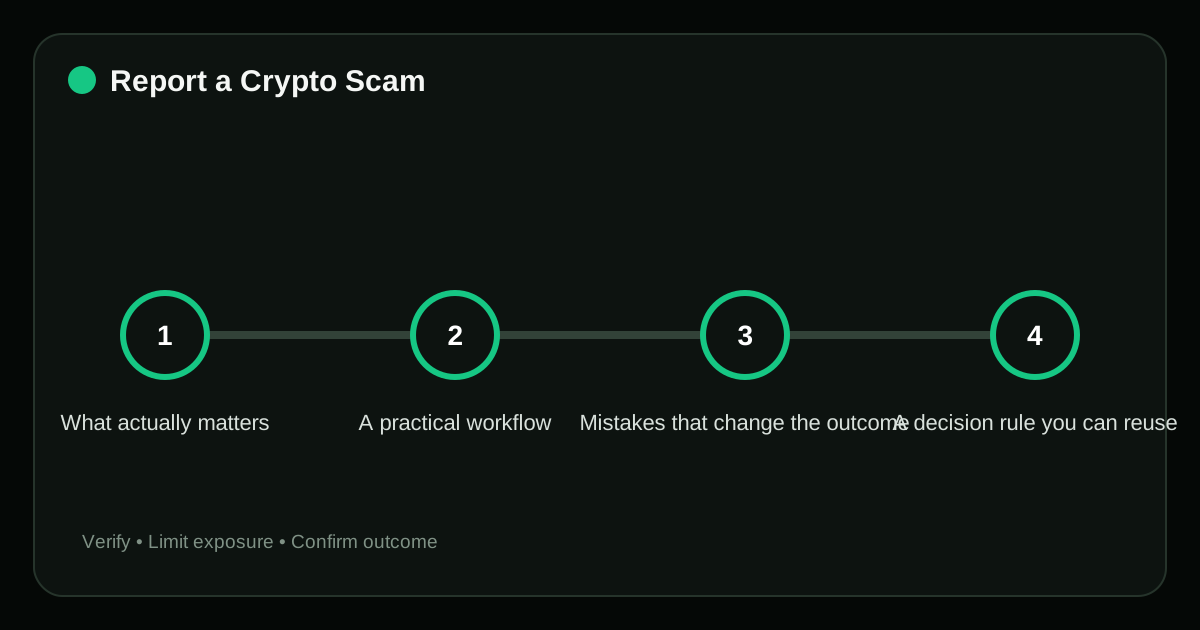
What actually matters#
Fast, structured reporting can help services preserve logs or freeze assets under lawful process. It also creates data that investigators can connect across victims.
For report crypto scam, the visible interface shows only part of the system. Confirm the identity, asset, network and authority involved before treating a familiar label as proof.
A practical workflow#
- Secure remaining accounts before contacting suspects. For report crypto scam, complete this before value or signing authority changes hands and verify the resulting state afterward.
- Export chats and preserve full URLs and headers. Keep the original timestamp, identifier and unedited record so another person can reproduce the conclusion.
- Record transaction hashes, chains, amounts and destination addresses. Keep the original timestamp, identifier and unedited record so another person can reproduce the conclusion.
- File official reports and keep case numbers. Complete this through the verified product interface, then test the control instead of assuming it is active.
- Notify the impersonated company and hosting platform. For report crypto scam, complete this before value or signing authority changes hands and verify the resulting state afterward.
Mistakes that change the outcome#
- Paying an online “recovery officer” first. This weakens a control that should limit the blast radius of report crypto scam.
- Editing screenshots in a way that removes metadata. The branding can be copied, so the request must be re-opened through an independently verified channel.
- Warning the scammer before evidence is preserved. This weakens a control that should limit the blast radius of report crypto scam.
- Publishing identity documents and account details publicly. This weakens a control that should limit the blast radius of report crypto scam.
A decision rule you can reuse#
Build a simple incident timeline. Separate facts you observed from conclusions about who operated the scam; accurate evidence is more useful than confident attribution.
Proof that the task is complete#
Do not judge the outcome of report crypto scam only by whether the interface shows a success message. Use evidence that can still be checked after the page is closed.
| Checkpoint | Evidence | Stop condition |
|---|---|---|
| Secure remaining accounts before contacting suspects | Dated screenshot or onchain record with sensitive data removed | Paying an online “recovery officer” first |
| Export chats and preserve full URLs and headers | Dated screenshot or onchain record with sensitive data removed | Editing screenshots in a way that removes metadata |
| Record transaction hashes, chains, amounts and destination addresses | Transaction or withdrawal ID plus the matching explorer or account record | Warning the scammer before evidence is preserved |
Keep transaction hashes, official case numbers or dated screenshots when they help document report crypto scam, but exclude seed phrases, private keys and authentication codes.
Frequently asked questions#
Where should US victims report?
The FBI Internet Crime Complaint Center and the FTC accept relevant reports; local police may also be appropriate.
Can I report an anonymous wallet address?
Yes. Include the chain and transaction ID so investigators can identify the correct ledger record.
Will reporting guarantee recovery?
No, but it improves the chance of timely preservation, freezing or linkage to a broader case.
Related guides#
Sources#
- FTC: What to Know About Cryptocurrency and Scams
- FBI IC3: Cryptocurrency Investment Fraud
- Ethereum.org: Scam Prevention
Risk notice: Crypto actions can be irreversible. Never share a seed phrase, private key, password or authentication code, and verify every domain and wallet prompt independently.
Editorial standard
This guide is educational and source-led. Security controls, exchange rules and legal requirements can change; verify critical steps through the relevant official service before acting.