Use the wallet’s current network estimate, then choose low, market or priority based on urgency. Confirm max fee, priority fee and gas limit where applicable; increasing gas limit does not make a valid transaction execute faster, while setting it too low can cause failure.
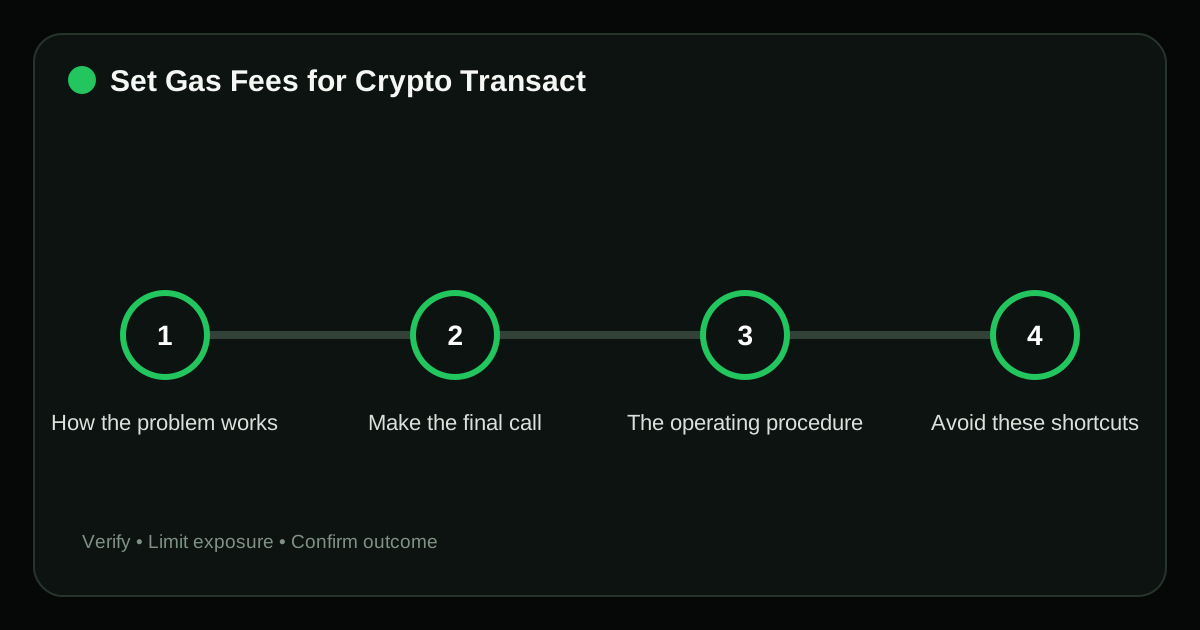
How the problem works#
On EIP-1559 networks, max fee caps total price per gas and priority fee rewards the validator. The final charge depends on base fee plus tip, up to the cap.
Make the final call#
For non-urgent transfers, wait for congestion to fall. For time-sensitive DeFi actions, include the economic cost of a failed or late transaction.
The operating procedure#
- Check network congestion from a reputable explorer. Compare the live venue details with the written plan; do not rely on a chart label or a remembered setting.
- Use wallet estimate for the transaction type. Use actual position size, venue rules and costs; a rounded mental estimate is not enough for an irreversible order.
- Choose priority based on deadline. The choice determines which asset, authority or risk model applies, so resolve any ambiguity before the next step.
- Keep enough native asset for worst-case fee. Use actual position size, venue rules and costs; a rounded mental estimate is not enough for an irreversible order.
- Replace or cancel only with the same nonce and sufficient fee. Calculate the total cost under a conservative execution assumption and record the value used.
Avoid these shortcuts#
- Confusing gas price with gas limit. This changes the planned exposure or execution cost of set crypto gas fee after the decision has already been made.
- Using all native balance as transfer amount. This changes the planned exposure or execution cost of set crypto gas fee after the decision has already been made.
- Following fee numbers from a different chain. Execution cost can consume the expected edge even when the directional idea is right.
- Repeatedly speeding up without checking nonce. This changes the planned exposure or execution cost of set crypto gas fee after the decision has already been made.
For set crypto gas fee, a clean result is not merely a completed transaction or setting. It is a result you can independently verify, reproduce and recover from if the surrounding service fails.
Confirm the result#
Do not judge the outcome of set crypto gas fee only by whether the interface shows a success message. Use evidence that can still be checked after the page is closed.
| Checkpoint | Evidence | Stop condition |
|---|---|---|
| Check network congestion from a reputable explorer | Account history entry and a journal note showing the planned value | Confusing gas price with gas limit |
| Use wallet estimate for the transaction type | Transaction or withdrawal ID plus the matching explorer or account record | Using all native balance as transfer amount |
| Choose priority based on deadline | Account history entry and a journal note showing the planned value | Following fee numbers from a different chain |
Record actual fills, fees and remaining exposure for set crypto gas fee. The order ticket is an estimate; account history is the durable record.
Frequently asked questions#
What happens to unused gas limit?
You pay for gas actually used, subject to the network’s fee model; the unused limit is not consumed.
Can I pay gas in the token I send?
Usually gas uses the chain’s native asset, though sponsored or abstracted systems may differ.
Why did I pay less than max fee?
The cap is not necessarily the final price; the network charges the applicable base and priority fee.
Related guides#
Sources#
- Uniswap Support: Swaps and Troubleshooting
- Ethereum.org: Gas and Fees
- MetaMask: Transactions and Gas
Risk notice: Crypto trading can produce rapid losses. Examples are educational, not personalized financial advice; verify venue rules, fees and legal or tax obligations before acting.
Editorial standard
This guide is educational and source-led. Security controls, exchange rules and legal requirements can change; verify critical steps through the relevant official service before acting.