On-chain analysis follows public transactions, address clusters, bridge movements and exchange deposits to build probabilistic links. Attackers use the same visibility to identify wealthy wallets, while investigators combine ledger data with subpoenas, seized devices and service records.
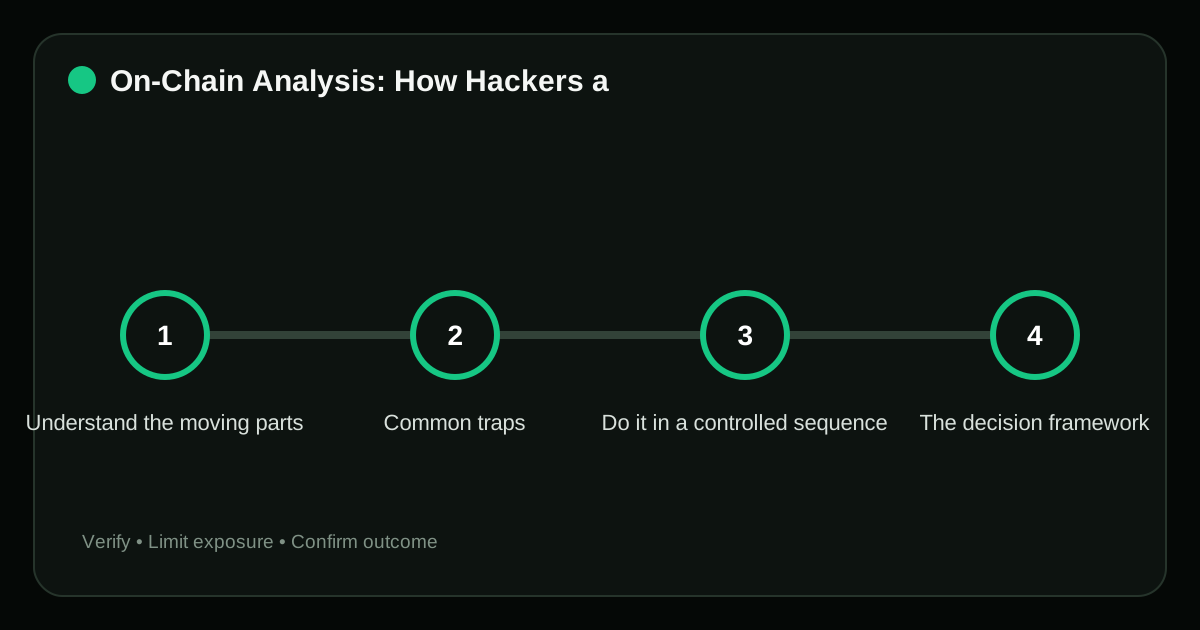
Understand the moving parts#
A blockchain address is pseudonymous until behavior or external data links it to a person. Address reuse, exact-amount transfers, timing and public posts can make that link easier.
Common traps#
- Assuming a new address automatically breaks all links. The branding can be copied, so the request must be re-opened through an independently verified channel.
- Treating clustering heuristics as perfect proof. This removes a required input from the on-chain crypto tracing decision and makes the apparent result unreliable.
- Posting a stolen-funds trail before law enforcement preserves evidence. This weakens a control that should limit the blast radius of on-chain crypto tracing.
- Using unknown “tracing” services that demand payment or keys. This weakens a control that should limit the blast radius of on-chain crypto tracing.
In on-chain crypto tracing, these errors share one pattern: speed or familiarity replaces verification. Slow down at the point where authority, money or an irreversible signature changes hands.
Do it in a controlled sequence#
- Separate public identity addresses from savings. For on-chain crypto tracing, complete this before value or signing authority changes hands and verify the resulting state afterward.
- Avoid publishing balances, signatures and transaction IDs unnecessarily. For on-chain crypto tracing, complete this before value or signing authority changes hands and verify the resulting state afterward.
- Verify privacy claims before using a new chain or wallet. Compare the exact domain, address, network or permission with an independent official source before continuing.
- Protect exchange and email records with strong authentication. Keep the original timestamp, identifier and unedited record so another person can reproduce the conclusion.
- Document theft addresses promptly for investigators and providers. Keep the original timestamp, identifier and unedited record so another person can reproduce the conclusion.
The decision framework#
Analysis is evidence, not certainty. Good investigations distinguish deterministic links—such as a signed transaction—from heuristics that can produce false associations.
A final verification pass#
Do not judge the outcome of on-chain crypto tracing only by whether the interface shows a success message. Use evidence that can still be checked after the page is closed.
| Checkpoint | Evidence | Stop condition |
|---|---|---|
| Separate public identity addresses from savings | Dated screenshot or onchain record with sensitive data removed | Assuming a new address automatically breaks all links |
| Avoid publishing balances, signatures and transaction IDs unnecessarily | Transaction or withdrawal ID plus the matching explorer or account record | Treating clustering heuristics as perfect proof |
| Verify privacy claims before using a new chain or wallet | Dated control check, recovery test or authenticated settings record with secrets removed | Posting a stolen-funds trail before law enforcement preserves evidence |
Keep transaction hashes, official case numbers or dated screenshots when they help document on-chain crypto tracing, but exclude seed phrases, private keys and authentication codes.
Frequently asked questions#
Can stolen crypto be traced after a bridge?
Often, but cross-chain systems complicate analysis and attribution. Traceability does not guarantee recovery.
Can anyone see my wallet balance?
Anyone can inspect a known public address on a public chain. The key privacy question is whether they can link it to you.
Do privacy coins prevent all tracing?
No technology guarantees anonymity; implementation, user behavior and service records still matter.
Related guides#
Sources#
- Bitcoin.org: Protect Your Privacy
- FATF: Targeted Update on Virtual Assets and VASPs
- OFAC: Sanctions Compliance Guidance for Virtual Currency
Risk notice: Crypto actions can be irreversible. Never share a seed phrase, private key, password or authentication code, and verify every domain and wallet prompt independently.
Editorial standard
This guide is educational and source-led. Security controls, exchange rules and legal requirements can change; verify critical steps through the relevant official service before acting.