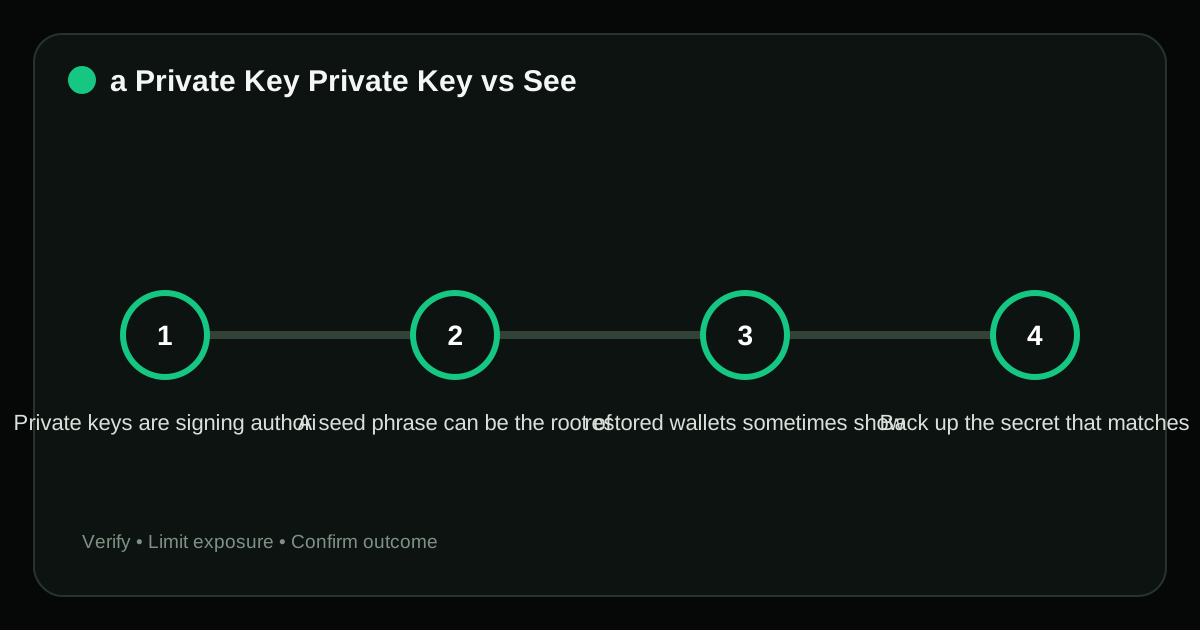
A private key authorizes transactions for one blockchain account, while a seed phrase usually restores a wallet that can derive many private keys. Sharing either secret can expose funds, but losing one imported private key may affect one account whereas losing a wallet’s seed phrase can affect every derived account.
Private keys are signing authority#
A private key is a secret number used by wallet software to create cryptographic signatures. The network checks the signature against the corresponding public key or address. It does not need to learn the private key itself.
“Owning crypto” therefore means controlling the authority required to move assets recorded on the network. The wallet interface is a tool for managing that authority; the coins are not stored inside the phone or hardware device.
Exporting a private key allows the associated account to be imported elsewhere. It should be handled with the same care as the assets it controls. A local wallet password does not make an exported key harmless.
A seed phrase can be the root of many keys#
Modern wallets often use hierarchical deterministic key derivation. One recovery phrase is converted into a master secret, from which the wallet derives a sequence of accounts and private keys. This makes one backup convenient—but also concentrates risk.
| Question | Private key | Seed phrase |
|---|---|---|
| Typical scope | One account | Many derived accounts |
| Primary use | Sign or import one account | Restore the wallet structure |
| Human format | Long encoded value | Ordered words |
| Can it be shared? | No | No |
| Can a password reset it? | No | No |
| If exposed | Move that account’s assets | Migrate every derived account |
MetaMask documents that each derived account has its own private key, while the Secret Recovery Phrase restores all accounts derived from that phrase. Manually imported accounts can be an exception: their keys may not be regenerated by the main seed and may need separate backups.
Why restored wallets sometimes show the wrong address#
Entering the correct seed does not guarantee that every interface immediately displays the expected account. Possible causes include:
- the wallet uses a different derivation path;
- the desired account was created later and has not yet been rediscovered;
- an optional passphrase produced a separate wallet;
- the account was manually imported from another private key;
- the selected network or account type is different.
Do not respond by entering the phrase into multiple random wallets. Use a trusted product that supports the relevant standard and consult its official recovery documentation.
Back up the secret that matches the account design#
For a standard seed-based wallet, verify the seed phrase and any optional passphrase. For a manually imported account, determine whether its private key is included in the main backup. For a smart-contract wallet or social-recovery account, recovery may instead depend on guardians, devices or provider-specific credentials.
Write down the recovery architecture in plain language without placing the secrets themselves in the same document. Someone performing an emergency recovery should know which wallet, network and method are involved.
Treat exposure according to its scope#
If one private key leaks, create a new account under a secure wallet and transfer every asset controlled by that key. Check multiple networks if the same key has been used across EVM-compatible chains.
If the seed phrase leaks, treat every derived key as compromised. A new account generated from that same phrase is not a new security boundary. Create a wallet from new recovery material and move assets after verifying the destination.
Changing an app password only re-encrypts local wallet data; it does not rotate blockchain keys already known to an attacker.
Frequently asked questions#
Can someone calculate my seed phrase from one private key?
With standard cryptographic derivation, exposing one child private key should not reveal the original phrase. The exposed account is still lost, and implementation mistakes or unusual wallet designs can change the analysis.
Is my public address safe to share?
It does not grant signing authority, but it reveals transaction activity associated with that address. Reusing or publishing it can reduce financial privacy.
Does a hardware wallet contain my coins?
No. It protects keys and signs transactions. The blockchain records the assets, and the recovery backup can usually recreate the wallet on a compatible replacement device.
Should I export private keys for every account?
Usually not when a verified seed phrase already covers the derived accounts. Extra exports create additional secrets to secure. Confirm imported-account exceptions before relying on the seed alone.
Sources#
- MetaMask: Secret Recovery Phrase, Password and Private Keys
- MetaMask: Reveal Your Secret Recovery Phrase Safely
- SEC Investor Bulletin: Crypto Asset Custody Basics
Risk notice: Exporting or displaying private keys and recovery phrases increases exposure. Perform recovery only through the verified process for the exact wallet design.
Editorial standard
This guide is educational and source-led. Security controls, exchange rules and legal requirements can change; verify critical steps through the relevant official service before acting.