A rug pull happens when insiders use control over a token, liquidity pool or project treasury to extract value and leave holders with losses. Before buying, inspect who can mint or freeze tokens, whether liquidity can be removed, how ownership is controlled and whether claims about locks are verifiable onchain.
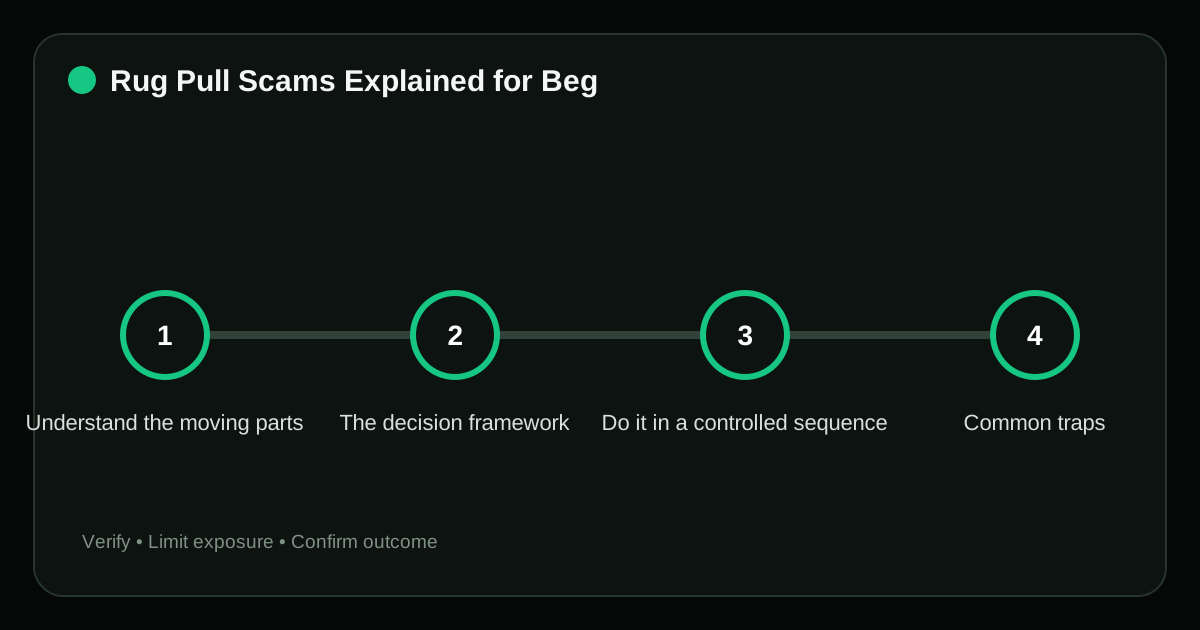
Understand the moving parts#
Price charts and active communities do not reveal administrative power. A token may trade normally until an owner changes fees, blocks sales, mints supply or removes liquidity.
The decision framework#
No single check proves safety. Combine contract permissions, liquidity custody, distribution, team accountability and product evidence; reduce size when any dimension remains opaque.
Do it in a controlled sequence#
- Verify the token contract on the correct block explorer. Compare the exact domain, address, network or permission with an independent official source before continuing.
- Read privileged functions and ownership status. Compare the exact domain, address, network or permission with an independent official source before continuing.
- Check liquidity lock terms and the actual locking contract. Compare the exact domain, address, network or permission with an independent official source before continuing.
- Examine holder concentration and deployer-linked wallets. For rug pull scam, complete this before value or signing authority changes hands and verify the resulting state afterward.
- Test whether buys and sells work with a small amount. Keep the first exposure small enough that a wrong assumption can be corrected without a material loss.
Common traps#
- Anonymous promotion presented as decentralization. This weakens a control that should limit the blast radius of rug pull scam.
- Audit badges that do not cover the deployed version. The branding can be copied, so the request must be re-opened through an independently verified channel.
- Liquidity “locked” for only a short period. Execution cost can consume the expected edge even when the directional idea is right.
- Transfer taxes or blacklist controls that can change. This weakens a control that should limit the blast radius of rug pull scam.
For rug pull scam, a clean result is not merely a completed transaction or setting. It is a result you can independently verify, reproduce and recover from if the surrounding service fails.
Confirm the result#
Do not judge the outcome of rug pull scam only by whether the interface shows a success message. Use evidence that can still be checked after the page is closed.
| Checkpoint | Evidence | Stop condition |
|---|---|---|
| Verify the token contract on the correct block explorer | Exact URL or contract address matched to official documentation | Anonymous promotion presented as decentralization |
| Read privileged functions and ownership status | Dated screenshot or onchain record with sensitive data removed | Audit badges that do not cover the deployed version |
| Check liquidity lock terms and the actual locking contract | Exact URL or contract address matched to official documentation | Liquidity “locked” for only a short period |
Keep transaction hashes, official case numbers or dated screenshots when they help document rug pull scam, but exclude seed phrases, private keys and authentication codes.
Frequently asked questions#
Is every project with an anonymous team a rug pull?
No, but anonymity removes a layer of accountability and makes technical controls more important.
Does locked liquidity prevent a rug pull?
It only limits the locked liquidity path. Minting, fees, treasury control or upgradeable contracts may create other exits.
Can an audit guarantee safety?
No. An audit is scoped evidence at a point in time, not insurance or a guarantee against fraud.
Related guides#
Sources#
Risk notice: Crypto actions can be irreversible. Never share a seed phrase, private key, password or authentication code, and verify every domain and wallet prompt independently.
Editorial standard
This guide is educational and source-led. Security controls, exchange rules and legal requirements can change; verify critical steps through the relevant official service before acting.