A market order prioritizes execution and accepts available prices; a limit order sets the worst price you will accept but may not fill. Choose the pair and side, enter size, review estimated value and fee, then verify the fill rather than assuming the screen price was guaranteed.
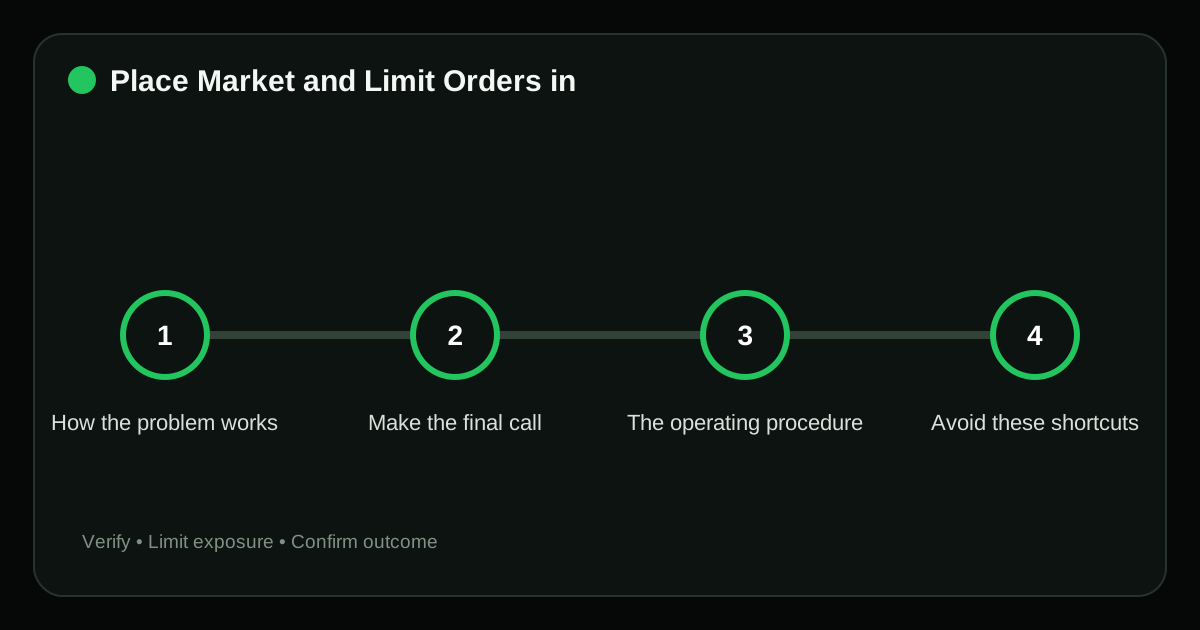
How the problem works#
The last traded price is not inventory. A market order walks the order book, so a large order can fill at several prices. A limit order rests or executes only at its limit or better.
Make the final call#
Use market orders for small, liquid, time-sensitive trades; use limits when price control matters. Neither choice removes market risk.
The operating procedure#
- Check bid-ask spread and depth. Compare the live venue details with the written plan; do not rely on a chart label or a remembered setting.
- Select buy or sell and confirm the pair direction. Compare the live venue details with the written plan; do not rely on a chart label or a remembered setting.
- Enter size in base or quote units carefully. For market vs limit order crypto, complete this before value or signing authority changes hands and verify the resulting state afterward.
- Set a limit price or preview market impact. Compare the live venue details with the written plan; do not rely on a chart label or a remembered setting.
- Inspect average fill price and remaining quantity. Compare the live venue details with the written plan; do not rely on a chart label or a remembered setting.
Avoid these shortcuts#
- Placing a buy limit above the market unintentionally. This changes the planned exposure or execution cost of market vs limit order crypto after the decision has already been made.
- Using market orders in illiquid pairs. Execution cost can consume the expected edge even when the directional idea is right.
- Assuming a placed limit order reserves no funds. This removes a required input from the market vs limit order crypto decision and makes the apparent result unreliable.
- Ignoring partial fills. This removes a required input from the market vs limit order crypto decision and makes the apparent result unreliable.
For market vs limit order crypto, a clean result is not merely a completed transaction or setting. It is a result you can independently verify, reproduce and recover from if the surrounding service fails.
Confirm the result#
Do not judge the outcome of market vs limit order crypto only by whether the interface shows a success message. Use evidence that can still be checked after the page is closed.
| Checkpoint | Evidence | Stop condition |
|---|---|---|
| Check bid-ask spread and depth | Account history entry and a journal note showing the planned value | Placing a buy limit above the market unintentionally |
| Select buy or sell and confirm the pair direction | Account history entry and a journal note showing the planned value | Using market orders in illiquid pairs |
| Enter size in base or quote units carefully | Account history entry and a journal note showing the planned value | Assuming a placed limit order reserves no funds |
Record actual fills, fees and remaining exposure for market vs limit order crypto. The order ticket is an estimate; account history is the durable record.
Frequently asked questions#
Can a limit order fill immediately?
Yes, if its price crosses available orders; it acts as a marketable limit.
Why did only part of my order fill?
There was not enough matching liquidity at your price.
What is the spread?
It is the gap between the best available bid and ask.
Related guides#
Sources#
- Coinbase: Understanding Order Types
- CFTC: Customer Advisory on Virtual Currencies
- Kraken: Trading Order Types
Risk notice: Crypto trading can produce rapid losses. Examples are educational, not personalized financial advice; verify venue rules, fees and legal or tax obligations before acting.
Editorial standard
This guide is educational and source-led. Security controls, exchange rules and legal requirements can change; verify critical steps through the relevant official service before acting.