Mark zones where price repeatedly changed direction or closed decisively, starting on a higher timeframe and refining lower. Treat support and resistance as areas, not exact lines, and define what confirms a break or rejection.
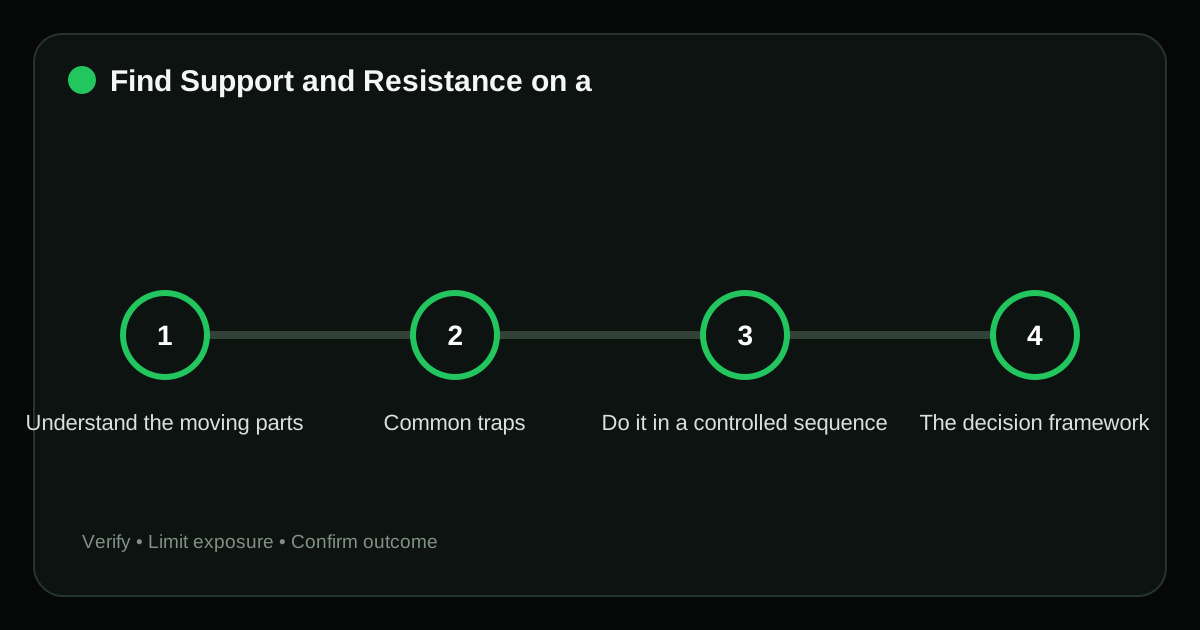
Understand the moving parts#
Levels reflect prior trading and attention, but they do not force price to turn. A broken level may reverse role, while low-liquidity wicks can create false precision.
Common traps#
- Drawing a line at every minor pivot. This changes the planned exposure or execution cost of crypto support resistance levels after the decision has already been made.
- Moving levels after the trade. The branding can be copied, so the request must be re-opened through an independently verified channel.
- Ignoring trend and volume. This removes a required input from the crypto support resistance levels decision and makes the apparent result unreliable.
- Buying support before any confirmation. The branding can be copied, so the request must be re-opened through an independently verified channel.
In crypto support resistance levels, these errors share one pattern: speed or familiarity replaces verification. Slow down at the point where authority, money or an irreversible signature changes hands.
Do it in a controlled sequence#
- Start with weekly or daily swing points. For crypto support resistance levels, complete this before value or signing authority changes hands and verify the resulting state afterward.
- Mark clusters of closes and reactions. For crypto support resistance levels, complete this before value or signing authority changes hands and verify the resulting state afterward.
- Note high-volume areas and gaps. For crypto support resistance levels, complete this before value or signing authority changes hands and verify the resulting state afterward.
- Refine the zone on the trading timeframe. For crypto support resistance levels, complete this before value or signing authority changes hands and verify the resulting state afterward.
- Set invalidation beyond the zone, not on its center. Use actual position size, venue rules and costs; a rounded mental estimate is not enough for an irreversible order.
The decision framework#
Keep only levels that could change a decision. If the chart becomes a grid, prioritization has failed.
A final verification pass#
Do not judge the outcome of crypto support resistance levels only by whether the interface shows a success message. Use evidence that can still be checked after the page is closed.
| Checkpoint | Evidence | Stop condition |
|---|---|---|
| Start with weekly or daily swing points | Account history entry and a journal note showing the planned value | Drawing a line at every minor pivot |
| Mark clusters of closes and reactions | Account history entry and a journal note showing the planned value | Moving levels after the trade |
| Note high-volume areas and gaps | Account history entry and a journal note showing the planned value | Ignoring trend and volume |
Record actual fills, fees and remaining exposure for crypto support resistance levels. The order ticket is an estimate; account history is the durable record.
Frequently asked questions#
Why do levels differ between traders?
Timeframe, exchange data and zone definitions differ.
Does more touches make a level stronger?
It can validate attention but may also consume resting orders, so context matters.
What is a false breakout?
Price moves beyond a level but fails to hold and returns into the prior range.
Related guides#
Sources#
- Coinbase: Understanding Order Types
- CFTC: Customer Advisory on Virtual Currencies
- Kraken: Trading Order Types
Risk notice: Crypto trading can produce rapid losses. Examples are educational, not personalized financial advice; verify venue rules, fees and legal or tax obligations before acting.
Editorial standard
This guide is educational and source-led. Security controls, exchange rules and legal requirements can change; verify critical steps through the relevant official service before acting.