Hardware wallets can fail through supply-chain tampering, firmware flaws, physical attacks, malicious transactions or recovery-phrase theft. Their main advantage is keeping signing keys isolated; they are not a substitute for verifying the address and action on the device screen.
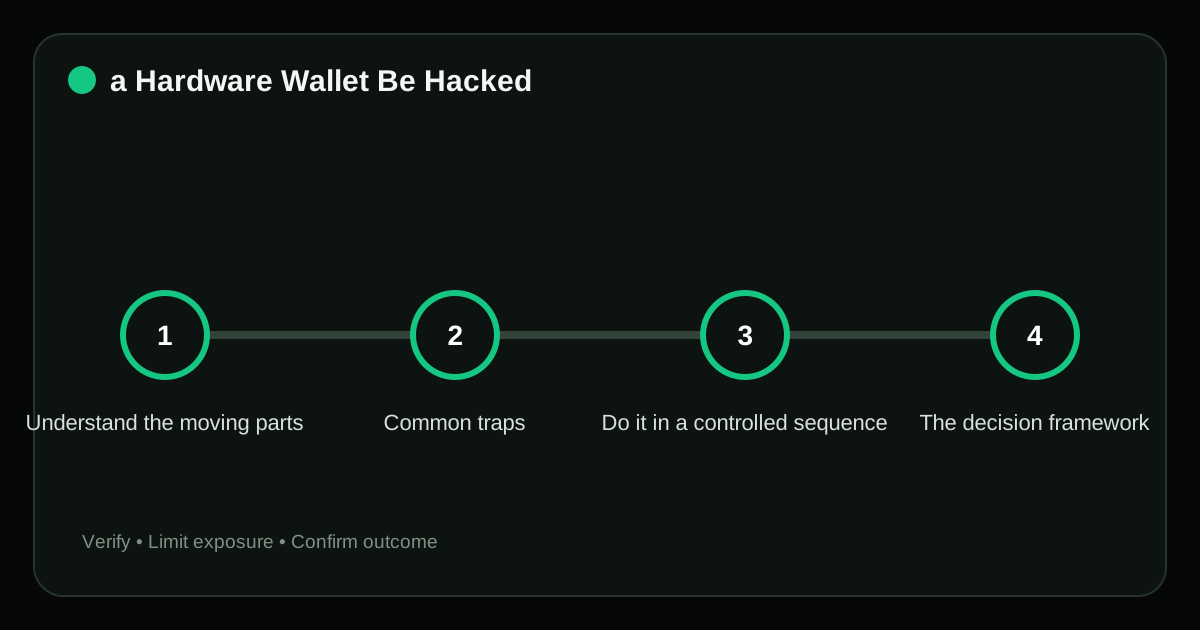
Understand the moving parts#
Most real-world losses described as hardware-wallet hacks involve exposed seed phrases, fake support, blind signing or a compromised computer changing transaction details.
Common traps#
- Accepting a device with a preprinted seed. This can expose the root credential; a later password change may not remove the attacker’s access.
- Typing the seed into a desktop companion app. This can expose the root credential; a later password change may not remove the attacker’s access.
- Ignoring device-screen differences. This removes a required input from the can hardware wallet be hacked decision and makes the apparent result unreliable.
- Keeping device, seed and passphrase together. This can expose the root credential; a later password change may not remove the attacker’s access.
In can hardware wallet be hacked, these errors share one pattern: speed or familiarity replaces verification. Slow down at the point where authority, money or an irreversible signature changes hands.
Do it in a controlled sequence#
- Buy through an authorized source. For can hardware wallet be hacked, complete this before value or signing authority changes hands and verify the resulting state afterward.
- Initialize the device yourself and update authentic firmware. For can hardware wallet be hacked, complete this before value or signing authority changes hands and verify the resulting state afterward.
- Verify receive and send details on the trusted display. Compare the exact domain, address, network or permission with an independent official source before continuing.
- Keep the seed entirely offline. Complete this through the verified product interface, then test the control instead of assuming it is active.
- Use a tested backup and optional passphrase only with a recovery plan. Keep the first exposure small enough that a wrong assumption can be corrected without a material loss.
The decision framework#
A hardware wallet is strongest against remote key theft. For targeted physical risk or complex smart-contract use, add multisignature, geographic separation or policy controls.
A final verification pass#
Do not judge the outcome of can hardware wallet be hacked only by whether the interface shows a success message. Use evidence that can still be checked after the page is closed.
| Checkpoint | Evidence | Stop condition |
|---|---|---|
| Buy through an authorized source | Dated screenshot or onchain record with sensitive data removed | Accepting a device with a preprinted seed |
| Initialize the device yourself and update authentic firmware | Dated screenshot or onchain record with sensitive data removed | Typing the seed into a desktop companion app |
| Verify receive and send details on the trusted display | Transaction or withdrawal ID plus the matching explorer or account record | Ignoring device-screen differences |
Keep transaction hashes, official case numbers or dated screenshots when they help document can hardware wallet be hacked, but exclude seed phrases, private keys and authentication codes.
Frequently asked questions#
Can malware steal from a hardware wallet?
It may deceive you about a transaction, but it should not extract keys from a correctly functioning device. Verify the device display.
What if the manufacturer disappears?
A standards-compatible backup may restore elsewhere, but coin support and derivation paths should be documented.
Should I use a passphrase?
It can protect a discovered seed, but losing or mistyping it creates permanent loss. Use only after a recovery drill.
Related guides#
Sources#
- Ethereum.org: Security and Scam Prevention
- MetaMask: Wallet Security
- CISA: Avoiding Social Engineering and Phishing Attacks
Risk notice: Crypto actions can be irreversible. Never share a seed phrase, private key, password or authentication code, and verify every domain and wallet prompt independently.
Editorial standard
This guide is educational and source-led. Security controls, exchange rules and legal requirements can change; verify critical steps through the relevant official service before acting.