A drainer is malicious infrastructure designed to turn wallet signatures, approvals or deceptive transactions into asset theft. It may target tokens, NFTs or native assets and can prioritize the most valuable items after a victim connects to a fake site.
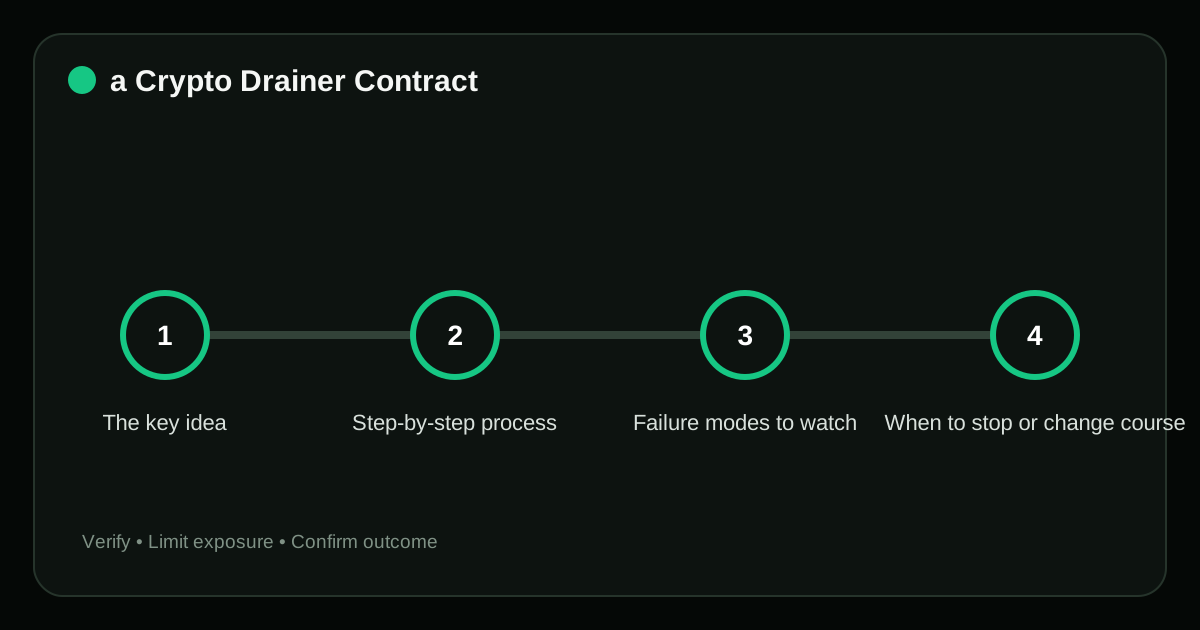
The key idea#
The contract is only part of the system. Phishing pages, sponsored ads, compromised accounts and signature kits bring victims to it; offchain permits may let the attacker act later.
For crypto drainer contract, the visible interface shows only part of the system. Confirm the identity, asset, network and authority involved before treating a familiar label as proof.
Step-by-step process#
- Reject unexpected approvals, permits and operator permissions. For crypto drainer contract, complete this before value or signing authority changes hands and verify the resulting state afterward.
- Check the spender contract and decoded effect. Compare the exact domain, address, network or permission with an independent official source before continuing.
- Move unaffected assets to a fresh wallet if a secret may be exposed. Write the boundary down first so urgency cannot quietly expand what the wallet or account is allowed to expose.
- Revoke remaining permissions from a trusted interface. For crypto drainer contract, complete this before value or signing authority changes hands and verify the resulting state afterward.
- Report the domain, addresses and transactions. For crypto drainer contract, complete this before value or signing authority changes hands and verify the resulting state afterward.
Failure modes to watch#
- Believing connection alone explains every loss. This removes a required input from the crypto drainer contract decision and makes the apparent result unreliable.
- Signing unreadable data to “verify ownership”. The branding can be copied, so the request must be re-opened through an independently verified channel.
- Using the compromised wallet for rescue transactions without a plan. This weakens a control that should limit the blast radius of crypto drainer contract.
- Paying a recovery drainer that promises reversal. This weakens a control that should limit the blast radius of crypto drainer contract.
When to stop or change course#
After suspected contact, determine whether the seed leaked or only a permission was granted. A leaked key requires migration; a contained allowance may be handled by revocation.
Proof that the task is complete#
Do not judge the outcome of crypto drainer contract only by whether the interface shows a success message. Use evidence that can still be checked after the page is closed.
| Checkpoint | Evidence | Stop condition |
|---|---|---|
| Reject unexpected approvals, permits and operator permissions | Exact URL or contract address matched to official documentation | Believing connection alone explains every loss |
| Check the spender contract and decoded effect | Exact URL or contract address matched to official documentation | Signing unreadable data to “verify ownership” |
| Move unaffected assets to a fresh wallet if a secret may be exposed | Dated control check, recovery test or authenticated settings record with secrets removed | Using the compromised wallet for rescue transactions without a plan |
Keep transaction hashes, official case numbers or dated screenshots when they help document crypto drainer contract, but exclude seed phrases, private keys and authentication codes.
Frequently asked questions#
Can a drainer steal without a signature?
It may exploit an existing approval or compromised key. A new site connection by itself generally does not authorize transfers.
Will disconnecting the site stop it?
No. Disconnecting removes a local session, not onchain approvals or leaked keys.
Can a hardware wallet block a drainer?
It protects key extraction but will sign a malicious request you approve. Device-screen verification remains essential.
Related guides#
Sources#
Risk notice: Crypto actions can be irreversible. Never share a seed phrase, private key, password or authentication code, and verify every domain and wallet prompt independently.
Editorial standard
This guide is educational and source-led. Security controls, exchange rules and legal requirements can change; verify critical steps through the relevant official service before acting.