Wallet approval risk is the possibility that a contract or operator can move tokens after you grant it permission. An approval may remain active after the original swap, mint or game interaction ends, so a compromised or malicious spender can use that standing authority later.
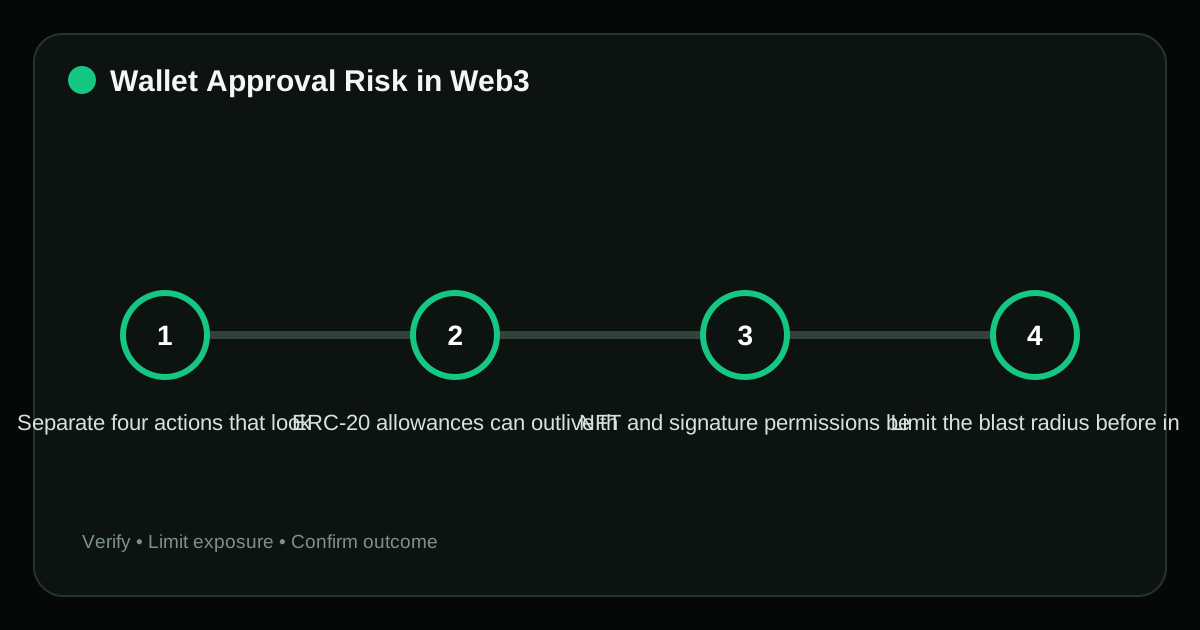
Separate four actions that look similar#
“Connect wallet” is often used loosely, but the authority changes at each step.
| Action | Typical effect |
|---|---|
| Connect | Shares public address and network context |
| Sign message | Proves control or authorizes structured data, depending on content |
| Approve/Permit | Gives a spender token authority up to a limit |
| Transfer/Swap | Moves assets or executes contract logic |
A connection can create privacy exposure without directly moving tokens. A signature may be harmless authentication or a powerful offchain authorization. An onchain approval records a reusable allowance. Read the payload, not the button text.
ERC-20 allowances can outlive the transaction#
Many token contracts require approval before a router or protocol can transfer tokens on the user’s behalf. Interfaces sometimes request a maximum allowance for convenience. Ethereum.org warns that unlimited access can allow the approved contract to spend all of that token balance.
The allowance belongs to the token, owner and spender combination on one network. Moving tokens away does not erase it. If tokens return later, the spender may still have authority.
NFT and signature permissions behave differently#
NFT contracts may grant ApprovalForAll, allowing an operator to transfer every item in a collection. Offchain permits can authorize spending through a signature and may not appear as a conventional approval transaction until used.
Typed-data screens are safer than unreadable hex only when the wallet explains the fields accurately and the user checks them. A familiar domain cannot guarantee a safe request if the front end or project account is compromised.
Limit the blast radius before interacting#
Use a dedicated interaction wallet with no long-term holdings. Verify the contract address through an independent project source, approve a specific amount when possible and reject unexpected operator or ownership permissions.
After a one-time interaction, review and revoke the allowance. Disconnecting a site clears a local relationship in the wallet interface but does not change blockchain state.
Transaction simulation is useful, but it is a prediction based on the current state and supported decoding. It should complement—not replace—contract, domain and permission verification.
Audit permissions as ongoing maintenance#
Review approvals when:
- a protocol reports an exploit or front-end compromise;
- you stop using an application;
- an interaction wallet has accumulated many permissions;
- a contract is upgraded or ownership changes;
- unexplained transactions or signing prompts appear.
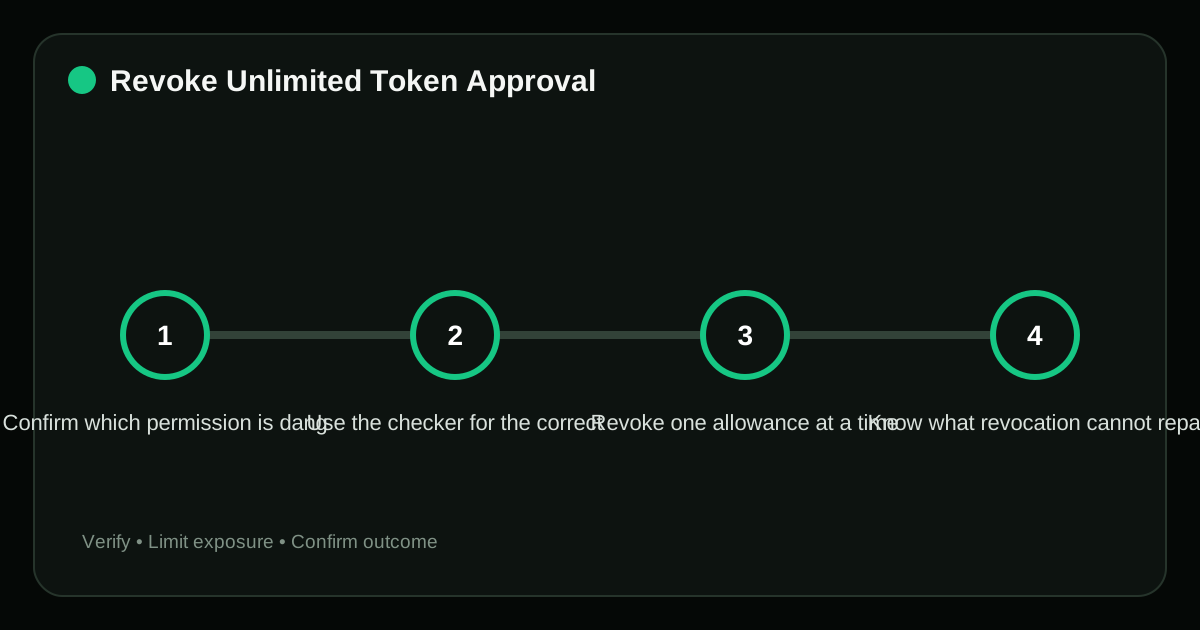
Prioritize unlimited allowances and unknown spenders tied to valuable balances. Revoke through a verified explorer or established checker and confirm the transaction onchain.
Frequently asked questions#
Does connecting a wallet grant token access?
Normally no. It exposes the public address and allows the site to request signatures. Token authority requires a relevant approval, permit or transaction.
Can a revoked approval be used again?
Once the revocation is confirmed, that allowance should no longer authorize spending. A new approval or separate permission may still exist.
Is a small approval always safe?
It limits the amount available through that allowance but does not prove the contract is legitimate. The approved amount can still be lost.
Can approvals exist on several networks?
Yes. Review each chain separately because the same address can have different allowances on different networks.
Sources#
- Ethereum.org: Security and Scam Prevention
- Ethereum.org: Revoke Smart Contract Access
- Uniswap: What Is an Approval Transaction?
- OWASP Smart Contract Security: UX Security Foundations
Risk notice: Permission formats vary by token standard, wallet and chain. Verify the exact authority requested before signing.
Editorial standard
This guide is educational and source-led. Security controls, exchange rules and legal requirements can change; verify critical steps through the relevant official service before acting.