Public blockchains are traceable, so no method can promise an untracked transfer. You can reduce unnecessary exposure by avoiding public address reuse, limiting what you disclose, using fresh receive addresses where supported and following applicable Travel Rule, tax and sanctions requirements.
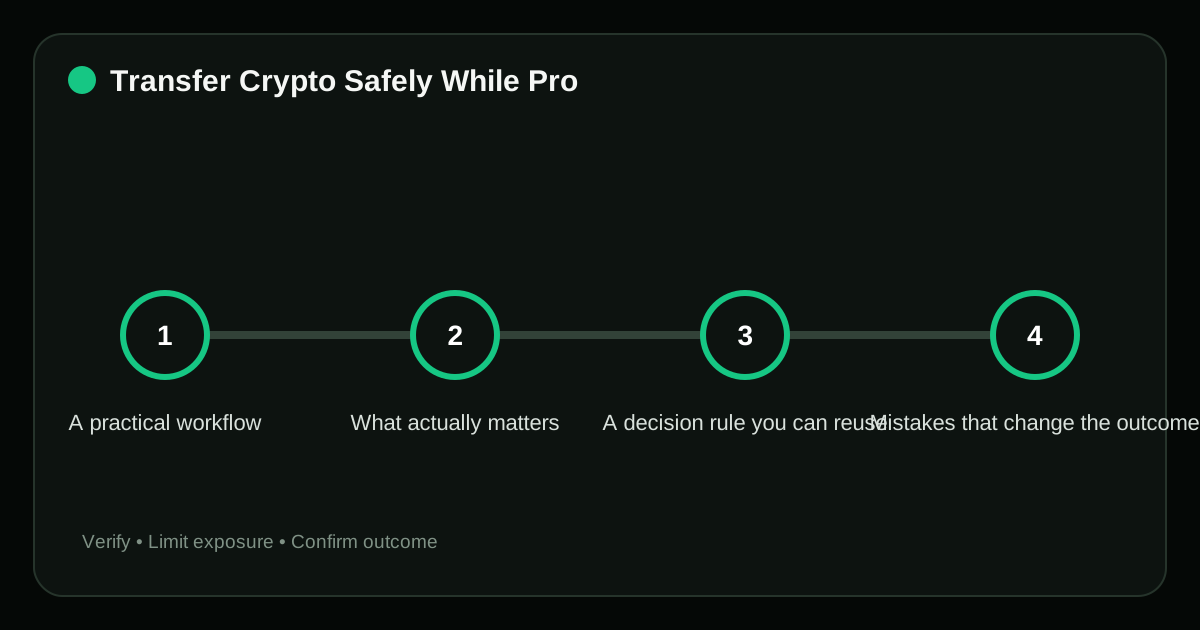
A practical workflow#
- Confirm the recipient and network through a separate channel. Compare the exact domain, address, network or permission with an independent official source before continuing.
- Use wallet-generated fresh receive addresses when the protocol supports them. Complete this through the verified product interface, then test the control instead of assuming it is active.
- Avoid posting transaction IDs and balances publicly. For private crypto transfer safety, complete this before value or signing authority changes hands and verify the resulting state afterward.
- Send a small test before the full amount. Keep the first exposure small enough that a wrong assumption can be corrected without a material loss.
- Keep lawful records for accounting and compliance. Keep the original timestamp, identifier and unedited record so another person can reproduce the conclusion.
What actually matters#
Privacy is not the same as evasion. Analytics can link addresses through transaction graphs, timing, exchange records and public posts; attempts to conceal illicit flows can create legal and counterparty risk.
For private crypto transfer safety, separate what can be verified before acting from what can only be monitored afterward. Put hard limits around the second category.
A decision rule you can reuse#
Set a realistic privacy goal: protect personal balance information from casual observers while maintaining lawful, auditable records. For regulated or high-risk transfers, obtain qualified legal advice.
Mistakes that change the outcome#
- Services promising guaranteed anonymity. This weakens a control that should limit the blast radius of private crypto transfer safety.
- Routing funds through unknown counterparties. This weakens a control that should limit the blast radius of private crypto transfer safety.
- Reusing a public donation or profile address for savings. The branding can be copied, so the request must be re-opened through an independently verified channel.
- Assuming a VPN hides blockchain relationships. This removes a required input from the private crypto transfer safety decision and makes the apparent result unreliable.
Evidence to keep#
Do not judge the outcome of private crypto transfer safety only by whether the interface shows a success message. Use evidence that can still be checked after the page is closed.
| Checkpoint | Evidence | Stop condition |
|---|---|---|
| Confirm the recipient and network through a separate channel | Dated screenshot or onchain record with sensitive data removed | Services promising guaranteed anonymity |
| Use wallet-generated fresh receive addresses when the protocol supports them | Dated control check, recovery test or authenticated settings record with secrets removed | Routing funds through unknown counterparties |
| Avoid posting transaction IDs and balances publicly | Transaction or withdrawal ID plus the matching explorer or account record | Reusing a public donation or profile address for savings |
Keep transaction hashes, official case numbers or dated screenshots when they help document private crypto transfer safety, but exclude seed phrases, private keys and authentication codes.
Frequently asked questions#
Can a VPN hide a blockchain transfer?
It may hide network metadata from some observers, but it does not erase the public transaction graph or exchange records.
Are mixers legal everywhere?
Rules and sanctions differ, and some services or addresses may be prohibited. Do not use privacy tools to evade law or compliance duties.
Can Bitcoin be anonymous?
Bitcoin is pseudonymous, not inherently anonymous. Address and transaction analysis can create strong links.
Related guides#
Sources#
- Bitcoin.org: Protect Your Privacy
- FATF: Targeted Update on Virtual Assets and VASPs
- OFAC: Sanctions Compliance Guidance for Virtual Currency
Risk notice: Crypto actions can be irreversible. Never share a seed phrase, private key, password or authentication code, and verify every domain and wallet prompt independently.
Editorial standard
This guide is educational and source-led. Security controls, exchange rules and legal requirements can change; verify critical steps through the relevant official service before acting.