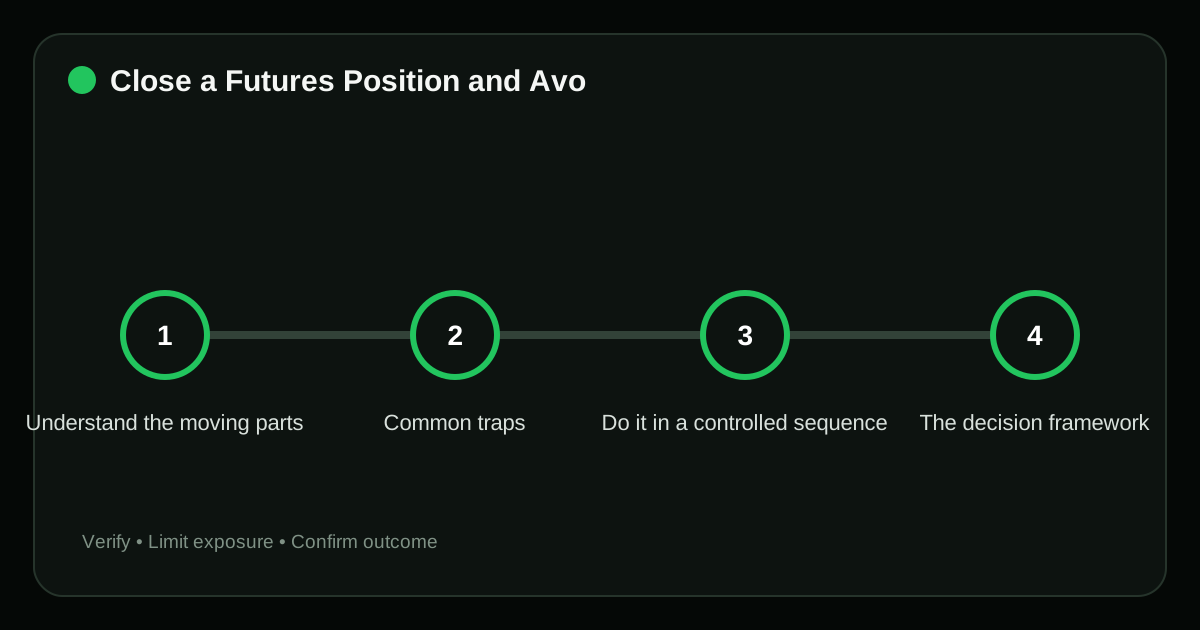
Close a futures position with a reduce-only order sized no larger than the open quantity. To avoid liquidation, use modest effective leverage, maintain a stop well before the liquidation threshold and monitor margin, funding and mark price.
Understand the moving parts#
A normal opposite-side order can accidentally reverse the position if it exceeds the open quantity. Reduce-only prevents the order from increasing or flipping exposure.
Common traps#
- Waiting for liquidation as a stop. This increases loss faster than the planned account-risk limit and may remove the opportunity to exit normally.
- Closing based on last price when liquidation uses mark price. This increases loss faster than the planned account-risk limit and may remove the opportunity to exit normally.
- Leaving stale take-profit orders after manual exit. This changes the planned exposure or execution cost of close futures position avoid liquidation after the decision has already been made.
- Adding margin without reducing an invalid trade. The branding can be copied, so the request must be re-opened through an independently verified channel.
In close futures position avoid liquidation, these errors share one pattern: speed or familiarity replaces verification. Slow down at the point where authority, money or an irreversible signature changes hands.
Do it in a controlled sequence#
- Check current position size and side. Compare the live venue details with the written plan; do not rely on a chart label or a remembered setting.
- Choose market close for urgency or limit close for price control. The choice determines which asset, authority or risk model applies, so resolve any ambiguity before the next step.
- Enable reduce-only or use the platform’s close control. Keep the first exposure small enough that a wrong assumption can be corrected without a material loss.
- Cancel conflicting open exit orders. The choice determines which asset, authority or risk model applies, so resolve any ambiguity before the next step.
- Verify position quantity is zero and margin released. Compare the live venue details with the written plan; do not rely on a chart label or a remembered setting.
The decision framework#
When the thesis fails, exit based on the plan. Moving liquidation farther away does not make the original trade correct.
A final verification pass#
Do not judge the outcome of close futures position avoid liquidation only by whether the interface shows a success message. Use evidence that can still be checked after the page is closed.
| Checkpoint | Evidence | Stop condition |
|---|---|---|
| Check current position size and side | Order ID, fill price, quantity, fees and current open-position screen | Waiting for liquidation as a stop |
| Choose market close for urgency or limit close for price control | Account history entry and a journal note showing the planned value | Closing based on last price when liquidation uses mark price |
| Enable reduce-only or use the platform’s close control | Account history entry and a journal note showing the planned value | Leaving stale take-profit orders after manual exit |
Record actual fills, fees and remaining exposure for close futures position avoid liquidation. The order ticket is an estimate; account history is the durable record.
Frequently asked questions#
Why is my position still open?
A limit close may not have filled, or only part of the quantity was closed.
What is mark price?
A reference price designed to reduce manipulation; many venues use it for unrealized P&L and liquidation.
Does liquidation close at the displayed price?
Not necessarily. Fees, slippage and platform rules affect the final result.
Related guides#
Sources#
- Coinbase: Understanding Order Types
- CFTC: Customer Advisory on Virtual Currencies
- Kraken: Trading Order Types
Risk notice: Crypto trading can produce rapid losses. Examples are educational, not personalized financial advice; verify venue rules, fees and legal or tax obligations before acting.
Editorial standard
This guide is educational and source-led. Security controls, exchange rules and legal requirements can change; verify critical steps through the relevant official service before acting.