Read the scope, commit hash, deployment address, severity definitions, unresolved findings and testing limitations before looking at the badge. An audit is useful only when it covers the code and configuration you may actually use.
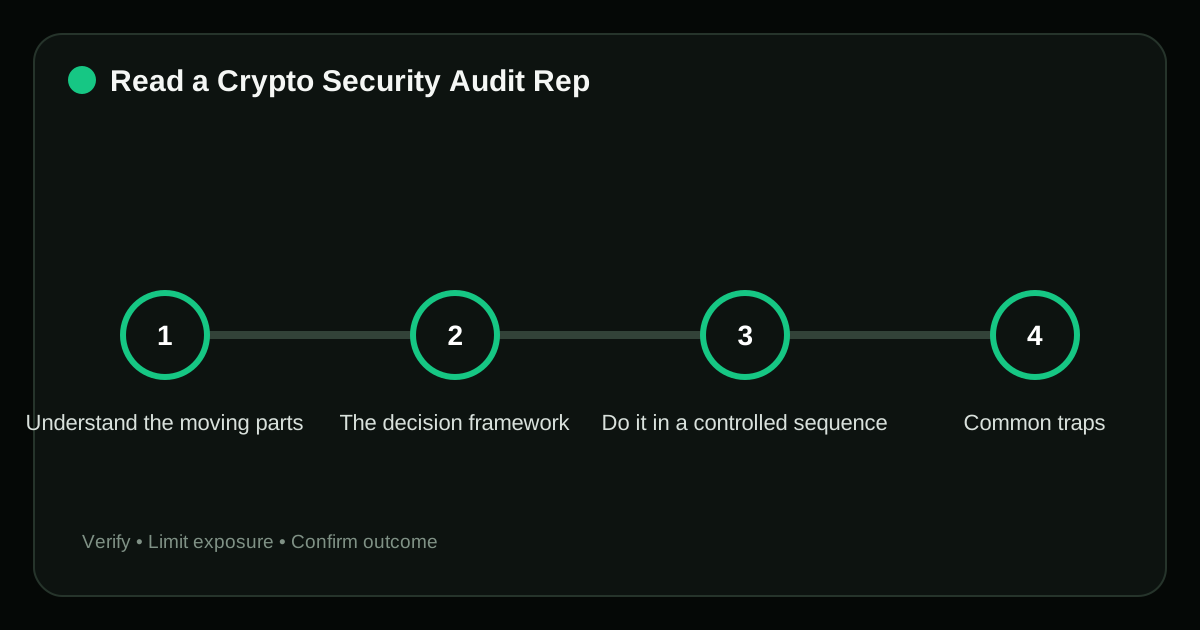
Understand the moving parts#
Reports are point-in-time reviews. They may exclude the front end, oracles, bridges, admin operations and economic assumptions that dominate real risk.
The decision framework#
Create a one-page risk map: code defects, privileged roles, external dependencies, upgradeability and incident response. The report informs that map but does not replace it.
Do it in a controlled sequence#
- Match repository commit and contract addresses. For read crypto security audit report, complete this before value or signing authority changes hands and verify the resulting state afterward.
- Check what components and chains were excluded. Compare the exact domain, address, network or permission with an independent official source before continuing.
- Read each critical and high finding plus remediation status. Compare the exact domain, address, network or permission with an independent official source before continuing.
- Confirm fixes were retested, not merely acknowledged. Compare the exact domain, address, network or permission with an independent official source before continuing.
- Review centralization, upgrade and key-management notes. Compare the exact domain, address, network or permission with an independent official source before continuing.
Common traps#
- Counting audits instead of reading scope. The branding can be copied, so the request must be re-opened through an independently verified channel.
- Treating “resolved” as proof the deployed fix matches. This removes a required input from the read crypto security audit report decision and makes the apparent result unreliable.
- Ignoring informational findings that reveal admin power. The branding can be copied, so the request must be re-opened through an independently verified channel.
- Assuming no findings means no vulnerabilities. This removes a required input from the read crypto security audit report decision and makes the apparent result unreliable.
For read crypto security audit report, a clean result is not merely a completed transaction or setting. It is a result you can independently verify, reproduce and recover from if the surrounding service fails.
Confirm the result#
Do not judge the outcome of read crypto security audit report only by whether the interface shows a success message. Use evidence that can still be checked after the page is closed.
| Checkpoint | Evidence | Stop condition |
|---|---|---|
| Match repository commit and contract addresses | Exact URL or contract address matched to official documentation | Counting audits instead of reading scope |
| Check what components and chains were excluded | Dated screenshot or onchain record with sensitive data removed | Treating “resolved” as proof the deployed fix matches |
| Read each critical and high finding plus remediation status | Dated screenshot or onchain record with sensitive data removed | Ignoring informational findings that reveal admin power |
Keep transaction hashes, official case numbers or dated screenshots when they help document read crypto security audit report, but exclude seed phrases, private keys and authentication codes.
Frequently asked questions#
What does “acknowledged” mean?
Usually the team accepts the risk without changing it. Read the auditor’s exact status definition.
Are bug bounties better than audits?
They are complementary: audits are scoped reviews, while bounties invite ongoing external testing.
How old is too old for an audit?
Age matters less than whether code, configuration or dependencies changed after the reviewed commit.
Related guides#
Sources#
Risk notice: Crypto actions can be irreversible. Never share a seed phrase, private key, password or authentication code, and verify every domain and wallet prompt independently.
Editorial standard
This guide is educational and source-led. Security controls, exchange rules and legal requirements can change; verify critical steps through the relevant official service before acting.