Liquidation price depends on entry, side, leverage, maintenance margin, collateral, fees, funding and margin mode. Use the exchange’s current formula and calculator; simple entry ± entry/leverage estimates are only rough intuition and can be dangerously wrong.
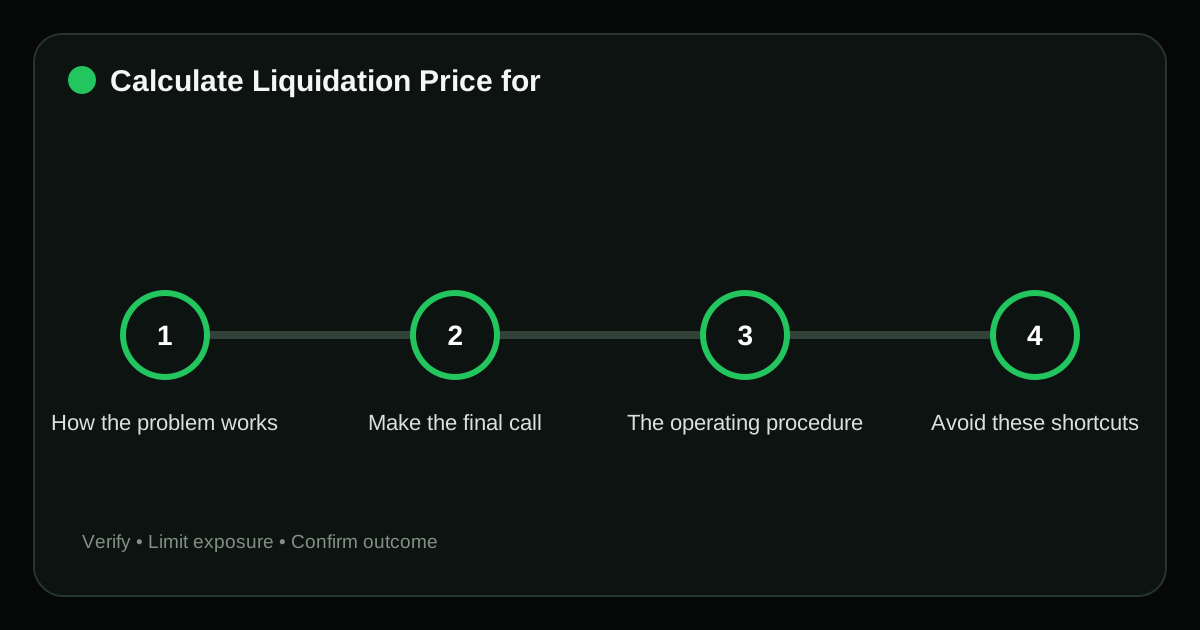
How the problem works#
Cross margin shares collateral across positions, while isolated margin limits the pool. Risk tiers may raise maintenance requirements as position size grows.
Make the final call#
Risk should be defined at a planned stop far from liquidation. If the trade relies on the liquidation estimate being exact, the position is too fragile.
The operating procedure#
- Identify contract type and settlement currency. Use actual position size, venue rules and costs; a rounded mental estimate is not enough for an irreversible order.
- Record entry, quantity and margin mode. Keep the original timestamp, identifier and unedited record so another person can reproduce the conclusion.
- Find the maintenance-margin tier. The choice determines which asset, authority or risk model applies, so resolve any ambiguity before the next step.
- Include fees and current funding treatment. Calculate the total cost under a conservative execution assumption and record the value used.
- Compare your manual estimate with the venue calculator. Use actual position size, venue rules and costs; a rounded mental estimate is not enough for an irreversible order.
Avoid these shortcuts#
- Using the bankruptcy price as liquidation price. This increases loss faster than the planned account-risk limit and may remove the opportunity to exit normally.
- Ignoring other cross-margin positions. This increases loss faster than the planned account-risk limit and may remove the opportunity to exit normally.
- Assuming leverage alone determines liquidation. This increases loss faster than the planned account-risk limit and may remove the opportunity to exit normally.
- Treating calculator output as fixed after funding changes. This removes a required input from the calculate crypto liquidation price decision and makes the apparent result unreliable.
For calculate crypto liquidation price, a clean result is not merely a completed transaction or setting. It is a result you can independently verify, reproduce and recover from if the surrounding service fails.
Confirm the result#
Do not judge the outcome of calculate crypto liquidation price only by whether the interface shows a success message. Use evidence that can still be checked after the page is closed.
| Checkpoint | Evidence | Stop condition |
|---|---|---|
| Identify contract type and settlement currency | Exact URL or contract address matched to official documentation | Using the bankruptcy price as liquidation price |
| Record entry, quantity and margin mode | Order ID, fill price, quantity, fees and current open-position screen | Ignoring other cross-margin positions |
| Find the maintenance-margin tier | Account history entry and a journal note showing the planned value | Assuming leverage alone determines liquidation |
Record actual fills, fees and remaining exposure for calculate crypto liquidation price. The order ticket is an estimate; account history is the durable record.
Frequently asked questions#
Why did liquidation price change?
Added margin, funding, fees, tier changes or other cross positions can move it.
Can a stop always prevent liquidation?
No. Gaps, outages and slippage can bypass a stop.
What is maintenance margin?
The minimum equity required to keep the position open under venue rules.
Related guides#
Sources#
- Coinbase: Understanding Order Types
- CFTC: Customer Advisory on Virtual Currencies
- Kraken: Trading Order Types
Risk notice: Crypto trading can produce rapid losses. Examples are educational, not personalized financial advice; verify venue rules, fees and legal or tax obligations before acting.
Editorial standard
This guide is educational and source-led. Security controls, exchange rules and legal requirements can change; verify critical steps through the relevant official service before acting.