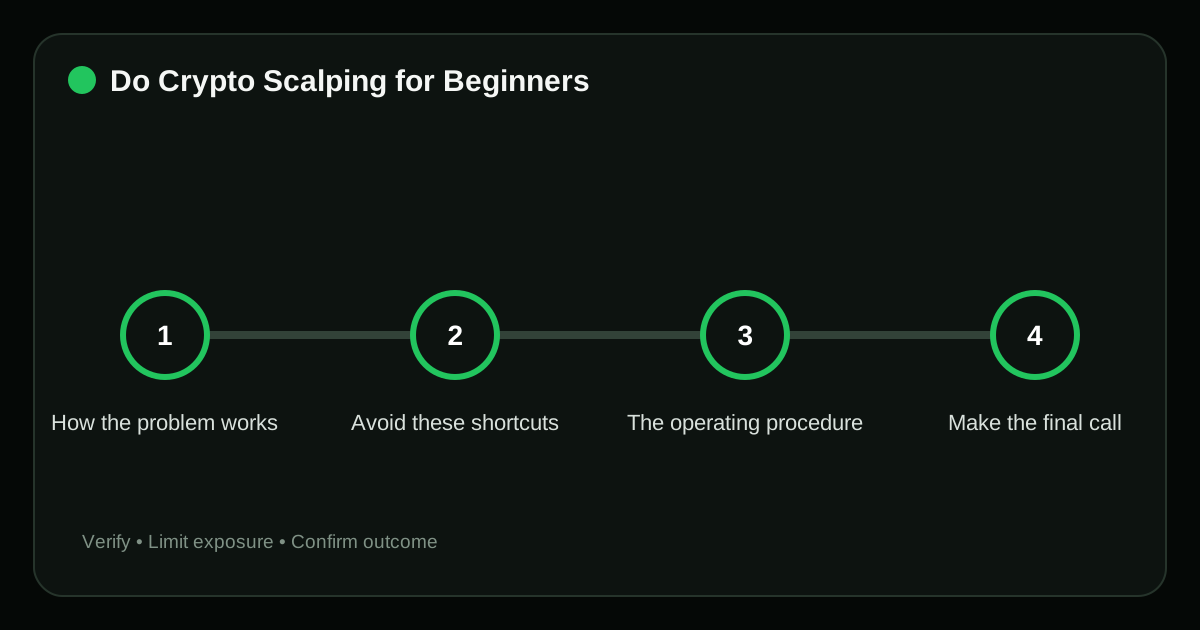
Beginners should practice scalping in a simulator before risking money. Trade only highly liquid pairs, use limit orders deliberately, cap daily loss and include fees and slippage in every setup; tiny gross targets can become negative after costs.
How the problem works#
Scalping compresses decision time and magnifies execution quality. Latency, spread, queue position and impulsive behavior often matter more than a chart pattern.
Avoid these shortcuts#
- Using high leverage to compensate for small targets. This increases loss faster than the planned account-risk limit and may remove the opportunity to exit normally.
- Trading during illiquid hours. The branding can be copied, so the request must be re-opened through an independently verified channel.
- Revenge trading after a missed fill. The branding can be copied, so the request must be re-opened through an independently verified channel.
- Evaluating results before costs. Execution cost can consume the expected edge even when the directional idea is right.
In crypto scalping beginners, these errors share one pattern: speed or familiarity replaces verification. Slow down at the point where authority, money or an irreversible signature changes hands.
The operating procedure#
- Choose one liquid venue and pair. The choice determines which asset, authority or risk model applies, so resolve any ambiguity before the next step.
- Define session hours and maximum trades. Use actual position size, venue rules and costs; a rounded mental estimate is not enough for an irreversible order.
- Use a fixed setup and hard risk limit. Use actual position size, venue rules and costs; a rounded mental estimate is not enough for an irreversible order.
- Track maker/taker fees and slippage. Calculate the total cost under a conservative execution assumption and record the value used.
- Stop after the daily loss or error threshold. For crypto scalping beginners, complete this before value or signing authority changes hands and verify the resulting state afterward.
Make the final call#
If the expected move is not comfortably larger than round-trip cost and normal slippage, there is no tradeable edge.
A final verification pass#
Do not judge the outcome of crypto scalping beginners only by whether the interface shows a success message. Use evidence that can still be checked after the page is closed.
| Checkpoint | Evidence | Stop condition |
|---|---|---|
| Choose one liquid venue and pair | Account history entry and a journal note showing the planned value | Using high leverage to compensate for small targets |
| Define session hours and maximum trades | Order ID, fill price, quantity, fees and current open-position screen | Trading during illiquid hours |
| Use a fixed setup and hard risk limit | Account history entry and a journal note showing the planned value | Revenge trading after a missed fill |
Record actual fills, fees and remaining exposure for crypto scalping beginners. The order ticket is an estimate; account history is the durable record.
Frequently asked questions#
Is scalping easier than swing trading?
No. It is faster, cost-sensitive and operationally demanding.
Should beginners use bots?
Automation adds code and execution risk. First prove the rules manually or in simulation.
How many trades per day?
No target is required; quality and risk limits matter more than activity.
Related guides#
Sources#
- Coinbase: Understanding Order Types
- CFTC: Customer Advisory on Virtual Currencies
- Kraken: Trading Order Types
Risk notice: Crypto trading can produce rapid losses. Examples are educational, not personalized financial advice; verify venue rules, fees and legal or tax obligations before acting.
Editorial standard
This guide is educational and source-led. Security controls, exchange rules and legal requirements can change; verify critical steps through the relevant official service before acting.