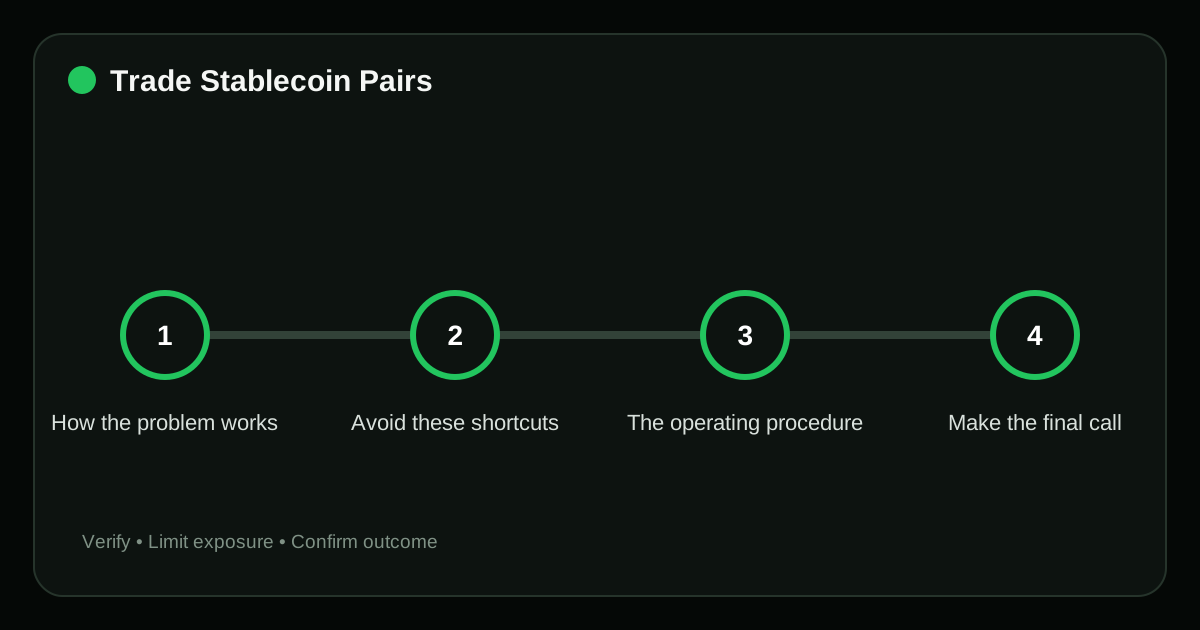
Stablecoin pairs trade relative issuer and redemption risk, not a guaranteed one-dollar equivalence. Check depth, spread, issuer reserves and redemption access; use limit orders when liquidity is thin and understand which stablecoin you will hold after the trade.
How the problem works#
Small price differences may reflect real risk, withdrawal constraints or fragmented liquidity. Leverage and fees can overwhelm an apparent arbitrage.
Avoid these shortcuts#
- Treating all dollar tokens as interchangeable. A label can look correct while the underlying destination differs, and a confirmed onchain action may be irreversible.
- Chasing a depeg with leverage. This increases loss faster than the planned account-risk limit and may remove the opportunity to exit normally.
- Ignoring chain-specific versions. This removes a required input from the trade stablecoin pairs decision and makes the apparent result unreliable.
- Assuming exchange price equals redeemable value. This removes a required input from the trade stablecoin pairs decision and makes the apparent result unreliable.
In trade stablecoin pairs, these errors share one pattern: speed or familiarity replaces verification. Slow down at the point where authority, money or an irreversible signature changes hands.
The operating procedure#
- Identify both issuers and backing models. The choice determines which asset, authority or risk model applies, so resolve any ambiguity before the next step.
- Check order-book depth and withdrawal status. Compare the live venue details with the written plan; do not rely on a chart label or a remembered setting.
- Calculate net edge after fees. Use actual position size, venue rules and costs; a rounded mental estimate is not enough for an irreversible order.
- Set limit price and maximum size. Use actual position size, venue rules and costs; a rounded mental estimate is not enough for an irreversible order.
- Plan custody and redemption after execution. For trade stablecoin pairs, complete this before value or signing authority changes hands and verify the resulting state afterward.
Make the final call#
For cash management, prioritize redeemability and custody concentration over tiny yield or spread differences.
A final verification pass#
Do not judge the outcome of trade stablecoin pairs only by whether the interface shows a success message. Use evidence that can still be checked after the page is closed.
| Checkpoint | Evidence | Stop condition |
|---|---|---|
| Identify both issuers and backing models | Account history entry and a journal note showing the planned value | Treating all dollar tokens as interchangeable |
| Check order-book depth and withdrawal status | Transaction or withdrawal ID plus the matching explorer or account record | Chasing a depeg with leverage |
| Calculate net edge after fees | Account history entry and a journal note showing the planned value | Ignoring chain-specific versions |
Record actual fills, fees and remaining exposure for trade stablecoin pairs. The order ticket is an estimate; account history is the durable record.
Frequently asked questions#
Why do stablecoins trade below one dollar?
Market liquidity, issuer confidence and redemption frictions can move price.
Is stablecoin arbitrage risk-free?
No. Execution, issuer, venue, transfer and redemption risks remain.
Should I diversify stablecoins?
It may reduce single-issuer exposure but adds operational and contract risks.
Related guides#
Sources#
- Coinbase: Understanding Order Types
- CFTC: Customer Advisory on Virtual Currencies
- Kraken: Trading Order Types
Risk notice: Crypto trading can produce rapid losses. Examples are educational, not personalized financial advice; verify venue rules, fees and legal or tax obligations before acting.
Editorial standard
This guide is educational and source-led. Security controls, exchange rules and legal requirements can change; verify critical steps through the relevant official service before acting.