Open source allows independent inspection and reproducible-build verification, but visibility alone does not make a wallet secure. Closed source limits public review but may still have strong engineering. Judge the exact release, update process, audits, key architecture and incident response.
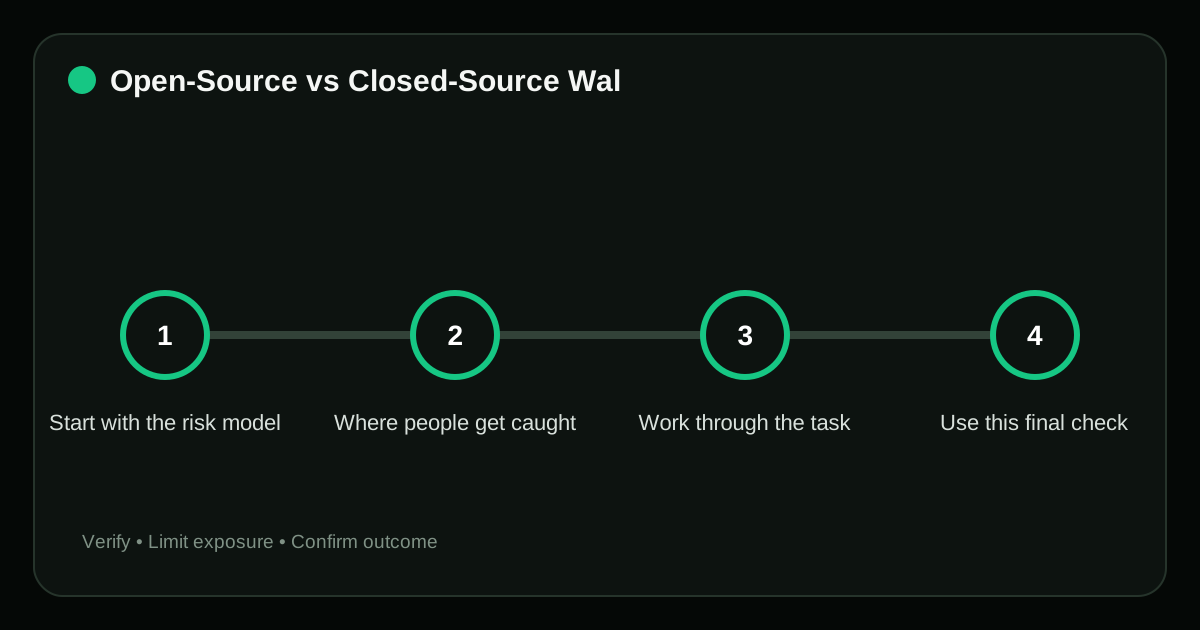
Start with the risk model#
The relevant question is whether reviewers can connect published code to the binary you install. A public repository that is outdated or cannot reproduce the shipped build offers less assurance than its label suggests.
Where people get caught#
- Treating GitHub stars as a security audit. This removes a required input from the open source vs closed source wallet decision and makes the apparent result unreliable.
- Assuming closed source means malicious. This removes a required input from the open source vs closed source wallet decision and makes the apparent result unreliable.
- Installing community builds without verifying signatures. This weakens a control that should limit the blast radius of open source vs closed source wallet.
- Ignoring dependencies and firmware because the app is open source. This removes a required input from the open source vs closed source wallet decision and makes the apparent result unreliable.
In open source vs closed source wallet, these errors share one pattern: speed or familiarity replaces verification. Slow down at the point where authority, money or an irreversible signature changes hands.
Work through the task#
- Check whether source code and releases are current. Compare the exact domain, address, network or permission with an independent official source before continuing.
- Look for reproducible build instructions and signatures. For open source vs closed source wallet, complete this before value or signing authority changes hands and verify the resulting state afterward.
- Review independent audits and how findings were fixed. Compare the exact domain, address, network or permission with an independent official source before continuing.
- Understand key storage, telemetry and backup behavior. For open source vs closed source wallet, complete this before value or signing authority changes hands and verify the resulting state afterward.
- Evaluate update authenticity and vulnerability response. For open source vs closed source wallet, complete this before value or signing authority changes hands and verify the resulting state afterward.
Use this final check#
Prefer evidence you can verify: active maintenance, transparent fixes, signed releases and a design that minimizes secret exposure. Source model is one input, not the final verdict.
A final verification pass#
Do not judge the outcome of open source vs closed source wallet only by whether the interface shows a success message. Use evidence that can still be checked after the page is closed.
| Checkpoint | Evidence | Stop condition |
|---|---|---|
| Check whether source code and releases are current | Dated screenshot or onchain record with sensitive data removed | Treating GitHub stars as a security audit |
| Look for reproducible build instructions and signatures | Dated screenshot or onchain record with sensitive data removed | Assuming closed source means malicious |
| Review independent audits and how findings were fixed | Dated screenshot or onchain record with sensitive data removed | Installing community builds without verifying signatures |
Keep transaction hashes, official case numbers or dated screenshots when they help document open source vs closed source wallet, but exclude seed phrases, private keys and authentication codes.
Frequently asked questions#
Can attackers find bugs more easily in open source?
They can inspect it, but defenders can too. Security should not depend on code secrecy alone.
What is a reproducible build?
It lets independent builders produce a binary matching the published release from the same source.
Should beginners compile their own wallet?
Usually not unless they can verify the toolchain. Official signed releases may be safer than an unreviewed local build.
Related guides#
Sources#
- Ethereum.org: Security and Scam Prevention
- MetaMask: Wallet Security
- CISA: Avoiding Social Engineering and Phishing Attacks
Risk notice: Crypto actions can be irreversible. Never share a seed phrase, private key, password or authentication code, and verify every domain and wallet prompt independently.
Editorial standard
This guide is educational and source-led. Security controls, exchange rules and legal requirements can change; verify critical steps through the relevant official service before acting.