To review wallet authorization history, inspect token allowances, NFT operator approvals, signed permissions and recent contract interactions on every chain you use. A transaction list alone is incomplete because an old approval can remain active without moving funds.
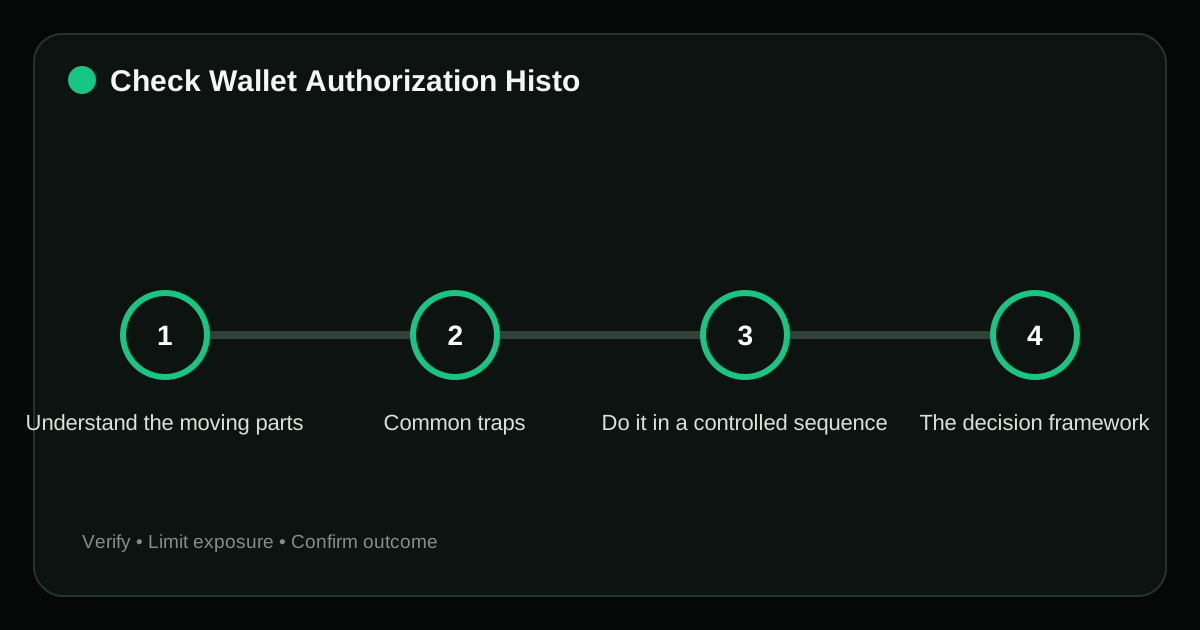
Understand the moving parts#
Wallet “connections” stored in a browser are not the same as onchain authority. Disconnecting a site removes its local session, while allowances and operator approvals remain in smart-contract state until changed.
Common traps#
- Checking only Ethereum mainnet. This weakens a control that should limit the blast radius of check wallet authorization history.
- Assuming zero token balance makes an approval irrelevant forever. A label can look correct while the underlying destination differs, and a confirmed onchain action may be irreversible.
- Signing a batch revoke without reading each action. The branding can be copied, so the request must be re-opened through an independently verified channel.
- Using an approval checker reached through a sponsored link. The branding can be copied, so the request must be re-opened through an independently verified channel.
In check wallet authorization history, these errors share one pattern: speed or familiarity replaces verification. Slow down at the point where authority, money or an irreversible signature changes hands.
Do it in a controlled sequence#
- List every network where the address holds or previously held assets. Write the boundary down first so urgency cannot quietly expand what the wallet or account is allowed to expose.
- Open a verified explorer approval checker for that network. Compare the exact domain, address, network or permission with an independent official source before continuing.
- Review token spenders, allowance size and NFT operators. Compare the exact domain, address, network or permission with an independent official source before continuing.
- Match unknown contracts to historical transactions and verified labels. For check wallet authorization history, complete this before value or signing authority changes hands and verify the resulting state afterward.
- Revoke stale permissions and confirm each revocation onchain. Compare the exact domain, address, network or permission with an independent official source before continuing.
The decision framework#
Prioritize unknown spenders, unlimited amounts, upgradeable contracts and permissions covering valuable collections. Keep a dated review log so future changes are visible.
A final verification pass#
Do not judge the outcome of check wallet authorization history only by whether the interface shows a success message. Use evidence that can still be checked after the page is closed.
| Checkpoint | Evidence | Stop condition |
|---|---|---|
| List every network where the address holds or previously held assets | Dated screenshot or onchain record with sensitive data removed | Checking only Ethereum mainnet |
| Open a verified explorer approval checker for that network | Exact URL or contract address matched to official documentation | Assuming zero token balance makes an approval irrelevant forever |
| Review token spenders, allowance size and NFT operators | Exact URL or contract address matched to official documentation | Signing a batch revoke without reading each action |
Keep transaction hashes, official case numbers or dated screenshots when they help document check wallet authorization history, but exclude seed phrases, private keys and authentication codes.
Frequently asked questions#
Can I see every offchain signature?
No. Not all signed messages are published. Some applications provide cancellation tools, but history may be incomplete.
Does revoking require gas?
Yes, changing an onchain allowance or operator setting normally requires a network transaction.
Will revoking break a dapp?
It may require a new approval the next time you use the application, which is often an acceptable security tradeoff.
Related guides#
Sources#
Risk notice: Crypto actions can be irreversible. Never share a seed phrase, private key, password or authentication code, and verify every domain and wallet prompt independently.
Editorial standard
This guide is educational and source-led. Security controls, exchange rules and legal requirements can change; verify critical steps through the relevant official service before acting.