Verify a wallet app by starting at the developer’s known official domain, following its store link, checking the publisher and signing information, and comparing the app identifier—not merely the icon or name. Never install a wallet from an ad, direct message or downloadable file sent by support.
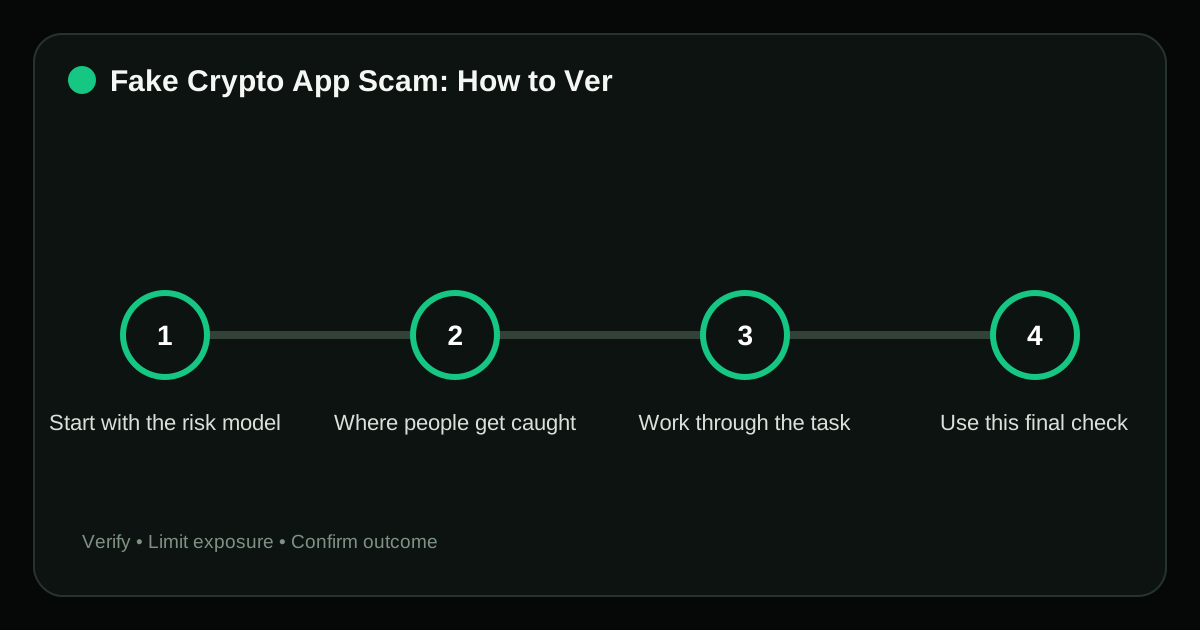
Start with the risk model#
Fake apps can mimic screenshots and reviews while sending a newly entered recovery phrase to an attacker. Some fraudulent trading apps show fictional balances and permit a small withdrawal before demanding more deposits.
Where people get caught#
- Trusting the top sponsored result. This removes a required input from the fake crypto app scam decision and makes the apparent result unreliable.
- Using review count as proof of authenticity. This weakens a control that should limit the blast radius of fake crypto app scam.
- Granting accessibility, screen-reading or device-admin permission without need. The branding can be copied, so the request must be re-opened through an independently verified channel.
- Entering an existing high-value seed phrase into a new installation. This can expose the root credential; a later password change may not remove the attacker’s access.
In fake crypto app scam, these errors share one pattern: speed or familiarity replaces verification. Slow down at the point where authority, money or an irreversible signature changes hands.
Work through the task#
- Type or use a bookmark for the official project domain. Complete this through the verified product interface, then test the control instead of assuming it is active.
- Follow the official App Store, Play Store or repository link. For fake crypto app scam, complete this before value or signing authority changes hands and verify the resulting state afterward.
- Check publisher name, package ID, release history and requested permissions. Compare the exact domain, address, network or permission with an independent official source before continuing.
- Create or import only after verifying the installed build. Compare the exact domain, address, network or permission with an independent official source before continuing.
- Send a small test amount and confirm withdrawal before increasing exposure. Compare the exact domain, address, network or permission with an independent official source before continuing.
Use this final check#
If any identifier differs from the official documentation, stop. For a high-value wallet, initialize a hardware wallet instead of importing its phrase into a phone app.
A final verification pass#
Do not judge the outcome of fake crypto app scam only by whether the interface shows a success message. Use evidence that can still be checked after the page is closed.
| Checkpoint | Evidence | Stop condition |
|---|---|---|
| Type or use a bookmark for the official project domain | Exact URL or contract address matched to official documentation | Trusting the top sponsored result |
| Follow the official App Store, Play Store or repository link | Exact URL or contract address matched to official documentation | Using review count as proof of authenticity |
| Check publisher name, package ID, release history and requested permissions | Dated screenshot or onchain record with sensitive data removed | Granting accessibility, screen-reading or device-admin permission without need |
Keep transaction hashes, official case numbers or dated screenshots when they help document fake crypto app scam, but exclude seed phrases, private keys and authentication codes.
Frequently asked questions#
Can app-store approval prove a wallet is genuine?
No. Store review reduces some risk but does not replace checking the official developer link and package identity.
What if I already entered my seed phrase?
Assume it is compromised. Create a new wallet on a trusted device and move remaining assets promptly.
Is an APK safe if antivirus finds nothing?
Not necessarily. Malware detection is imperfect, and an authentic wallet should be obtained through its documented distribution channel.
Related guides#
Sources#
- FTC: What to Know About Cryptocurrency and Scams
- FBI IC3: Cryptocurrency Investment Fraud
- Ethereum.org: Scam Prevention
Risk notice: Crypto actions can be irreversible. Never share a seed phrase, private key, password or authentication code, and verify every domain and wallet prompt independently.
Editorial standard
This guide is educational and source-led. Security controls, exchange rules and legal requirements can change; verify critical steps through the relevant official service before acting.