Use a demo account to practice order entry, stops, position sizing and journaling under live-like prices. Set a realistic virtual balance and fees, follow one written strategy and review execution—not the size of fictional profits.
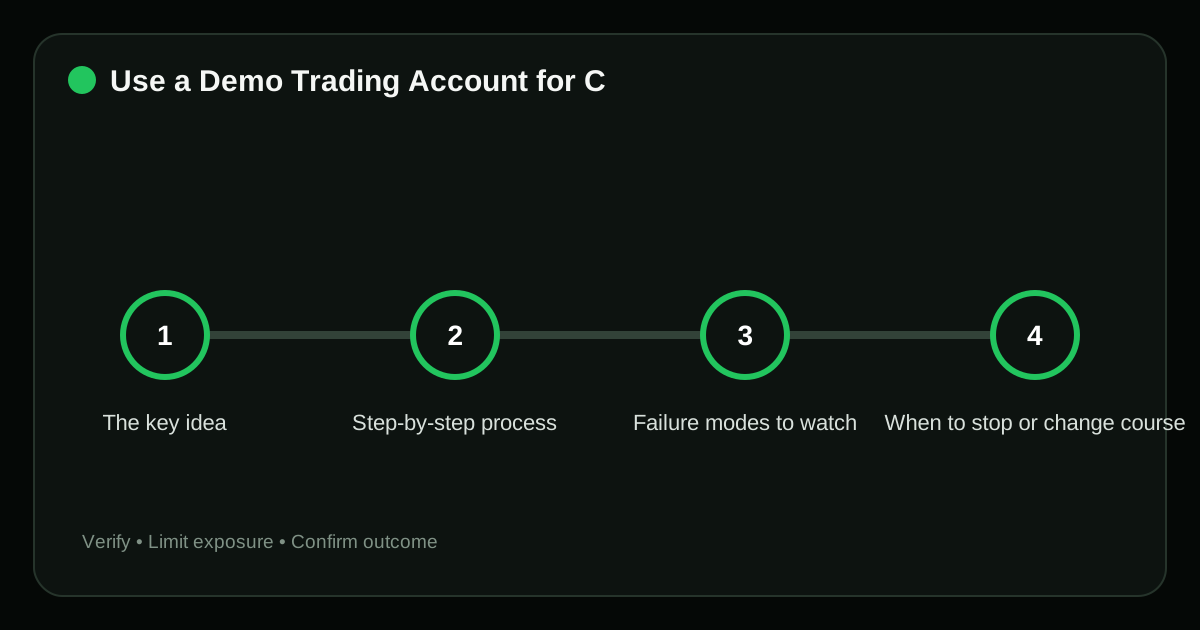
The key idea#
Demo trading removes emotional and liquidity consequences. It is valuable for mechanics but can overstate fills and understate stress.
For crypto demo trading account, the visible interface shows only part of the system. Confirm the identity, asset, network and authority involved before treating a familiar label as proof.
Step-by-step process#
- Match virtual capital to planned real capital. For crypto demo trading account, complete this before value or signing authority changes hands and verify the resulting state afterward.
- Enable realistic fees and slippage if available. Calculate the total cost under a conservative execution assumption and record the value used.
- Practice market, limit, stop and reduce-only orders. Keep the first exposure small enough that a wrong assumption can be corrected without a material loss.
- Keep the same journal used for live trading. Complete this through the verified product interface, then test the control instead of assuming it is active.
- Set a transition rule based on process consistency. Use actual position size, venue rules and costs; a rounded mental estimate is not enough for an irreversible order.
Failure modes to watch#
- Using enormous virtual size. This increases loss faster than the planned account-risk limit and may remove the opportunity to exit normally.
- Resetting after every loss. This changes the planned exposure or execution cost of crypto demo trading account after the decision has already been made.
- Changing strategy daily. This changes the planned exposure or execution cost of crypto demo trading account after the decision has already been made.
- Assuming demo fills equal live fills. This removes a required input from the crypto demo trading account decision and makes the apparent result unreliable.
When to stop or change course#
Move to a very small live account only after consistent rule adherence. Expect behavior to change when money becomes real.
Proof that the task is complete#
Do not judge the outcome of crypto demo trading account only by whether the interface shows a success message. Use evidence that can still be checked after the page is closed.
| Checkpoint | Evidence | Stop condition |
|---|---|---|
| Match virtual capital to planned real capital | Account history entry and a journal note showing the planned value | Using enormous virtual size |
| Enable realistic fees and slippage if available | Account history entry and a journal note showing the planned value | Resetting after every loss |
| Practice market, limit, stop and reduce-only orders | Order ID, fill price, quantity, fees and current open-position screen | Changing strategy daily |
Record actual fills, fees and remaining exposure for crypto demo trading account. The order ticket is an estimate; account history is the durable record.
Frequently asked questions#
How long should I demo trade?
Until order mechanics and risk rules are consistent across varied conditions, not for a fixed number of days.
Can demo results prove profitability?
No. Execution, emotion and market impact differ live.
Should I use leverage in demo mode?
Only to learn mechanics after understanding liquidation; do not let virtual survivorship normalize excessive risk.
Related guides#
Sources#
- Coinbase: Understanding Order Types
- CFTC: Customer Advisory on Virtual Currencies
- Kraken: Trading Order Types
Risk notice: Crypto trading can produce rapid losses. Examples are educational, not personalized financial advice; verify venue rules, fees and legal or tax obligations before acting.
Editorial standard
This guide is educational and source-led. Security controls, exchange rules and legal requirements can change; verify critical steps through the relevant official service before acting.