A sandbox wallet is a low-value wallet created to isolate experimental dapps, testnets, mints or unknown contracts from your primary holdings. Its value comes from a separate seed or security boundary—not merely another address that shares the vault’s recovery phrase.
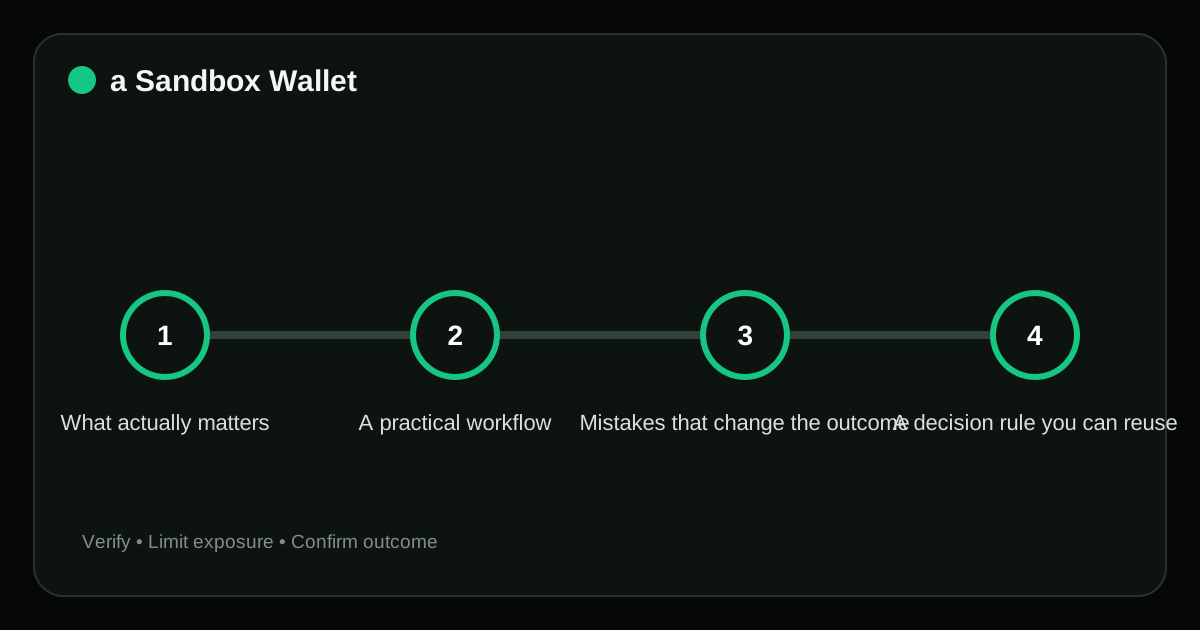
What actually matters#
Sandboxing limits consequences when a site requests excessive permissions or a contract behaves unexpectedly. It does not make malicious signatures safe or protect the device from malware.
For sandbox wallet crypto, the visible interface shows only part of the system. Confirm the identity, asset, network and authority involved before treating a familiar label as proof.
A practical workflow#
- Create it with a separate seed on a trusted wallet. Complete this through the verified product interface, then test the control instead of assuming it is active.
- Fund only the amount needed for the experiment. Keep the first exposure small enough that a wrong assumption can be corrected without a material loss.
- Keep no valuable NFTs or long-lived approvals in it. Complete this through the verified product interface, then test the control instead of assuming it is active.
- Label it clearly to avoid signing from the wrong account. For sandbox wallet crypto, complete this before value or signing authority changes hands and verify the resulting state afterward.
- Retire or reset it after high-risk use. Write the boundary down first so urgency cannot quietly expand what the wallet or account is allowed to expose.
Mistakes that change the outcome#
- Using the vault seed in a new browser profile. This can expose the root credential; a later password change may not remove the attacker’s access.
- Sending the entire working balance to save fees. This increases loss faster than the planned account-risk limit and may remove the opportunity to exit normally.
- Assuming testnet tokens and links are harmless. The branding can be copied, so the request must be re-opened through an independently verified channel.
- Reusing the sandbox address as a public identity. The branding can be copied, so the request must be re-opened through an independently verified channel.
A decision rule you can reuse#
Use a sandbox when uncertainty is high and the required value is low. If the protocol needs access to your main assets, sandboxing cannot remove that core exposure.
Proof that the task is complete#
Do not judge the outcome of sandbox wallet crypto only by whether the interface shows a success message. Use evidence that can still be checked after the page is closed.
| Checkpoint | Evidence | Stop condition |
|---|---|---|
| Create it with a separate seed on a trusted wallet | Dated control check, recovery test or authenticated settings record with secrets removed | Using the vault seed in a new browser profile |
| Fund only the amount needed for the experiment | Dated screenshot or onchain record with sensitive data removed | Sending the entire working balance to save fees |
| Keep no valuable NFTs or long-lived approvals in it | Exact URL or contract address matched to official documentation | Assuming testnet tokens and links are harmless |
Keep transaction hashes, official case numbers or dated screenshots when they help document sandbox wallet crypto, but exclude seed phrases, private keys and authentication codes.
Frequently asked questions#
Is a burner wallet the same thing?
The terms overlap. A burner is often short-lived; a sandbox may be reused for controlled experiments.
Can I create it as Account 2 in MetaMask?
That may isolate approvals by address, but a compromised shared seed exposes both accounts.
Should I use a hardware wallet for the sandbox?
It can protect keys, but frequent experimental signing can create confusion. Keep the balance and permissions limited either way.
Related guides#
Sources#
- Ethereum.org: Security and Scam Prevention
- MetaMask: Wallet Security
- CISA: Avoiding Social Engineering and Phishing Attacks
Risk notice: Crypto actions can be irreversible. Never share a seed phrase, private key, password or authentication code, and verify every domain and wallet prompt independently.
Editorial standard
This guide is educational and source-led. Security controls, exchange rules and legal requirements can change; verify critical steps through the relevant official service before acting.