Use the authenticated exchange’s orders, fills, transactions and account-statement sections. Export the full date range in CSV or API format, then reconcile fills with deposits, withdrawals, fees and balance changes.
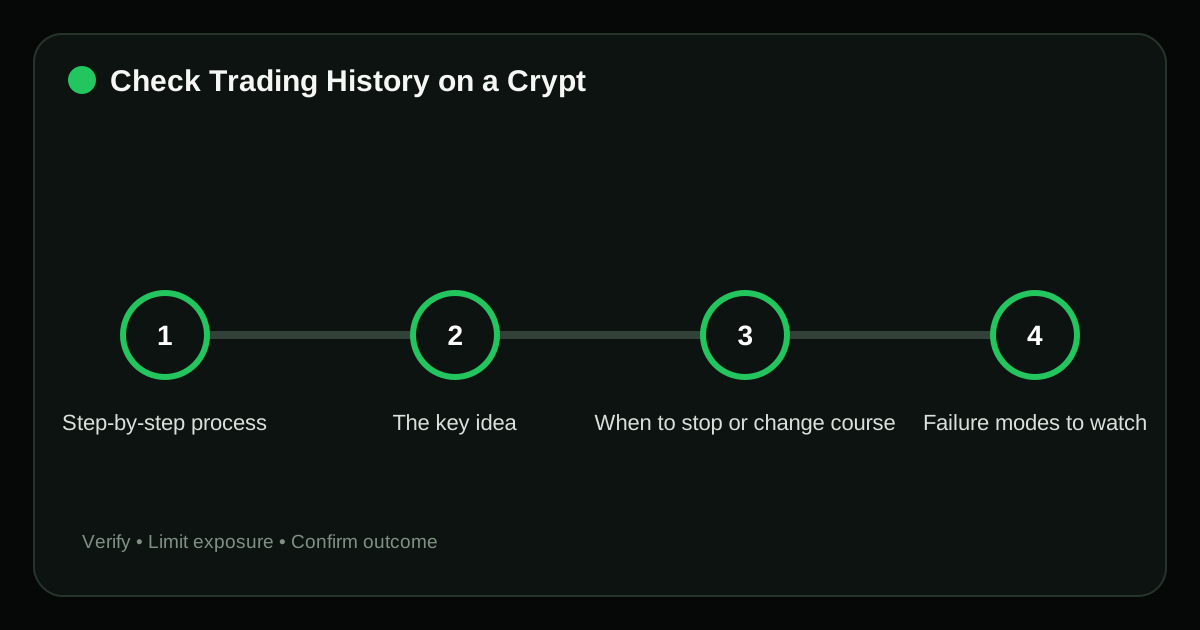
Step-by-step process#
- Set timezone and full date range. Use actual position size, venue rules and costs; a rounded mental estimate is not enough for an irreversible order.
- Export orders and fills separately. Keep the original timestamp, identifier and unedited record so another person can reproduce the conclusion.
- Include fee currency and rebates. Calculate the total cost under a conservative execution assumption and record the value used.
- Reconcile with account ledger. For check crypto trading history, complete this before value or signing authority changes hands and verify the resulting state afterward.
- Store signed or timestamped copies securely. For check crypto trading history, complete this before value or signing authority changes hands and verify the resulting state afterward.
The key idea#
Order history and trade history differ: one order can create multiple fills at different prices and fees. Tax and performance analysis usually need fills.
For check crypto trading history, separate what can be verified before acting from what can only be monitored afterward. Put hard limits around the second category.
When to stop or change course#
Build records before the exchange retention window expires. Keep raw exports unchanged and perform calculations on a copy.
Failure modes to watch#
- Using screenshots as the only record. This changes the planned exposure or execution cost of check crypto trading history after the decision has already been made.
- Ignoring subaccounts and converted dust. This removes a required input from the check crypto trading history decision and makes the apparent result unreliable.
- Mixing UTC with local time. This changes the planned exposure or execution cost of check crypto trading history after the decision has already been made.
- Sharing API keys with withdrawal permission. This changes the planned exposure or execution cost of check crypto trading history after the decision has already been made.
Evidence to keep#
Do not judge the outcome of check crypto trading history only by whether the interface shows a success message. Use evidence that can still be checked after the page is closed.
| Checkpoint | Evidence | Stop condition |
|---|---|---|
| Set timezone and full date range | Account history entry and a journal note showing the planned value | Using screenshots as the only record |
| Export orders and fills separately | Order ID, fill price, quantity, fees and current open-position screen | Ignoring subaccounts and converted dust |
| Include fee currency and rebates | Account history entry and a journal note showing the planned value | Mixing UTC with local time |
Record actual fills, fees and remaining exposure for check crypto trading history. The order ticket is an estimate; account history is the durable record.
Frequently asked questions#
Why does order count differ from trade count?
One order may fill against several counterparties and produce multiple trade records.
Can I use read-only API access?
Yes, if carefully permissioned and stored; never grant withdrawals to a reporting tool.
What if old history is missing?
Request an account statement from official support and reconcile bank and blockchain records.
Related guides#
Sources#
- Coinbase: Understanding Order Types
- CFTC: Customer Advisory on Virtual Currencies
- Kraken: Trading Order Types
Risk notice: Crypto trading can produce rapid losses. Examples are educational, not personalized financial advice; verify venue rules, fees and legal or tax obligations before acting.
Editorial standard
This guide is educational and source-led. Security controls, exchange rules and legal requirements can change; verify critical steps through the relevant official service before acting.