First classify the withdrawal: rejected internally, pending at the exchange, broadcast but unconfirmed, or confirmed to the wrong destination. Each requires different action. Preserve the withdrawal ID and transaction hash, then contact only official support.
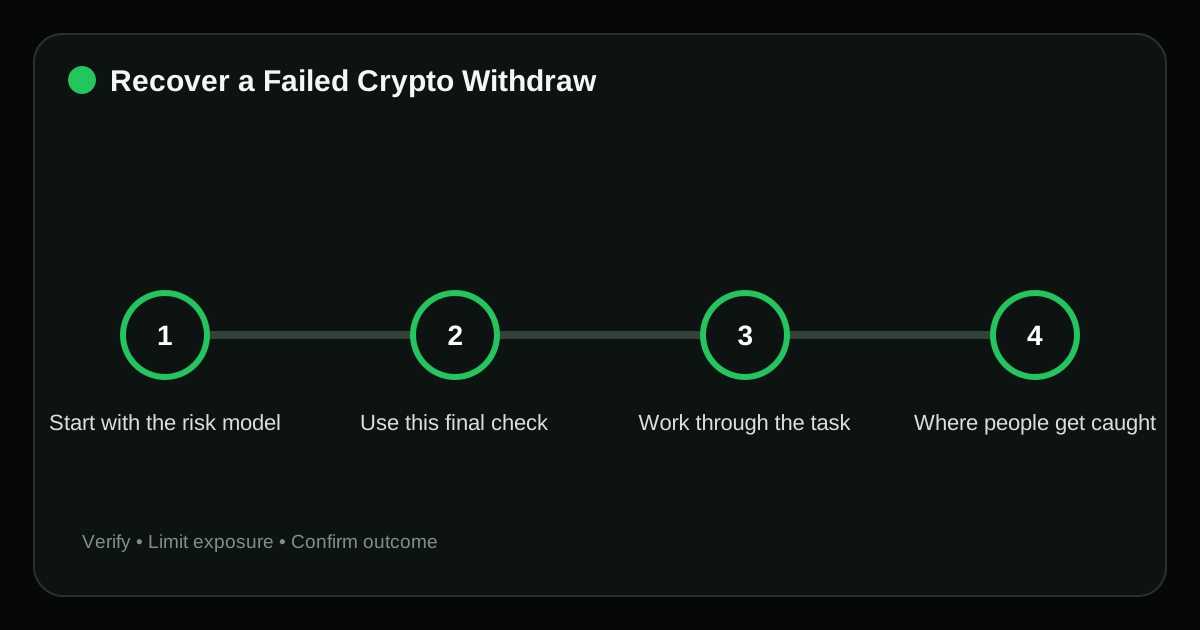
Start with the risk model#
A “failed” label may mean funds never left the exchange and should return automatically. A confirmed blockchain transfer cannot be canceled by exchange support.
Use this final check#
If the transaction is confirmed to your own wallet but invisible, add the correct network and token contract before considering recovery services.
Work through the task#
- Check exchange withdrawal status and reason. Compare the live venue details with the written plan; do not rely on a chart label or a remembered setting.
- Find transaction hash on the correct explorer. The choice determines which asset, authority or risk model applies, so resolve any ambiguity before the next step.
- Verify destination address, network and memo. Compare the live venue details with the written plan; do not rely on a chart label or a remembered setting.
- Open an official support ticket with evidence. The choice determines which asset, authority or risk model applies, so resolve any ambiguity before the next step.
- Do not retry until the first attempt is resolved. For failed crypto withdrawal recovery, complete this before value or signing authority changes hands and verify the resulting state afterward.
Where people get caught#
- Paying a private recovery agent. This changes the planned exposure or execution cost of failed crypto withdrawal recovery after the decision has already been made.
- Sending a second withdrawal to test a pending route. This changes the planned exposure or execution cost of failed crypto withdrawal recovery after the decision has already been made.
- Sharing password or seed with support. This can expose the root credential; a later password change may not remove the attacker’s access.
- Assuming no wallet display means no onchain funds. This removes a required input from the failed crypto withdrawal recovery decision and makes the apparent result unreliable.
For failed crypto withdrawal recovery, a clean result is not merely a completed transaction or setting. It is a result you can independently verify, reproduce and recover from if the surrounding service fails.
Confirm the result#
Do not judge the outcome of failed crypto withdrawal recovery only by whether the interface shows a success message. Use evidence that can still be checked after the page is closed.
| Checkpoint | Evidence | Stop condition |
|---|---|---|
| Check exchange withdrawal status and reason | Transaction or withdrawal ID plus the matching explorer or account record | Paying a private recovery agent |
| Find transaction hash on the correct explorer | Transaction or withdrawal ID plus the matching explorer or account record | Sending a second withdrawal to test a pending route |
| Verify destination address, network and memo | Account history entry and a journal note showing the planned value | Sharing password or seed with support |
Record actual fills, fees and remaining exposure for failed crypto withdrawal recovery. The order ticket is an estimate; account history is the durable record.
Frequently asked questions#
Can an exchange replace a stuck transaction?
Some can rebroadcast or adjust fees before confirmation; the user usually cannot control a custodial withdrawal transaction.
What if I used the wrong network?
Recovery depends on whether the destination controls compatible keys and supports manual recovery.
How long should I wait?
Use the exchange’s stated processing time and network conditions, then open a ticket with identifiers.
Related guides#
Sources#
- Uniswap Support: Swaps and Troubleshooting
- Ethereum.org: Gas and Fees
- MetaMask: Transactions and Gas
Risk notice: Crypto trading can produce rapid losses. Examples are educational, not personalized financial advice; verify venue rules, fees and legal or tax obligations before acting.
Editorial standard
This guide is educational and source-led. Security controls, exchange rules and legal requirements can change; verify critical steps through the relevant official service before acting.