Approve only the input amount needed for the swap when possible. After trading, open a trusted approval checker on the same chain, locate the router allowance and submit a revoke transaction, then verify the allowance is zero.
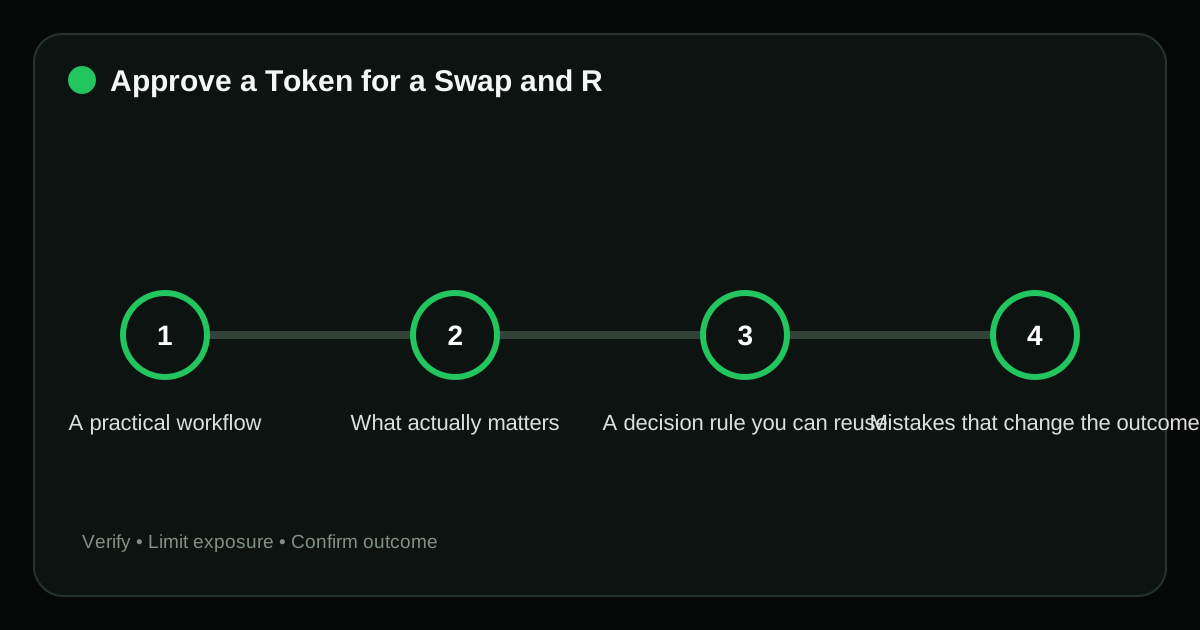
A practical workflow#
- Verify token and spender contract. Compare the live venue details with the written plan; do not rely on a chart label or a remembered setting.
- Choose exact amount or time-limited permit if available. The choice determines which asset, authority or risk model applies, so resolve any ambiguity before the next step.
- Confirm approval onchain before swapping. Compare the live venue details with the written plan; do not rely on a chart label or a remembered setting.
- Complete the swap and check output. Compare the live venue details with the written plan; do not rely on a chart label or a remembered setting.
- Revoke stale permission and verify confirmation. Compare the live venue details with the written plan; do not rely on a chart label or a remembered setting.
What actually matters#
Approval authorizes the router; the swap consumes tokens under that permission. An unlimited allowance may remain even after the wallet balance reaches zero.
For approve token revoke after swap, separate what can be verified before acting from what can only be monitored afterward. Put hard limits around the second category.
A decision rule you can reuse#
For trusted, frequently used routers, repeated approvals may cost more. Decide based on balance exposure and usage frequency, not convenience alone.
Mistakes that change the outcome#
- Approving a look-alike router. A label can look correct while the underlying destination differs, and a confirmed onchain action may be irreversible.
- Revoking on the wrong chain. This changes the planned exposure or execution cost of approve token revoke after swap after the decision has already been made.
- Disconnecting instead of revoking. The branding can be copied, so the request must be re-opened through an independently verified channel.
- Following a fake revoke link after an incident. The branding can be copied, so the request must be re-opened through an independently verified channel.
Evidence to keep#
Do not judge the outcome of approve token revoke after swap only by whether the interface shows a success message. Use evidence that can still be checked after the page is closed.
| Checkpoint | Evidence | Stop condition |
|---|---|---|
| Verify token and spender contract | Exact URL or contract address matched to official documentation | Approving a look-alike router |
| Choose exact amount or time-limited permit if available | Account history entry and a journal note showing the planned value | Revoking on the wrong chain |
| Confirm approval onchain before swapping | Transaction or withdrawal ID plus the matching explorer or account record | Disconnecting instead of revoking |
Record actual fills, fees and remaining exposure for approve token revoke after swap. The order ticket is an estimate; account history is the durable record.
Frequently asked questions#
Does revoking return spent tokens?
No. It only prevents future use of that allowance.
Why are approval and swap separate?
ERC-20 contracts require the owner to authorize a spender before it can transfer input tokens.
Can permit signatures be revoked?
Some can be invalidated through nonce or allowance controls; implementation differs.
Related guides#
Sources#
- Uniswap Support: Swaps and Troubleshooting
- Ethereum.org: Gas and Fees
- MetaMask: Transactions and Gas
Risk notice: Crypto trading can produce rapid losses. Examples are educational, not personalized financial advice; verify venue rules, fees and legal or tax obligations before acting.
Editorial standard
This guide is educational and source-led. Security controls, exchange rules and legal requirements can change; verify critical steps through the relevant official service before acting.