LP tokens represent a claim on assets deposited in a pool, not an ordinary directional coin. Before buying, depositing or transferring them, verify the pool, fee tier, position range, reward contract and withdrawal path.
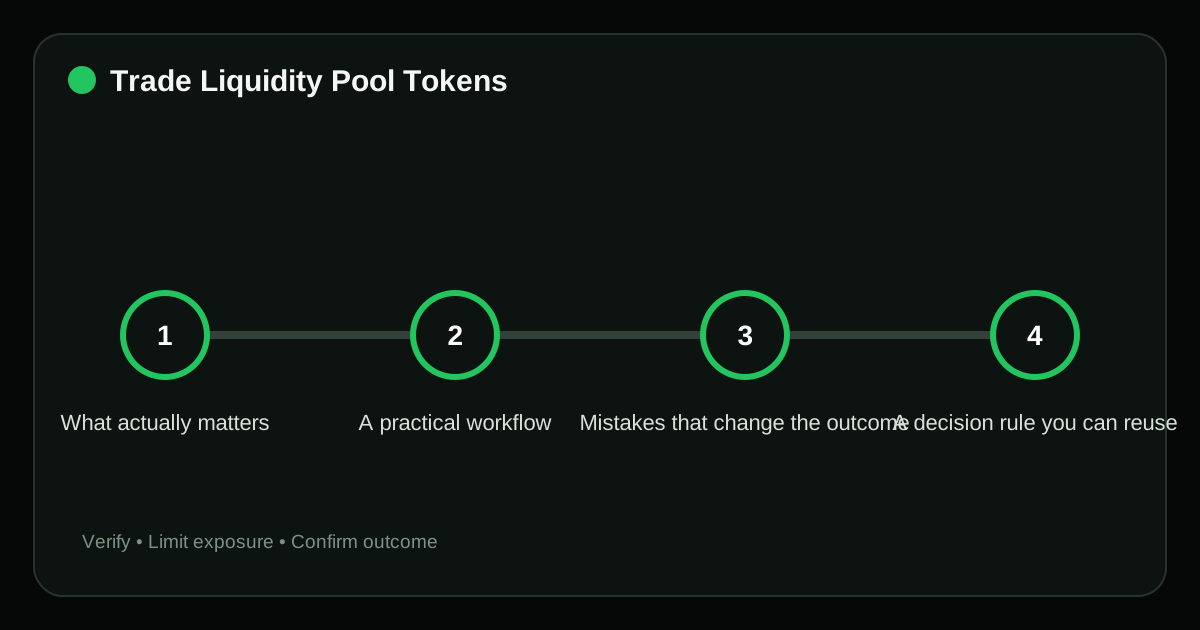
What actually matters#
Value changes with both underlying assets, accumulated fees and impermanent loss. Concentrated-liquidity positions may be NFTs rather than fungible LP tokens.
For trade liquidity pool tokens, the visible interface shows only part of the system. Confirm the identity, asset, network and authority involved before treating a familiar label as proof.
A practical workflow#
- Identify underlying assets and pool contract. Use actual position size, venue rules and costs; a rounded mental estimate is not enough for an irreversible order.
- Estimate exposure under different price moves. Use actual position size, venue rules and costs; a rounded mental estimate is not enough for an irreversible order.
- Check volume, fee yield and incentive duration. Compare the live venue details with the written plan; do not rely on a chart label or a remembered setting.
- Verify whether the position is transferable. Compare the live venue details with the written plan; do not rely on a chart label or a remembered setting.
- Test removal with a small position. Keep the first exposure small enough that a wrong assumption can be corrected without a material loss.
Mistakes that change the outcome#
- Valuing rewards without token liquidity. A label can look correct while the underlying destination differs, and a confirmed onchain action may be irreversible.
- Ignoring out-of-range concentrated positions. This removes a required input from the trade liquidity pool tokens decision and makes the apparent result unreliable.
- Buying a fake LP token by symbol. A label can look correct while the underlying destination differs, and a confirmed onchain action may be irreversible.
- Depositing LP tokens into an unverified farm. A label can look correct while the underlying destination differs, and a confirmed onchain action may be irreversible.
A decision rule you can reuse#
Model the position as a strategy, not a ticker. Compare expected fees with divergence loss, gas, smart-contract and reward-token risk.
Proof that the task is complete#
Do not judge the outcome of trade liquidity pool tokens only by whether the interface shows a success message. Use evidence that can still be checked after the page is closed.
| Checkpoint | Evidence | Stop condition |
|---|---|---|
| Identify underlying assets and pool contract | Exact URL or contract address matched to official documentation | Valuing rewards without token liquidity |
| Estimate exposure under different price moves | Account history entry and a journal note showing the planned value | Ignoring out-of-range concentrated positions |
| Check volume, fee yield and incentive duration | Account history entry and a journal note showing the planned value | Buying a fake LP token by symbol |
Record actual fills, fees and remaining exposure for trade liquidity pool tokens. The order ticket is an estimate; account history is the durable record.
Frequently asked questions#
Can LP tokens lose value?
Yes, through underlying price declines, divergence loss, exploit or poor liquidity.
Do LP tokens earn fees automatically?
Mechanics differ; fees may accrue to the position or require collection.
Can I sell an LP token?
Some are transferable, but direct markets may be illiquid; removal is often the normal exit.
Related guides#
Sources#
- Uniswap Support: Swaps and Troubleshooting
- Ethereum.org: Gas and Fees
- MetaMask: Transactions and Gas
Risk notice: Crypto trading can produce rapid losses. Examples are educational, not personalized financial advice; verify venue rules, fees and legal or tax obligations before acting.
Editorial standard
This guide is educational and source-led. Security controls, exchange rules and legal requirements can change; verify critical steps through the relevant official service before acting.