Dollar-cost averaging invests a fixed amount on a fixed schedule regardless of price. Define the asset, interval, budget, fee limit and end condition in advance; DCA reduces timing decisions but cannot make a poor asset safe or guarantee profit.
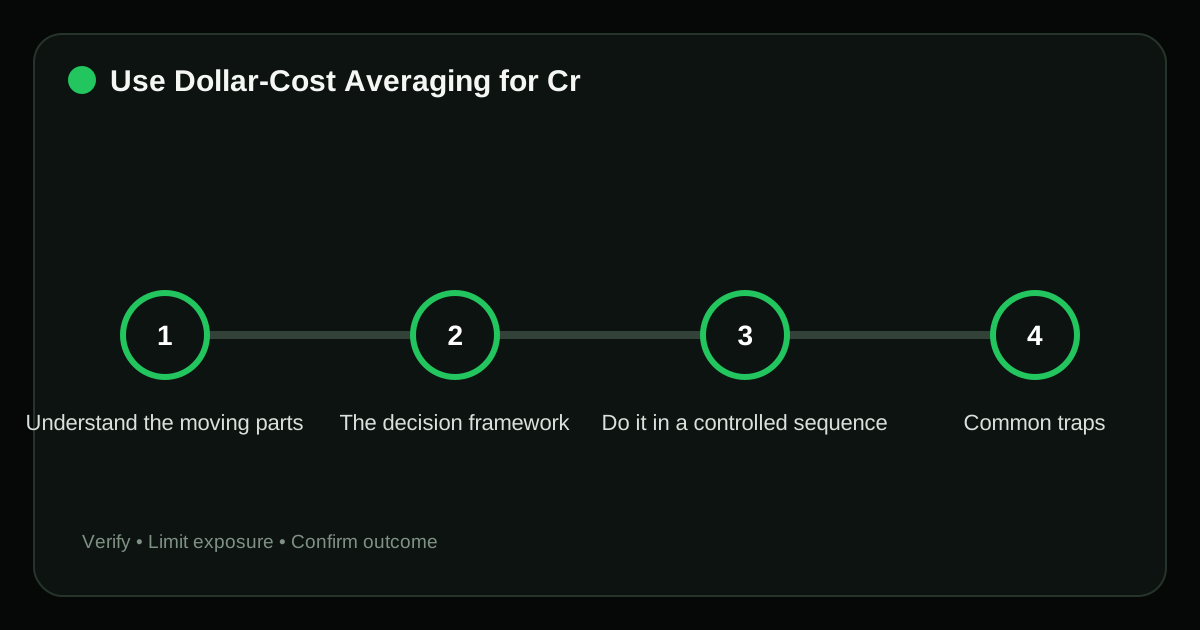
Understand the moving parts#
DCA spreads entry prices over time. It can underperform a lump sum in a steadily rising market and continues buying through declines unless the plan includes review rules.
The decision framework#
Separate schedule from thesis. Keep the calendar mechanical, but pause at predeclared review points if custody, liquidity or the asset itself materially changes.
Do it in a controlled sequence#
- Choose a liquid asset you have researched. Use actual position size, venue rules and costs; a rounded mental estimate is not enough for an irreversible order.
- Set an amount that does not affect essential finances. Use actual position size, venue rules and costs; a rounded mental estimate is not enough for an irreversible order.
- Match frequency to fees and cash flow. Calculate the total cost under a conservative execution assumption and record the value used.
- Automate only on a secured account. For crypto DCA strategy, complete this before value or signing authority changes hands and verify the resulting state afterward.
- Review thesis and allocation on scheduled dates. Compare the live venue details with the written plan; do not rely on a chart label or a remembered setting.
Common traps#
- Increasing buys after social-media hype. The branding can be copied, so the request must be re-opened through an independently verified channel.
- DCA into an asset with broken fundamentals. This changes the planned exposure or execution cost of crypto DCA strategy after the decision has already been made.
- Ignoring total portfolio concentration. This removes a required input from the crypto DCA strategy decision and makes the apparent result unreliable.
- Using borrowed money for scheduled purchases. This changes the planned exposure or execution cost of crypto DCA strategy after the decision has already been made.
For crypto DCA strategy, a clean result is not merely a completed transaction or setting. It is a result you can independently verify, reproduce and recover from if the surrounding service fails.
Confirm the result#
Do not judge the outcome of crypto DCA strategy only by whether the interface shows a success message. Use evidence that can still be checked after the page is closed.
| Checkpoint | Evidence | Stop condition |
|---|---|---|
| Choose a liquid asset you have researched | Account history entry and a journal note showing the planned value | Increasing buys after social-media hype |
| Set an amount that does not affect essential finances | Account history entry and a journal note showing the planned value | DCA into an asset with broken fundamentals |
| Match frequency to fees and cash flow | Account history entry and a journal note showing the planned value | Ignoring total portfolio concentration |
Record actual fills, fees and remaining exposure for crypto DCA strategy. The order ticket is an estimate; account history is the durable record.
Frequently asked questions#
Is weekly better than monthly?
Not universally. More frequent buys smooth timing but may increase fees and complexity.
Should I DCA out?
Scheduled selling can also reduce timing decisions, but tax and liquidity effects matter.
Does DCA lower average price?
Not necessarily; it creates a weighted average of purchases over the chosen period.
Related guides#
Sources#
- Coinbase: Understanding Order Types
- CFTC: Customer Advisory on Virtual Currencies
- Kraken: Trading Order Types
Risk notice: Crypto trading can produce rapid losses. Examples are educational, not personalized financial advice; verify venue rules, fees and legal or tax obligations before acting.
Editorial standard
This guide is educational and source-led. Security controls, exchange rules and legal requirements can change; verify critical steps through the relevant official service before acting.