Do not store a seed phrase in ordinary cloud notes, email, photos or synced documents. Account takeover, shared-device access, backups and accidental links can expose it. Use a durable offline backup, with redundancy and physical access controls.
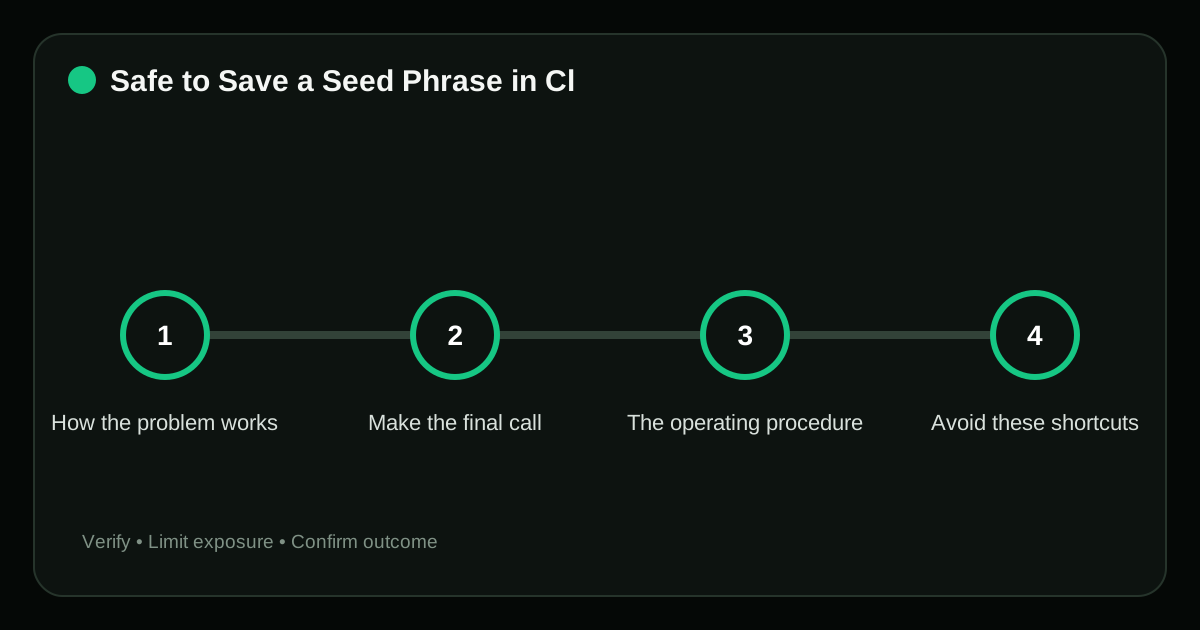
How the problem works#
Encryption at the service does not remove endpoint and account-recovery risk. A screenshot may be copied into photo backups, thumbnails and deleted-item retention without the user noticing.
Make the final call#
For advanced users, encrypted digital backups may be designed safely, but key management becomes another failure point. Offline physical backup is the clearer default for beginners.
The operating procedure#
- Write the phrase by hand or use a durable offline medium. Complete this through the verified product interface, then test the control instead of assuming it is active.
- Store redundant copies in separate secure locations. For seed phrase cloud storage, complete this before value or signing authority changes hands and verify the resulting state afterward.
- Verify spelling and order before funding. Compare the exact domain, address, network or permission with an independent official source before continuing.
- Consider tamper evidence and inheritance access. For seed phrase cloud storage, complete this before value or signing authority changes hands and verify the resulting state afterward.
- Never digitize the live phrase during routine use. Complete this through the verified product interface, then test the control instead of assuming it is active.
Avoid these shortcuts#
- Photographing the backup for convenience. This weakens a control that should limit the blast radius of seed phrase cloud storage.
- Saving it in a password-manager note without understanding the threat model. This can expose the root credential; a later password change may not remove the attacker’s access.
- Printing through a networked office printer. A label can look correct while the underlying destination differs, and a confirmed onchain action may be irreversible.
- Keeping the only copy beside the device. This weakens a control that should limit the blast radius of seed phrase cloud storage.
For seed phrase cloud storage, a clean result is not merely a completed transaction or setting. It is a result you can independently verify, reproduce and recover from if the surrounding service fails.
Confirm the result#
Do not judge the outcome of seed phrase cloud storage only by whether the interface shows a success message. Use evidence that can still be checked after the page is closed.
| Checkpoint | Evidence | Stop condition |
|---|---|---|
| Write the phrase by hand or use a durable offline medium | Dated screenshot or onchain record with sensitive data removed | Photographing the backup for convenience |
| Store redundant copies in separate secure locations | Dated screenshot or onchain record with sensitive data removed | Saving it in a password-manager note without understanding the threat model |
| Verify spelling and order before funding | Order ID, fill price, quantity, fees and current open-position screen | Printing through a networked office printer |
Keep transaction hashes, official case numbers or dated screenshots when they help document seed phrase cloud storage, but exclude seed phrases, private keys and authentication codes.
Frequently asked questions#
What if the note app uses end-to-end encryption?
That reduces provider access but not compromised devices, account recovery or accidental sharing.
Can I split the phrase between two notes?
Naive splitting can reduce reliability without providing robust protection. Use a documented secret-sharing scheme only if you understand recovery.
Should I delete an existing cloud copy?
Assume it may already have been exposed. Create a new wallet and migrate before deleting copies and backups.
Related guides#
Sources#
- Ethereum.org: Security and Scam Prevention
- MetaMask: Wallet Security
- CISA: Avoiding Social Engineering and Phishing Attacks
Risk notice: Crypto actions can be irreversible. Never share a seed phrase, private key, password or authentication code, and verify every domain and wallet prompt independently.
Editorial standard
This guide is educational and source-led. Security controls, exchange rules and legal requirements can change; verify critical steps through the relevant official service before acting.