To revoke an unlimited token approval, open the official approval checker for the relevant blockchain, connect the correct wallet, inspect the spender contract and allowance, then submit an onchain revoke transaction. Revocation costs network fees and stops future use of that allowance; disconnecting a website does not.
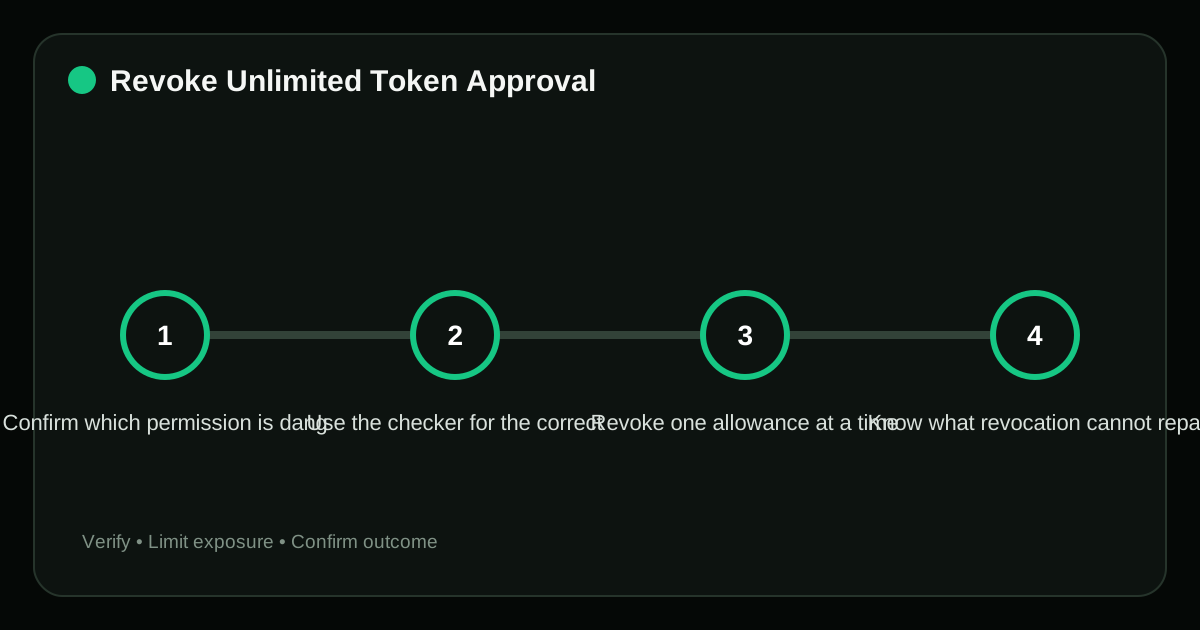
Confirm which permission is dangerous#
An ERC-20 approval gives a spender contract permission to transfer up to an allowance from your address. “Unlimited” usually means the allowance is set near the token standard’s maximum value so the application does not need a new approval before every future trade.
The approval does not automatically move tokens. Risk appears when the approved spender is malicious, compromised or upgradeable in an unsafe way. A stale allowance can remain usable long after you stop visiting the application.
NFT permissions may use setApprovalForAll, which can authorize an operator across an entire collection. Read the permission type rather than assuming every approval affects only one token amount.
Use the checker for the correct chain#
Approvals are network-specific. An Ethereum allowance is not the same record as an approval on Base, Arbitrum, BNB Smart Chain or Polygon, even when the wallet address looks identical.
Use a block explorer reached through its verified domain or an established approval manager linked by a trusted ecosystem source. Ethereum.org points users to Etherscan’s Token Approval Checker and Revoke.cash. Avoid approval links delivered through unsolicited messages.
Before connecting, verify:
- the network shown in the wallet;
- the wallet address being inspected;
- the token contract;
- the spender contract;
- the current allowance and last-use context.
Revoke one allowance at a time#
Prioritize unknown spenders, contracts tied to abandoned applications and allowances covering valuable balances. Select revoke, read the wallet prompt and confirm that the transaction changes an allowance rather than transferring tokens or granting a different permission.
The revoke transaction must be mined before the allowance changes. Keep enough of the network’s native asset to pay the fee. After confirmation, refresh the checker and verify that the allowance is zero or removed.
Uniswap notes that revocation is an onchain transaction with a network cost and that it is different from disconnecting a dapp. The next legitimate swap may require a new approval.
Know what revocation cannot repair#
Revocation prevents future spending through that specific permission. It cannot reverse a completed transfer, recover stolen assets or protect a seed phrase that has leaked. If a malicious signer or drainer has several permissions, removing only one may leave other paths open.
If the seed phrase, private key or signing device may be compromised, create a fresh wallet and migrate remaining assets. If only one known allowance is risky, revocation may be sufficient after a complete review of recent activity and other approvals.
Replace unlimited approval with controlled exposure#
Where the interface permits, approve only the amount required for the intended transaction. Use an interaction wallet with a limited balance for unfamiliar protocols. Review allowances after completing a one-time action and whenever a protocol announces a security incident.
Small allowances are not a substitute for verifying the spender. A malicious contract can still take the approved amount, and repeated approvals can expose additional fees and signing opportunities.
Frequently asked questions#
Does revoking an approval move my tokens?
No. A normal revoke changes the allowance recorded by the token contract. Verify the transaction details because a fake revocation interface could request something else.
Why does revocation cost gas?
The allowance is blockchain state. Updating it requires a network transaction and therefore the native fee asset.
Can I revoke without connecting my wallet?
You can inspect allowances using a public address, but changing them requires a signature from the controlling wallet.
Should I revoke every approval?
Remove permissions you no longer need and scrutinize unknown or unlimited allowances. Active applications may require approval again, so prioritize by exposure rather than signing dozens of unfamiliar transactions blindly.
Sources#
- Ethereum.org: Revoke Smart Contract Access
- Uniswap: How to Revoke a Token Approval
- Ethereum.org: Scam Help and Reporting
Risk notice: Approval tools require wallet signatures. Verify the domain, chain, token and spender before submitting any transaction.
Editorial standard
This guide is educational and source-led. Security controls, exchange rules and legal requirements can change; verify critical steps through the relevant official service before acting.