Using one wallet for everything creates a single failure domain. A safer design separates long-term savings, routine transactions and high-risk Web3 experiments, while keeping the number of backups small enough to manage correctly.
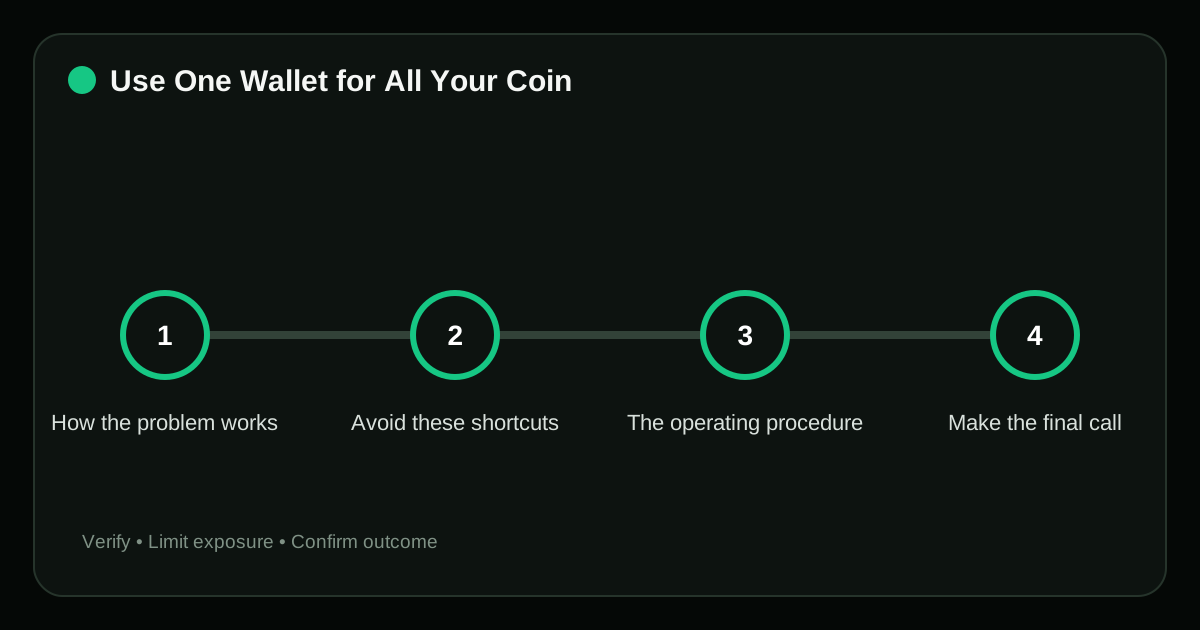
How the problem works#
Wallet separation limits blast radius: a malicious approval in an experimental wallet should not expose the vault. It also improves privacy by preventing every activity from being trivially linked to one address.
Avoid these shortcuts#
- Creating so many wallets that backups become confused. This weakens a control that should limit the blast radius of one wallet for all crypto.
- Reusing the same seed across “separate” accounts without understanding linkage. This can expose the root credential; a later password change may not remove the attacker’s access.
- Keeping excessive value in the convenience wallet. This weakens a control that should limit the blast radius of one wallet for all crypto.
- Sending from the vault directly to unknown contracts. A label can look correct while the underlying destination differs, and a confirmed onchain action may be irreversible.
In one wallet for all crypto, these errors share one pattern: speed or familiarity replaces verification. Slow down at the point where authority, money or an irreversible signature changes hands.
The operating procedure#
- Keep long-term holdings in a rarely used vault. Complete this through the verified product interface, then test the control instead of assuming it is active.
- Use a funded-as-needed wallet for known applications. Keep the first exposure small enough that a wrong assumption can be corrected without a material loss.
- Use a disposable address for untrusted claims and tests. Keep the first exposure small enough that a wrong assumption can be corrected without a material loss.
- Label networks and addresses in an offline inventory. For one wallet for all crypto, complete this before value or signing authority changes hands and verify the resulting state afterward.
- Maintain a tested backup and inheritance plan for each key set. Write the boundary down first so urgency cannot quietly expand what the wallet or account is allowed to expose.
Make the final call#
Choose separation based on consequence, not coin count. Several assets supported by one hardware wallet can share a security boundary; risky behavior deserves a different seed or account.
A final verification pass#
Do not judge the outcome of one wallet for all crypto only by whether the interface shows a success message. Use evidence that can still be checked after the page is closed.
| Checkpoint | Evidence | Stop condition |
|---|---|---|
| Keep long-term holdings in a rarely used vault | Dated screenshot or onchain record with sensitive data removed | Creating so many wallets that backups become confused |
| Use a funded-as-needed wallet for known applications | Exact URL or contract address matched to official documentation | Reusing the same seed across “separate” accounts without understanding linkage |
| Use a disposable address for untrusted claims and tests | Dated screenshot or onchain record with sensitive data removed | Keeping excessive value in the convenience wallet |
Keep transaction hashes, official case numbers or dated screenshots when they help document one wallet for all crypto, but exclude seed phrases, private keys and authentication codes.
Frequently asked questions#
Do different addresses under one seed isolate risk?
They may isolate some approvals, but compromise of the seed exposes every derived account.
Does one hardware wallet support multiple coins safely?
It can, when the device and apps support them, but verify each transaction and maintain recovery compatibility.
Will multiple wallets improve privacy?
Only if you avoid linking them through transfers, public identity and repeated behavior. It is not guaranteed anonymity.
Related guides#
Sources#
- Ethereum.org: Security and Scam Prevention
- MetaMask: Wallet Security
- CISA: Avoiding Social Engineering and Phishing Attacks
Risk notice: Crypto actions can be irreversible. Never share a seed phrase, private key, password or authentication code, and verify every domain and wallet prompt independently.
Editorial standard
This guide is educational and source-led. Security controls, exchange rules and legal requirements can change; verify critical steps through the relevant official service before acting.