The Travel Rule requires qualifying virtual-asset transfers handled by regulated providers to carry specified originator and beneficiary information. For users, the main security effects are identity-data handling, recipient verification, transfer delays and increased phishing risk around compliance requests.
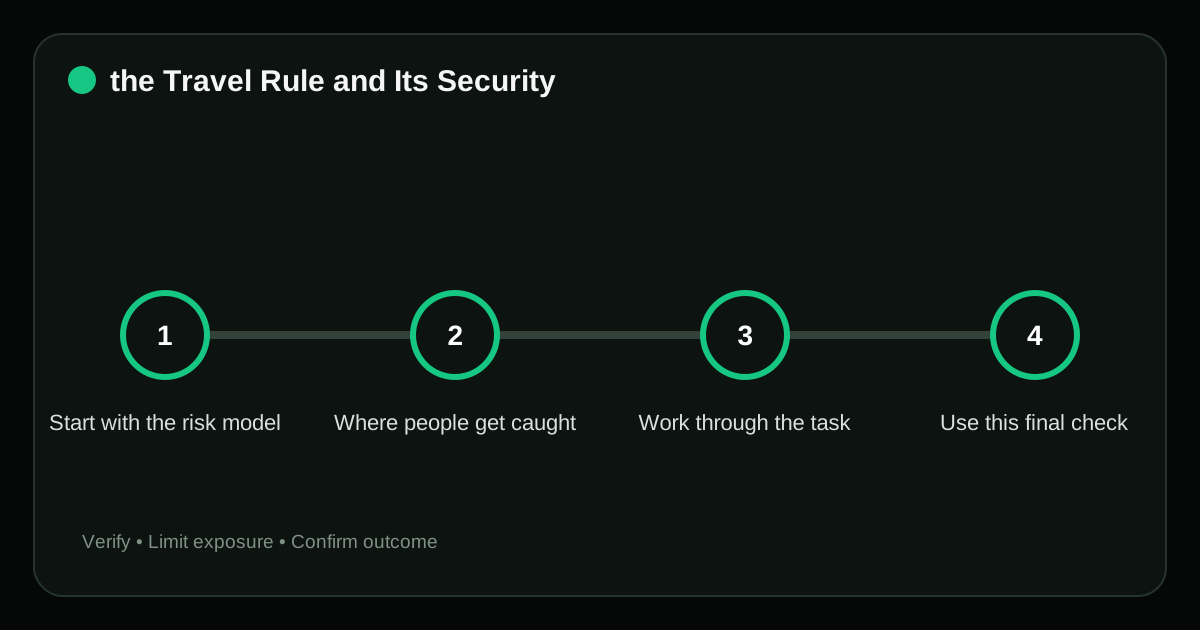
Start with the risk model#
Requirements vary by jurisdiction and provider. A transfer may require the recipient’s legal name, destination provider or proof that you control a self-hosted wallet; this does not mean a stranger should receive your documents by email.
Where people get caught#
- Assuming rules are identical in every country. This removes a required input from the crypto Travel Rule security decision and makes the apparent result unreliable.
- Sending identity documents through chat. This weakens a control that should limit the blast radius of crypto Travel Rule security.
- Using a recipient name that does not match the destination account. This weakens a control that should limit the blast radius of crypto Travel Rule security.
- Repeating a transfer without learning why the first was held. This weakens a control that should limit the blast radius of crypto Travel Rule security.
In crypto Travel Rule security, these errors share one pattern: speed or familiarity replaces verification. Slow down at the point where authority, money or an irreversible signature changes hands.
Work through the task#
- Read the provider’s current requirements before sending. Compare the exact domain, address, network or permission with an independent official source before continuing.
- Enter recipient information only inside the authenticated platform. For crypto Travel Rule security, complete this before value or signing authority changes hands and verify the resulting state afterward.
- Confirm whether the destination provider and network are supported. Compare the exact domain, address, network or permission with an independent official source before continuing.
- Expect manual review for mismatched or incomplete data. Compare the exact domain, address, network or permission with an independent official source before continuing.
- Treat external “Travel Rule verification” links as phishing until verified. For crypto Travel Rule security, complete this before value or signing authority changes hands and verify the resulting state afterward.
Use this final check#
Security and compliance meet at data minimization: provide required information through the provider’s official channel, but do not volunteer secrets, seed phrases or unrelated documents.
A final verification pass#
Do not judge the outcome of crypto Travel Rule security only by whether the interface shows a success message. Use evidence that can still be checked after the page is closed.
| Checkpoint | Evidence | Stop condition |
|---|---|---|
| Read the provider’s current requirements before sending | Transaction or withdrawal ID plus the matching explorer or account record | Assuming rules are identical in every country |
| Enter recipient information only inside the authenticated platform | Dated screenshot or onchain record with sensitive data removed | Sending identity documents through chat |
| Confirm whether the destination provider and network are supported | Dated screenshot or onchain record with sensitive data removed | Using a recipient name that does not match the destination account |
Keep transaction hashes, official case numbers or dated screenshots when they help document crypto Travel Rule security, but exclude seed phrases, private keys and authentication codes.
Frequently asked questions#
Does the Travel Rule make blockchain transactions private?
No. It governs information exchanged by covered providers; public-ledger activity may remain visible.
Does it apply to every self-hosted wallet transfer?
Rules and thresholds differ. Check the sending provider and local jurisdiction.
Why is my withdrawal pending?
The provider may be matching beneficiary data or reviewing risk. Contact support through the official account interface.
Related guides#
Sources#
- Bitcoin.org: Protect Your Privacy
- FATF: Targeted Update on Virtual Assets and VASPs
- OFAC: Sanctions Compliance Guidance for Virtual Currency
Risk notice: Crypto actions can be irreversible. Never share a seed phrase, private key, password or authentication code, and verify every domain and wallet prompt independently.
Editorial standard
This guide is educational and source-led. Security controls, exchange rules and legal requirements can change; verify critical steps through the relevant official service before acting.