A smart contract exploit abuses a flaw in code, economic design, permissions or an external dependency to produce an unintended result—often draining or freezing assets. It differs from ordinary key theft because the attacker may use valid contract rules in an unexpected sequence.
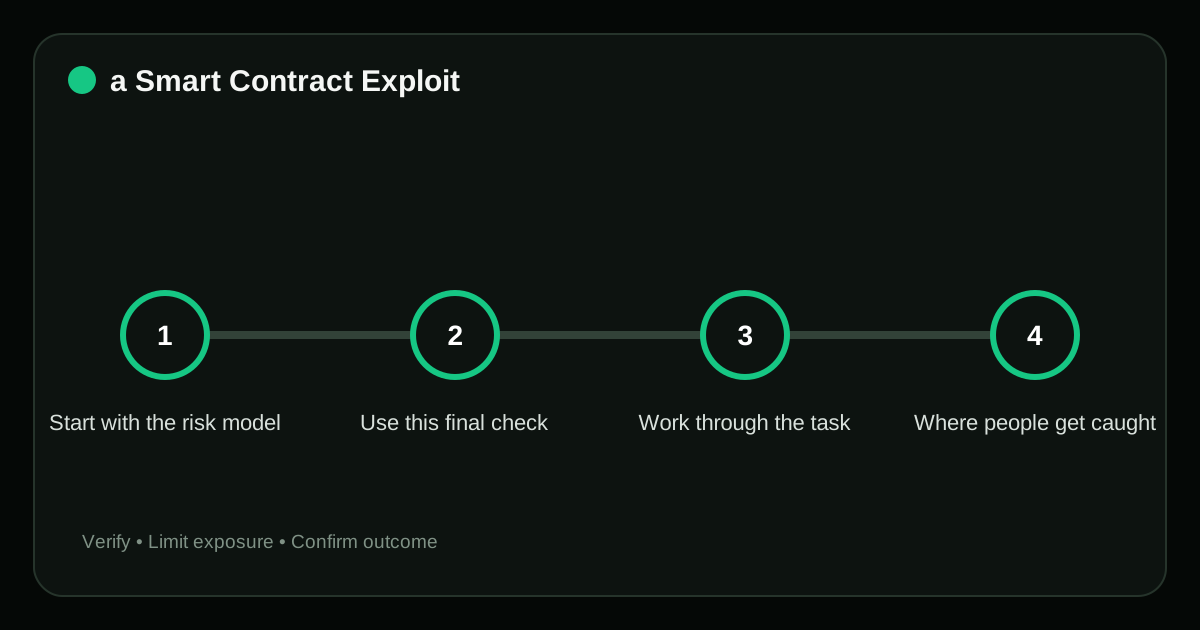
Start with the risk model#
Common exploit classes include access-control failures, price-oracle manipulation, reentrancy, accounting errors, unsafe upgrades and compromised admin keys. The visible loss may be the final step of a longer dependency failure.
Use this final check#
Users should evaluate containment and authority: can the protocol pause, upgrade or recover assets, and who controls those powers? Those same controls may reduce or create risk.
Work through the task#
- Identify the affected contract and deployed version. The choice determines which asset, authority or risk model applies, so resolve any ambiguity before the next step.
- Pause interactions and revoke related approvals if advised by verified sources. Complete this through the verified product interface, then test the control instead of assuming it is active.
- Check whether front end, contract or admin key is affected. Compare the exact domain, address, network or permission with an independent official source before continuing.
- Follow official incident updates and preserve transaction evidence. Keep the original timestamp, identifier and unedited record so another person can reproduce the conclusion.
- Do not trust unsolicited reimbursement or recovery links. For smart contract exploit, complete this before value or signing authority changes hands and verify the resulting state afterward.
Where people get caught#
- Assuming an audit covered every dependency. This removes a required input from the smart contract exploit decision and makes the apparent result unreliable.
- Depositing during an unresolved incident for a higher yield. This weakens a control that should limit the blast radius of smart contract exploit.
- Signing an “emergency migration” from social replies. The branding can be copied, so the request must be re-opened through an independently verified channel.
- Confusing a market loss with a code exploit. This can expose the root credential; a later password change may not remove the attacker’s access.
For smart contract exploit, a clean result is not merely a completed transaction or setting. It is a result you can independently verify, reproduce and recover from if the surrounding service fails.
Confirm the result#
Do not judge the outcome of smart contract exploit only by whether the interface shows a success message. Use evidence that can still be checked after the page is closed.
| Checkpoint | Evidence | Stop condition |
|---|---|---|
| Identify the affected contract and deployed version | Exact URL or contract address matched to official documentation | Assuming an audit covered every dependency |
| Pause interactions and revoke related approvals if advised by verified sources | Transaction or withdrawal ID plus the matching explorer or account record | Depositing during an unresolved incident for a higher yield |
| Check whether front end, contract or admin key is affected | Exact URL or contract address matched to official documentation | Signing an “emergency migration” from social replies |
Keep transaction hashes, official case numbers or dated screenshots when they help document smart contract exploit, but exclude seed phrases, private keys and authentication codes.
Frequently asked questions#
Can an exploited contract be patched?
Upgradeable systems may be changed, while immutable deployments may require migration. Recovery depends on design and remaining control.
Does open-source code prevent exploits?
No. It enables review but does not guarantee that every bug or economic interaction is found.
Should I revoke approvals after an exploit?
If the affected spender could use them, revocation can reduce future exposure; verify the chain and official guidance.
Related guides#
Sources#
Risk notice: Crypto actions can be irreversible. Never share a seed phrase, private key, password or authentication code, and verify every domain and wallet prompt independently.
Editorial standard
This guide is educational and source-led. Security controls, exchange rules and legal requirements can change; verify critical steps through the relevant official service before acting.