Trading fee equals executed notional multiplied by the applicable maker or taker rate, adjusted for tier, discounts and fee currency. Add spread, slippage, funding and transfer costs to measure the true cost of a trade.
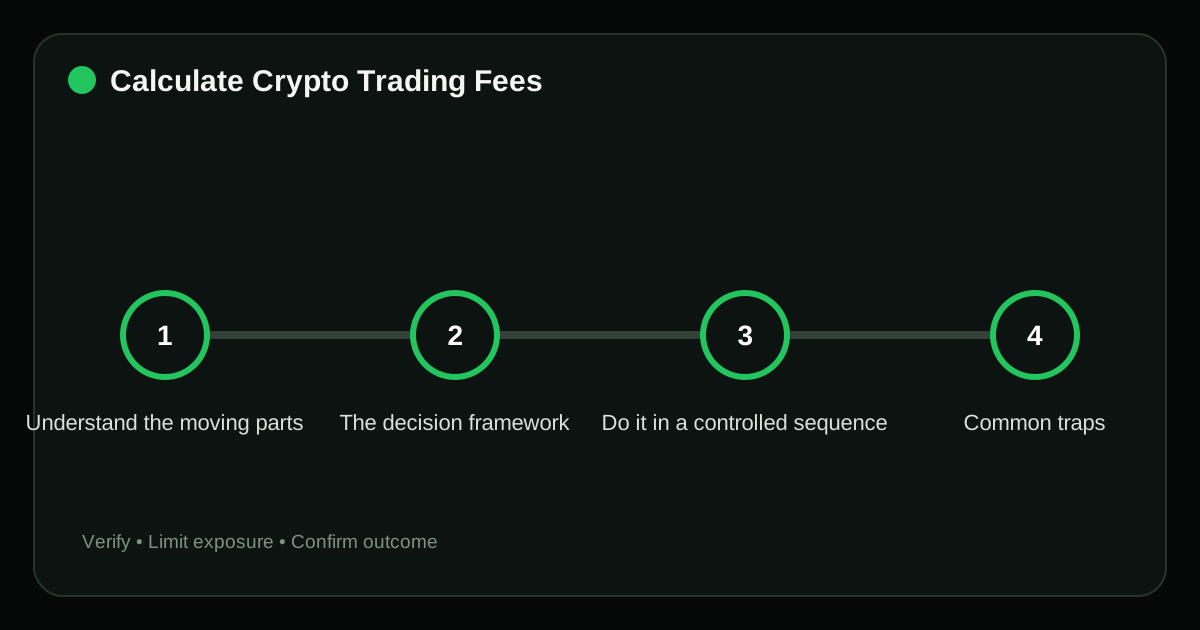
Understand the moving parts#
Advertised fee rates omit execution cost. A zero-fee market can have a wider spread, while a limit order can still be taker if it crosses the book.
The decision framework#
Use realized fill data, not the order preview, for final accounting. For planning, stress-test a worse tier and modest slippage.
Do it in a controlled sequence#
- Identify maker/taker status for each fill. The choice determines which asset, authority or risk model applies, so resolve any ambiguity before the next step.
- Multiply fill value by the actual tier rate. For calculate crypto trading fees, complete this before value or signing authority changes hands and verify the resulting state afterward.
- Convert fee currency at a documented price. Keep the original timestamp, identifier and unedited record so another person can reproduce the conclusion.
- Add funding and withdrawal costs. Calculate the total cost under a conservative execution assumption and record the value used.
- Compare total round-trip cost with expected edge. Calculate the total cost under a conservative execution assumption and record the value used.
Common traps#
- Applying the current tier to old trades. The branding can be copied, so the request must be re-opened through an independently verified channel.
- Assuming every limit order is maker. This removes a required input from the calculate crypto trading fees decision and makes the apparent result unreliable.
- Ignoring fees paid in a platform token. A label can look correct while the underlying destination differs, and a confirmed onchain action may be irreversible.
- Excluding spread from decision-making. The branding can be copied, so the request must be re-opened through an independently verified channel.
For calculate crypto trading fees, a clean result is not merely a completed transaction or setting. It is a result you can independently verify, reproduce and recover from if the surrounding service fails.
Confirm the result#
Do not judge the outcome of calculate crypto trading fees only by whether the interface shows a success message. Use evidence that can still be checked after the page is closed.
| Checkpoint | Evidence | Stop condition |
|---|---|---|
| Identify maker/taker status for each fill | Account history entry and a journal note showing the planned value | Applying the current tier to old trades |
| Multiply fill value by the actual tier rate | Account history entry and a journal note showing the planned value | Assuming every limit order is maker |
| Convert fee currency at a documented price | Account history entry and a journal note showing the planned value | Ignoring fees paid in a platform token |
Record actual fills, fees and remaining exposure for calculate crypto trading fees. The order ticket is an estimate; account history is the durable record.
Frequently asked questions#
What is maker versus taker?
Maker liquidity rests on the book; taker liquidity executes against resting orders.
Why was my limit order charged taker fee?
It crossed available liquidity and executed immediately.
Are network fees trading fees?
No, but they are part of the total cost when depositing or withdrawing.
Related guides#
Sources#
- Coinbase: Understanding Order Types
- CFTC: Customer Advisory on Virtual Currencies
- Kraken: Trading Order Types
Risk notice: Crypto trading can produce rapid losses. Examples are educational, not personalized financial advice; verify venue rules, fees and legal or tax obligations before acting.
Editorial standard
This guide is educational and source-led. Security controls, exchange rules and legal requirements can change; verify critical steps through the relevant official service before acting.