HTTPS only means the connection to that domain is encrypted; it does not prove the domain belongs to the real crypto service. Verify the exact registered name, navigate from a trusted source, inspect certificate warnings and bookmark the confirmed site before connecting a wallet.
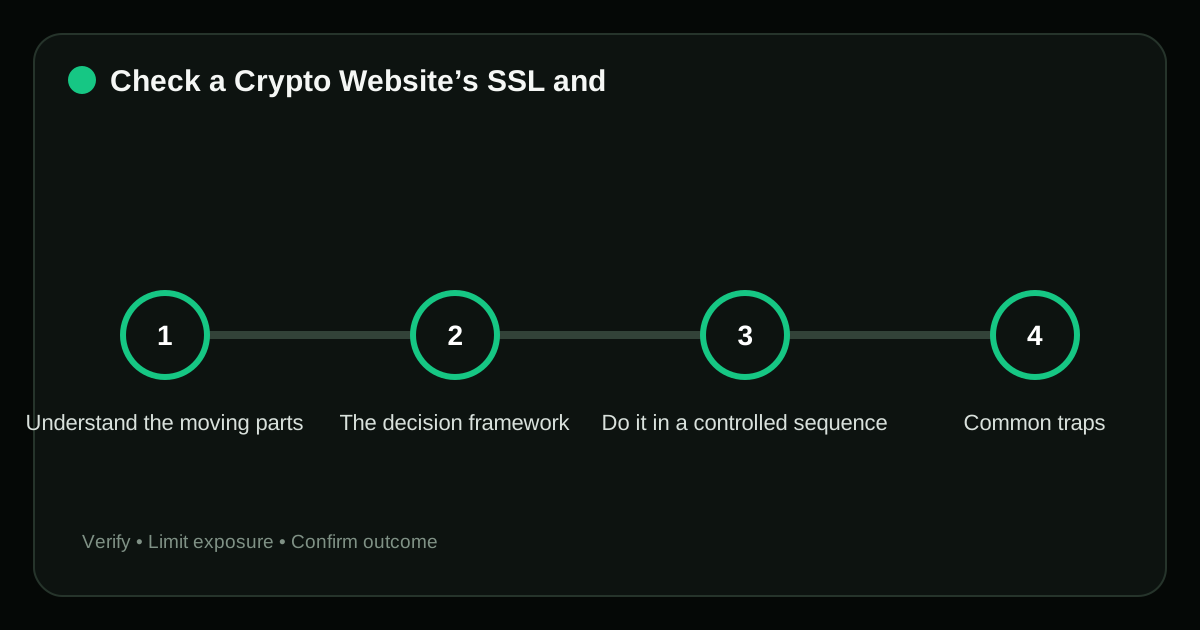
Understand the moving parts#
Look-alike domains use swapped letters, extra words, deceptive subdomains and international characters. Modern phishing sites can obtain valid TLS certificates, so the padlock is a minimum requirement rather than an identity badge.
The decision framework#
Use at least two independent anchors: a previously saved official link plus a verified repository, app-store listing or ecosystem directory. Social posts alone are not independent evidence.
Do it in a controlled sequence#
- Read the domain from right to left to find the registrable name. Compare the exact domain, address, network or permission with an independent official source before continuing.
- Compare spelling with the project’s official documentation. Keep the original timestamp, identifier and unedited record so another person can reproduce the conclusion.
- Open certificate details if the browser shows any warning. The choice determines which asset, authority or risk model applies, so resolve any ambiguity before the next step.
- Avoid sponsored results and shortened links. For check crypto website authenticity, complete this before value or signing authority changes hands and verify the resulting state afterward.
- Save a bookmark after independent verification. Keep the original timestamp, identifier and unedited record so another person can reproduce the conclusion.
Common traps#
- Mistaking project.example.com.attacker.tld for an official subdomain. The branding can be copied, so the request must be re-opened through an independently verified channel.
- Trusting a domain because it has HTTPS. The branding can be copied, so the request must be re-opened through an independently verified channel.
- Ignoring a recently registered look-alike domain. The branding can be copied, so the request must be re-opened through an independently verified channel.
- Entering a seed phrase after a site claims the wallet is corrupted. This can expose the root credential; a later password change may not remove the attacker’s access.
For check crypto website authenticity, a clean result is not merely a completed transaction or setting. It is a result you can independently verify, reproduce and recover from if the surrounding service fails.
Confirm the result#
Do not judge the outcome of check crypto website authenticity only by whether the interface shows a success message. Use evidence that can still be checked after the page is closed.
| Checkpoint | Evidence | Stop condition |
|---|---|---|
| Read the domain from right to left to find the registrable name | Exact URL or contract address matched to official documentation | Mistaking project.example.com.attacker.tld for an official subdomain |
| Compare spelling with the project’s official documentation | Dated screenshot or onchain record with sensitive data removed | Trusting a domain because it has HTTPS |
| Open certificate details if the browser shows any warning | Dated screenshot or onchain record with sensitive data removed | Ignoring a recently registered look-alike domain |
Keep transaction hashes, official case numbers or dated screenshots when they help document check crypto website authenticity, but exclude seed phrases, private keys and authentication codes.
Frequently asked questions#
Can a phishing site have a valid certificate?
Yes. Certificate authorities validate control of a domain, not the legitimacy of the business behind it.
Does the browser padlock still appear?
Browser UI changes, but HTTPS status and warnings remain available in site information. Do not use the icon as the only check.
What if the official domain redirects?
Confirm the redirect through official documentation before trusting the new destination.
Related guides#
Sources#
- Ethereum.org: Security and Scam Prevention
- MetaMask: Wallet Security
- CISA: Avoiding Social Engineering and Phishing Attacks
Risk notice: Crypto actions can be irreversible. Never share a seed phrase, private key, password or authentication code, and verify every domain and wallet prompt independently.
Editorial standard
This guide is educational and source-led. Security controls, exchange rules and legal requirements can change; verify critical steps through the relevant official service before acting.