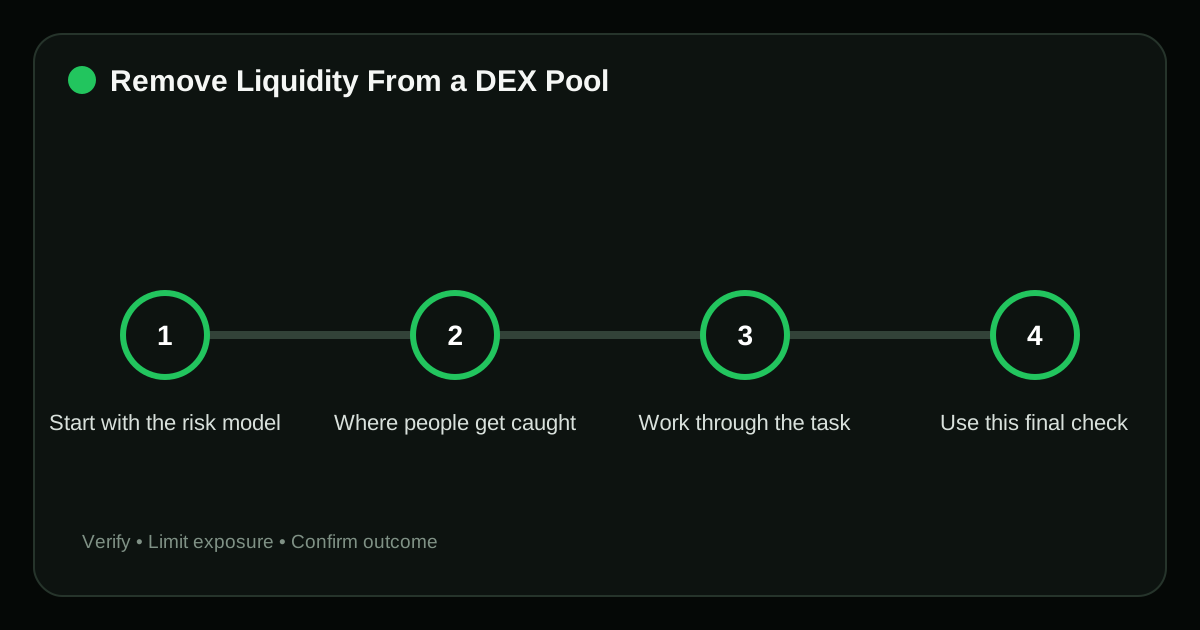
Open the verified DEX interface, locate the exact position, choose the percentage to remove, review expected token amounts and slippage, approve the position if required and confirm the removal transaction. Collect unclaimed fees separately if the protocol requires it.
Start with the risk model#
The output composition may differ from the original deposit because pool prices changed. A concentrated position may be entirely in one asset when out of range.
Where people get caught#
- Removing during extreme price movement with loose slippage. Execution cost can consume the expected edge even when the directional idea is right.
- Forgetting staked LP tokens must be unstaked first. A label can look correct while the underlying destination differs, and a confirmed onchain action may be irreversible.
- Assuming original asset ratio will return. This removes a required input from the remove liquidity DEX decision and makes the apparent result unreliable.
- Using a fake migration interface. This changes the planned exposure or execution cost of remove liquidity DEX after the decision has already been made.
In remove liquidity DEX, these errors share one pattern: speed or familiarity replaces verification. Slow down at the point where authority, money or an irreversible signature changes hands.
Work through the task#
- Verify pool and wallet account. Compare the live venue details with the written plan; do not rely on a chart label or a remembered setting.
- Review current underlying amounts and fees. Compare the live venue details with the written plan; do not rely on a chart label or a remembered setting.
- Set removal percentage and minimum outputs. Use actual position size, venue rules and costs; a rounded mental estimate is not enough for an irreversible order.
- Confirm approval and burn/remove transaction. Compare the live venue details with the written plan; do not rely on a chart label or a remembered setting.
- Add output tokens by contract if not displayed. For remove liquidity DEX, complete this before value or signing authority changes hands and verify the resulting state afterward.
Use this final check#
Before removal, compare the cost and risk of waiting with immediate exit. Smart-contract concerns may justify accepting worse market conditions.
A final verification pass#
Do not judge the outcome of remove liquidity DEX only by whether the interface shows a success message. Use evidence that can still be checked after the page is closed.
| Checkpoint | Evidence | Stop condition |
|---|---|---|
| Verify pool and wallet account | Exact URL or contract address matched to official documentation | Removing during extreme price movement with loose slippage |
| Review current underlying amounts and fees | Account history entry and a journal note showing the planned value | Forgetting staked LP tokens must be unstaked first |
| Set removal percentage and minimum outputs | Account history entry and a journal note showing the planned value | Assuming original asset ratio will return |
Record actual fills, fees and remaining exposure for remove liquidity DEX. The order ticket is an estimate; account history is the durable record.
Frequently asked questions#
Why can’t I see my position?
It may be on another chain, account, fee tier or staking contract.
Does removal cause impermanent loss?
It realizes the position’s current composition; the economic divergence existed before removal.
Why are two transactions required?
A protocol may require approval or fee collection before liquidity removal.
Related guides#
Sources#
- Uniswap Support: Swaps and Troubleshooting
- Ethereum.org: Gas and Fees
- MetaMask: Transactions and Gas
Risk notice: Crypto trading can produce rapid losses. Examples are educational, not personalized financial advice; verify venue rules, fees and legal or tax obligations before acting.
Editorial standard
This guide is educational and source-led. Security controls, exchange rules and legal requirements can change; verify critical steps through the relevant official service before acting.