Do not connect a valuable wallet to random websites. A connection usually reveals addresses rather than granting spending authority, but the site can immediately present deceptive signature or approval requests and profile your holdings for targeted attacks.
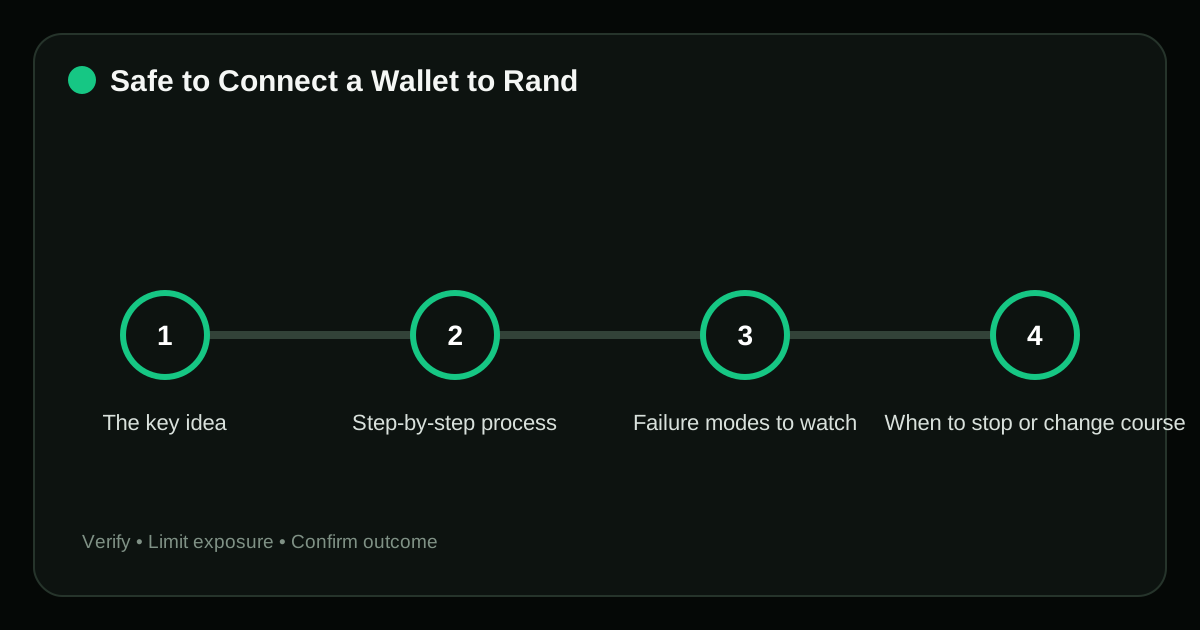
The key idea#
Users often treat “connect” as the final decision when it is only the start of an authorization sequence. The dangerous step may be the next permit, approval or transaction.
For connect wallet to random website, the visible interface shows only part of the system. Confirm the identity, asset, network and authority involved before treating a familiar label as proof.
Step-by-step process#
- Verify the domain and application reputation first. Compare the exact domain, address, network or permission with an independent official source before continuing.
- Use a sandbox wallet with limited funds. Keep the first exposure small enough that a wrong assumption can be corrected without a material loss.
- Read every subsequent wallet prompt. Compare the exact domain, address, network or permission with an independent official source before continuing.
- Reject requests unrelated to the stated action. For connect wallet to random website, complete this before value or signing authority changes hands and verify the resulting state afterward.
- Disconnect locally and review onchain approvals afterward. Compare the exact domain, address, network or permission with an independent official source before continuing.
Failure modes to watch#
- Connecting the vault to check eligibility. This weakens a control that should limit the blast radius of connect wallet to random website.
- Signing a message described only as verification. The branding can be copied, so the request must be re-opened through an independently verified channel.
- Assuming disconnecting revokes allowances. This removes a required input from the connect wallet to random website decision and makes the apparent result unreliable.
- Trusting a site because the wallet shows its logo. This removes a required input from the connect wallet to random website decision and makes the apparent result unreliable.
When to stop or change course#
If the site’s value is uncertain, inspect it without connecting or use a public address in a read-only explorer. Connection should be earned by a clear purpose.
Proof that the task is complete#
Do not judge the outcome of connect wallet to random website only by whether the interface shows a success message. Use evidence that can still be checked after the page is closed.
| Checkpoint | Evidence | Stop condition |
|---|---|---|
| Verify the domain and application reputation first | Exact URL or contract address matched to official documentation | Connecting the vault to check eligibility |
| Use a sandbox wallet with limited funds | Dated control check, recovery test or authenticated settings record with secrets removed | Signing a message described only as verification |
| Read every subsequent wallet prompt | Dated control check, recovery test or authenticated settings record with secrets removed | Assuming disconnecting revokes allowances |
Keep transaction hashes, official case numbers or dated screenshots when they help document connect wallet to random website, but exclude seed phrases, private keys and authentication codes.
Frequently asked questions#
Can a site steal funds immediately on connect?
A standard connection alone does not transfer funds, but compromised wallets or later approvals can.
Does a burner wallet make any site safe?
No. It limits financial exposure but not malware, device compromise or privacy leakage.
How do I remove a connection?
Use the wallet’s connected-sites settings, then separately inspect onchain approvals.
Related guides#
Sources#
Risk notice: Crypto actions can be irreversible. Never share a seed phrase, private key, password or authentication code, and verify every domain and wallet prompt independently.
Editorial standard
This guide is educational and source-led. Security controls, exchange rules and legal requirements can change; verify critical steps through the relevant official service before acting.