A cross-chain swap combines a swap with bridge or messaging risk. Verify the route and destination token, check bridge trust assumptions and destination liquidity, use a small test and keep enough native gas on both chains.
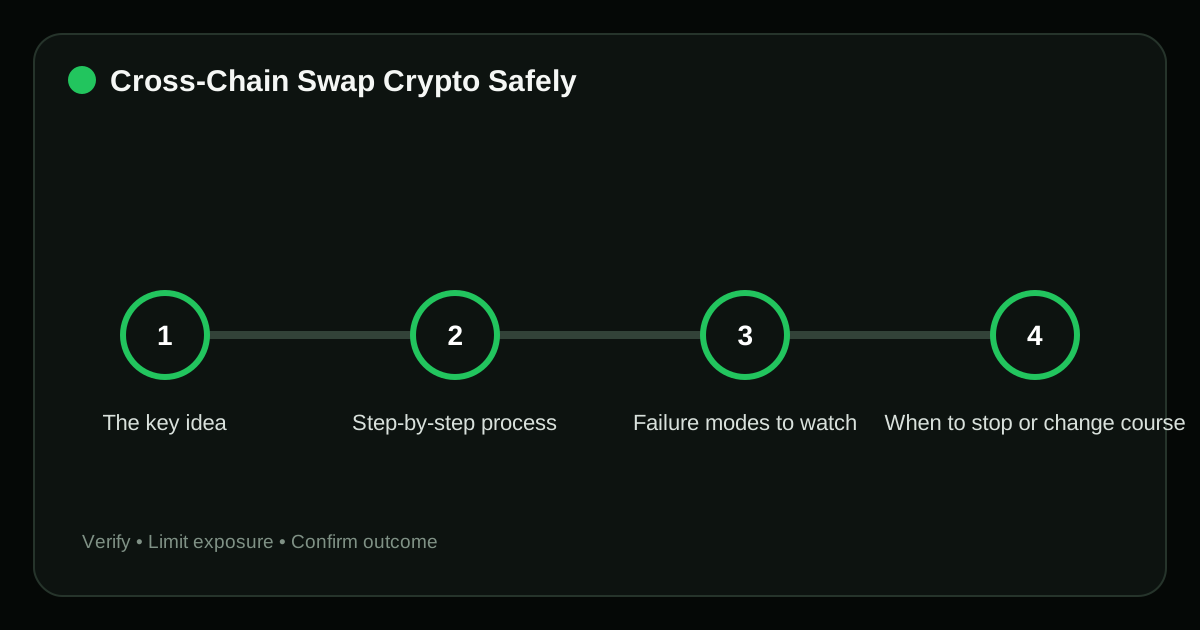
The key idea#
The cheapest quote may use a lightly reviewed bridge or deliver a wrapped asset that is hard to exit. Failure can occur on the source transaction, message relay or destination swap.
For cross-chain swap safely, the visible interface shows only part of the system. Confirm the identity, asset, network and authority involved before treating a familiar label as proof.
Step-by-step process#
- Verify aggregator and bridge domains. Compare the live venue details with the written plan; do not rely on a chart label or a remembered setting.
- Inspect source and destination token contracts. Compare the live venue details with the written plan; do not rely on a chart label or a remembered setting.
- Review fees, estimated time and refund behavior. Compare the live venue details with the written plan; do not rely on a chart label or a remembered setting.
- Maintain destination gas. For cross-chain swap safely, complete this before value or signing authority changes hands and verify the resulting state afterward.
- Test before moving a large amount. Keep the first exposure small enough that a wrong assumption can be corrected without a material loss.
Failure modes to watch#
- Sending to an unsupported destination address type. The branding can be copied, so the request must be re-opened through an independently verified channel.
- Accepting an unknown wrapped token. A label can look correct while the underlying destination differs, and a confirmed onchain action may be irreversible.
- Retrying while the first transfer is still pending. This changes the planned exposure or execution cost of cross-chain swap safely after the decision has already been made.
- Using maximum slippage across both legs. Execution cost can consume the expected edge even when the directional idea is right.
When to stop or change course#
Choose routes by recoverability and trust model before marginal fee savings. Record transaction and message IDs for troubleshooting.
Proof that the task is complete#
Do not judge the outcome of cross-chain swap safely only by whether the interface shows a success message. Use evidence that can still be checked after the page is closed.
| Checkpoint | Evidence | Stop condition |
|---|---|---|
| Verify aggregator and bridge domains | Transaction or withdrawal ID plus the matching explorer or account record | Sending to an unsupported destination address type |
| Inspect source and destination token contracts | Exact URL or contract address matched to official documentation | Accepting an unknown wrapped token |
| Review fees, estimated time and refund behavior | Account history entry and a journal note showing the planned value | Retrying while the first transfer is still pending |
Record actual fills, fees and remaining exposure for cross-chain swap safely. The order ticket is an estimate; account history is the durable record.
Frequently asked questions#
Why is my destination balance missing?
The bridge message may still be finalizing, or the token may need to be added by contract address.
Can I cancel a cross-chain swap?
Usually not after the source transaction is confirmed. Some routes have documented refund paths.
Do I need gas on the destination?
Often yes for later approvals, swaps or claims.
Related guides#
Sources#
- Uniswap Support: Swaps and Troubleshooting
- Ethereum.org: Gas and Fees
- MetaMask: Transactions and Gas
Risk notice: Crypto trading can produce rapid losses. Examples are educational, not personalized financial advice; verify venue rules, fees and legal or tax obligations before acting.
Editorial standard
This guide is educational and source-led. Security controls, exchange rules and legal requirements can change; verify critical steps through the relevant official service before acting.