For a closed spot trade, net profit equals sale proceeds minus purchase cost minus all trading, funding and transfer fees. For partial sales, apply a consistent cost-basis method required by your jurisdiction and keep records in the quote currency and reporting currency.
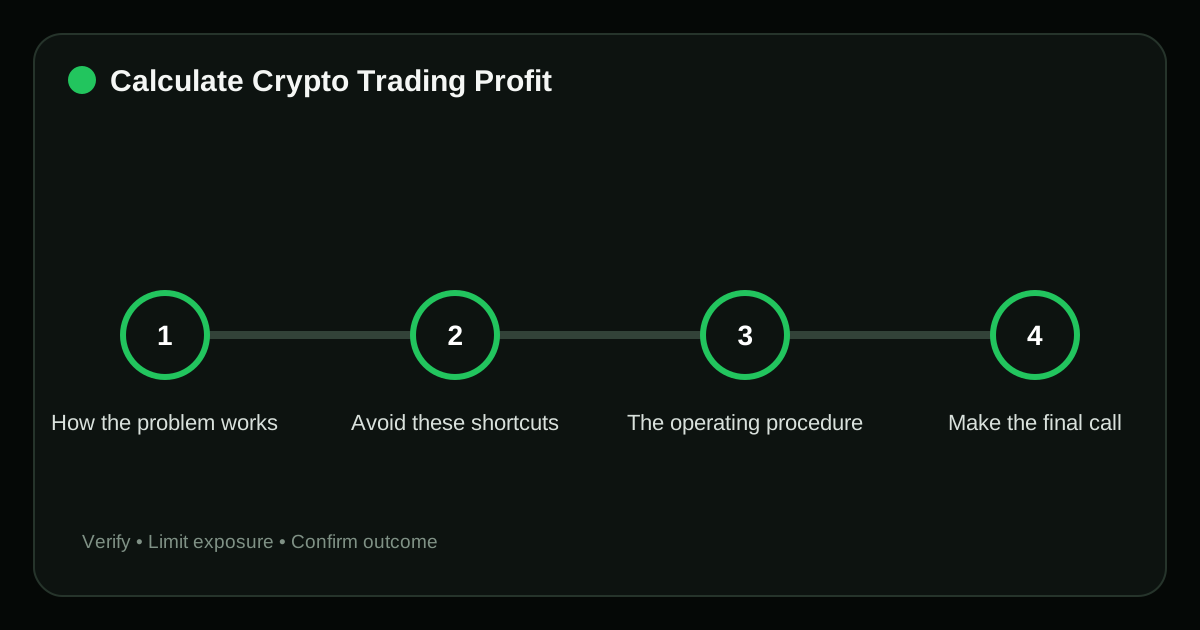
How the problem works#
The percentage move is not the account return when position size, multiple entries and fees differ. Futures P&L also depends on contract specification, leverage, funding and settlement price.
Avoid these shortcuts#
- Using chart price instead of actual fills. The branding can be copied, so the request must be re-opened through an independently verified channel.
- Ignoring funding and withdrawal fees. Execution cost can consume the expected edge even when the directional idea is right.
- Counting unrealized gains as cash profit. This changes the planned exposure or execution cost of calculate crypto trading profit loss after the decision has already been made.
- Mixing cost-basis methods. Execution cost can consume the expected edge even when the directional idea is right.
In calculate crypto trading profit loss, these errors share one pattern: speed or familiarity replaces verification. Slow down at the point where authority, money or an irreversible signature changes hands.
The operating procedure#
- Record quantity and execution price for every fill. Keep the original timestamp, identifier and unedited record so another person can reproduce the conclusion.
- Add buy-side fees to cost. Calculate the total cost under a conservative execution assumption and record the value used.
- Subtract sell-side fees from proceeds. Calculate the total cost under a conservative execution assumption and record the value used.
- Allocate cost basis to the quantity sold. Calculate the total cost under a conservative execution assumption and record the value used.
- Convert to reporting currency using a documented rate. Keep the original timestamp, identifier and unedited record so another person can reproduce the conclusion.
Make the final call#
Use exchange exports as raw data, then reconcile them with deposits, withdrawals and onchain transfers. A transfer between your own wallets is not automatically a sale.
A final verification pass#
Do not judge the outcome of calculate crypto trading profit loss only by whether the interface shows a success message. Use evidence that can still be checked after the page is closed.
| Checkpoint | Evidence | Stop condition |
|---|---|---|
| Record quantity and execution price for every fill | Account history entry and a journal note showing the planned value | Using chart price instead of actual fills |
| Add buy-side fees to cost | Account history entry and a journal note showing the planned value | Ignoring funding and withdrawal fees |
| Subtract sell-side fees from proceeds | Account history entry and a journal note showing the planned value | Counting unrealized gains as cash profit |
Record actual fills, fees and remaining exposure for calculate crypto trading profit loss. The order ticket is an estimate; account history is the durable record.
Frequently asked questions#
How do I calculate return percentage?
Divide net P&L by the capital allocated or cost basis, then multiply by 100.
Does leverage multiply profit?
It increases exposure relative to margin and also magnifies loss and liquidation risk.
Why does tax P&L differ from trading P&L?
Tax rules may require specific cost-basis, currency conversion and event treatment.
Related guides#
Sources#
- Coinbase: Understanding Order Types
- CFTC: Customer Advisory on Virtual Currencies
- Kraken: Trading Order Types
Risk notice: Crypto trading can produce rapid losses. Examples are educational, not personalized financial advice; verify venue rules, fees and legal or tax obligations before acting.
Editorial standard
This guide is educational and source-led. Security controls, exchange rules and legal requirements can change; verify critical steps through the relevant official service before acting.